




Behind the scenes: Ship Models at Sweden’s Maritime Museum
Explore the behind the scenes process of filming the Argentina, a 'votive', the Aeolus and the East Indiaman ship models at the National Maritime Museum, Sweden.
This page is approximately a 17 minute read
Roy and Lesley Adkins, Historians and Archaeologists
Roy and Lesley Adkins are historians and archaeologists who live in Devon. They have written widely acclaimed books on social, naval and military history, including Jack Tar, Gibraltar, Trafalgar, The War for All the Oceans, Eavesdropping on Jane Austen’s England and When There Were Birds. They are Fellows of the Society of Antiquaries, Fellows of the Royal Historical Society and Members of the Chartered Institute for Archaeologists.
The recycling of iron and steel ships differed substantially from the disposal of old or wrecked wooden vessels. Some were converted to other maritime functions, such as training ships, accommodation and cable laying, or else the hulls were turned into hulks, primarily for storage, or were disposed of by abandonment and deliberate sinking. Unwanted ships and hulks were frequently sold to shipbreakers who dismantled the vessels and recycled anything useful, in particular scrap metal.
In the past the main types of iron were wrought or malleable iron (an iron alloy with a low carbon content), cast iron (an iron alloy with a high carbon content) and mild steel (an alloy of iron with less than 0.25 percent carbon). Cast iron, which is hard and brittle, was made by smelting iron ore with charcoal (and later coke) in blast furnaces, and the resulting molten iron was directed into rectangular moulds or ‘pigs’. By reheating the pig iron in a furnace, the molten iron could be poured into moulds to create cast-iron objects, such as components for early iron bridges, street furniture and fittings in ships. Smelted iron could also be converted to wrought (‘worked’) iron, which was stronger, malleable and capable of being hammered or rolled into shape without breaking.1 In Jumping Jenny, a murder mystery first published in 1933, these characteristics are mentioned in relation to a suspect’s alibi: ‘Is it really cast-iron?’ ‘Absolutely. No, not cast-iron. Not so brittle. Wrought iron. I’ve ... just been forging it.’2
In shipbuilding from the 18th century, the shortage of naturally shaped timber led to the adoption of iron fittings such as knees, initially made from cast iron, but later forged from wrought iron. Hulls of composite ships had wrought-iron frames to which wooden planking was fixed, but to construct a hull entirely of iron required substantial amounts of wrought iron. In the 1780s, after processes were developed for producing far greater quantities of wrought iron, experiments began with canal boats.3The New Annual Register described the arrival in Birmingham in July 1787 of the Trial, which had the first hull constructed largely of wrought-iron plates:
A few days ago a boat built with English iron by J. Wilkinson, esq. of Bradley Forge, came up our canal to this town ... It is nearly of equal dimensions with the other boats employed upon the canal, being seventy feet long, and six feet eight inches and a half wide. The thickness of the plates with which it is made is about 5-16ths of an inch, and it is put together with rivets ... but the sternposts are wood, and the gun-wale is lined with and the beams are made of elm planks. Her weight is about eight tons.4
The first vessel built entirely of iron was the Vulcan. Launched in 1819 and belonging to the Forth and Clyde Canal Company, this horse-drawn barge carried passengers between Edinburgh and Glasgow. As shipbuilders began to understand the properties of wrought iron, they found ways of making merchant ships larger than was possible in wood, and because iron hulls did not need such an extensive internal framework, more space was available for cargo.5
The invention of the Bessemer process in 1856 and the Siemens-Martin (or open-hearth) process a decade later enabled mild steel to be mass produced, eventually replacing wrought iron. Steel was ideal for shipbuilding, being stronger and more elastic so that ships were better able to withstand heavy seas and less likely to fracture in a collision or grounding. Larger plates could be rolled from steel, reducing the number of joints and rivets, and from the 1920s welding was adopted in ship construction. Because steel vessels were considerably lighter, less fuel was needed and more cargo carried.6 By the end of the 19th century steel was much cheaper, partly because scrap steel and iron were used in its production, as the maritime journalist Frank C Bowen explained in 1936:
Well over fifty years ago Denny Brothers of Dumbarton started to use forgings of scrap steel for their new ships and found that it answered perfectly. They began making the stems of all their sea-going steamers, a part of the ship which demands great strength, of scrap steel. They soon extended it to other parts, experimenting until stern frames up to a considerable weight could be made of scrap steel without difficulty or risk.7
Except in places with abundant timber supplies, like North America, sailing ships were increasingly constructed of iron and steel for transporting bulk cargoes such as coal, nitrate and grain, while ships powered by steam (and later oil) took over the carriage of more valuable cargoes and many more passengers. Unwanted wooden boats and ships were reused in numerous ways, from hulks to building materials and souvenirs, and some were even set alight so as to salvage the metal fittings for scrap.8 Unwanted iron and steel ships faced different challenges, but shipbreaking was critical owing to the need for scrap metal in the production of iron and steel.9
Iron or steel ships that were no longer useful, or were likely to fail (or had failed) surveys, would often be converted to other maritime functions, giving rise to complex histories and name changes. Drastic remodelling might be involved, such as a steamship converted to oil or turned into a sailing vessel, while in wartime commercial vessels were frequently altered for military use.10 The full-rigged iron ship Dunboyne was launched at Whitehaven, Cumberland, in 1888 and sold to Norwegian owners in 1909 and to the Transatlantic Company of Gothenburg in Sweden in 1915, when she was renamed G D Kennedy. In 1923 the vessel was sold to the Swedish Navy, renamed af Chapman and used for a decade as a training ship and then as naval accommodation during the Second World War. She was subsequently renovated as a youth hostel, moored at Skeppsholmen in Stockholm, and remains in use today.11
An early iron steamship was the Great Britain, designed by Isambard Kingdom Brunel and launched at Bristol in 1843. Constructed of wrought iron, this vessel was a passenger and cargo steamship for the transatlantic route, but ran aground off Ireland in 1846 and was brought back to Liverpool, with the costs bankrupting her owners. She was purchased in 1850 by Gibbs, Bright & Co and refitted with new engines, boilers, two funnels and rigging, along with increased cargo capacity and more accommodation for steerage passengers heading from Liverpool to Melbourne in Australia, where gold had been discovered. In 1881 she was acquired by Antony Gibbs & Son and converted to a sailing ship (primarily by removing the engines, funnels and passenger accommodation) for carrying cargoes to and from San Francisco.12
The Great Eastern was a double-hulled iron passenger liner, an astonishing vessel, initially called the Leviathan. She was launched in 1857, but only a few years later was converted to lay the first electric telegraph cables across the Atlantic, as well as one from Bombay to Aden. After being laid up at Milford Haven, the Great Eastern was sold at auction in 1885 to Edward de Mattos, a coal merchant and shipbroker of London Traders Limited, and was then used for advertising and as a marine exhibition at Liverpool and other ports, attracting thousands of visitors.13
As with wooden ships, the hulls of iron and steel ships could be converted into hulks, which lacked their own means of propulsion, so needed to be towed into position to provide floating or beached storage facilities in or near ports. Countless vessels ended their days scattered across the globe as hulks, particularly for coal storage. Edward de Mattos had originally intended converting the Great Eastern into a coal hulk to be moored in Gibraltar Bay, as The Times reported in 1884: ‘Permission for her anchorage has been obtained from the Colonial Office. The project is viewed also with favour by the Admiralty, as the Great Eastern will effect a great improvement in the Bay by dispensing with the multitude of small coal hulks which now encumber the harbour.'14 The plan never went ahead, but around this time, in 1886, the Great Britain was damaged in severe weather and made it into Port Stanley, where she was sold to the Falkland Islands Company as a hulk for storing wool and coal. This function lasted until 1933, when the hulk of the Fennia, a French four-masted barque, replaced the Great Britain.15
Built at Port Glasgow in 1866, the Antiope three-masted iron sailing ship ended up in Mozambique as a hulk over half a century later. In 1915 she was sold as a coal hulk, though actually returned to service and was damaged by fire in 1921 at Lourenco Marques (now Maputo) in Mozambique while discharging a cargo of timber from the Baltic. She was purchased for a sugar hulk by the Sena Sugar Estates and towed 600 miles by their steamer Waterbuck up the coast to Chinde, a port at the mouth of the Zambezi river. In February 1922 a devastating cyclone hit Chinde and blew many vessels ashore. The Antiope hulk was eventually hauled back into the river with little damage. By then John Ellis Jones was captain of the Waterbuck, and he recorded rescuing the ‘old lady’ in two further incidents, the last time in 1926 when laden with 1,800 tons of sugar. Writing in 1932, Jones said: ‘In this position I left her in 1926, none the worse for her many adventures, and, to the best of my knowledge, she is still up there as a sugar hulk, carrying out her duties full of sweetness.’16
A correspondent to the Sea Breezes magazine in 1948 described various hulks at Milford Haven in Pembrokeshire, as well as a noteworthy hulk nearby: ‘Quite recently I discovered the hulk of an “ironclad” lying inshore above Pembroke Dock. On her deck were a Nissen hut, several derricks, and other gear, and she was being used as a jetty at which oil tankers discharged ... I was informed that she was none other than the original of ironclads, the Warrior.’ Launched in 1859, HMS Warrior was the Royal Navy’s first ironclad battleship, constructed of wrought iron. She was decommissioned in 1883 and in 1902 became a Royal Navy hulk at Portsmouth, used for various functions. In 1927 she was converted to an oil fuel hulk and towed to the Llanion oil depot at Pembroke Dock, being designated ‘Oil Fuel Hulk C.77’ in 1942. The hulk became redundant in 1978 with the closure of the depot, but was rescued by the Maritime Trust and taken to Hartlepool for restoration. The Warrior can now be visited at the National Museum of the Royal Navy at Portsmouth.17
Iron and steel vessels (including hulks) were often abandoned when there was no economic alternative, including times when shipbreaking was not profitable with high labour costs or low metal prices. In 1937 the Great Britain was too decayed to continue as a storage hulk, and so she was beached at Sparrow Cove in the Falklands, from where she was rescued in 1970 and brought back to Britain for preservation as a historic ship and is now a ship museum at Bristol.18 Unwanted vessels were also sunk to dispose of them or to support embankments, breakwaters and wharves. Large accumulations of vessels abandoned inshore or at sea are referred to as ships’ graveyards, such as the Deepwater Graveyard south-west of Rottnest Island near Fremantle in Western Australia, established in the early 20th century by the Port of Fremantle.19
The three-masted iron sailing ship Loch Ness, launched in 1869, carried cargoes and passengers for decades, mainly to and from Australia, and in 1908 was sold to an Australian company. She was converted at Port Adelaide to a coal hulk and towed to Fremantle during the First World War. Over a decade later the redundant hulk was taken out to Rottnest Island and sunk on 18 August 1926 in target practice by HMAS Melbourne.20 Three weeks later, on 10 September 1926, the coal hulk Tamerlane was also scuttled at Rottnest Island. This three-masted iron ship had been built in 1861 at Greenock for trading between London to China, but at the end of the century was converted to a coal hulk for use in Fremantle harbour and was even refloated and repaired after being rammed and sunk in 1918 by the steamship Dimboola. Explosives were now used to blow holes in the hull, as one eyewitness recounted:
The Tamerlane settled down on an even keel, and her deck was awash 15 minutes afterwards. A moment later she heeled over slightly on one side, and the final plunge was accompanied by a roar, as imprisoned air under the deck smashed the timbers and forced columns of water mast-high. The weight of the iron hull took the vessel rapidly to the bottom of the sea.21
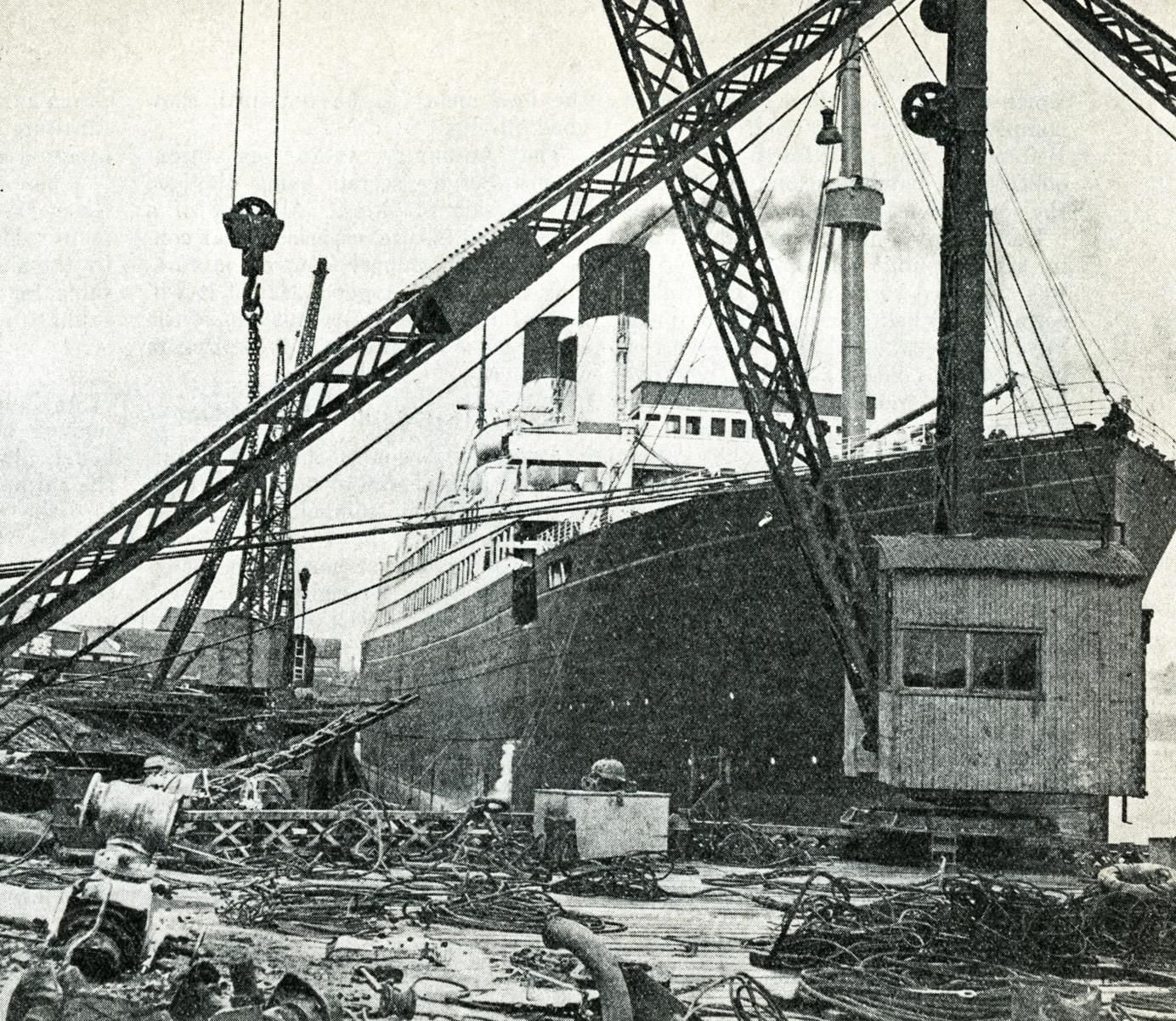
Shipbreaking (also known as ship scrapping, ship dismantling and ship recycling) is the dismantling of vessels to reuse materials and equipment. Iron and steel ships and hulks were broken up – scrapped – when they had no further use or were too costly to repair. The process was much different to the dismantling of timber vessels and needed to be close to steelworks to be economic. Some work took place in dry docks, but many vessels were dealt with in tidal yards along sheltered foreshores that had a sufficient rise and fall of the tide for beaching vessels.22 In 1937 J M Hussey, a Scottish journalist, described the scene:
... where ships have to be run ashore and secured by chains and hawsers, the beaching of a great liner is one of the most spectacular sights that any industry can offer; and it is a spectacle not untinged with sadness, for who can watch unmoved the last brief dash of such a vessel as it charges full steam ahead for a broad white target on the shore, to come to a shuddering standstill amid the roar of blown-off steam from boilers fed for the last time?23
Much preparation had to be done:
The beaching of such huge vessels entails weeks of preparation at the yard, where careful soundings are taken and every small bank carefully noted, so that the ship’s ‘run’ may be planned according to the accommodation in the yard. And even after a vessel is safely ashore yard officials have to contend with the strain of wind and tide upon her moorings; for once a big liner begins to slip back seawards, chain and hawser snap like twine, and only the tenacity of the river mud will prevent a second and most undesirable ‘launching’.24
In 1888 the Great Eastern was sold yet again, this time purchased by the shipbreakers Henry Bath and Sons of Liverpool, who started by auctioning all the fixtures and fittings, a practice that became increasingly common in the industry. From 1 January 1889, it took 200 men two years working day and night to break up the Great Eastern while beached close to New Ferry on the River Mersey. A year later, newspapers recorded the progress:
... the work of demolition has gone on slowly but surely, and now scarcely anything remains of the leviathan but its skin ... On the so-called upper deck there is a donkey-engine and windlasses, as well as a powerful beam steam travelling crane, these appliances, as well as several manual winches, being used in dislocating and hoisting the ironwork, &c., out of the ship. Those employed in the breaking up ... state that the material is almost as good as on the day it was put in.25
Initially, shipbreaking relied on unskilled labour, but was transformed from the 1920s by advances in technology. Before the First World War, hand tools were used for the ‘unbuttoning’ of riveted vessels, as Hussey described: ‘In pre-war days this work demanded the employment of men of exceptionally strong physique, as every rivet had to be broken asunder by sledge-hammer and crowbar.'26 The Great Eastern’s cranes operated iron wrecking balls to smash cast iron, an early use of such apparatus for shipbreaking, and the awful noise and reverberations made life wretched for those living nearby. Some months later, in the final stages of breaking up the Great Eastern, the Liverpool Mercury said that the shattered hull was unrecognisable:
... one has to approach pretty close to the mass of rusty-looking iron to discern any resemblance of the Great Eastern’s stupendous proportions ... Of course her masts, her funnels, and her paddle wheels have all gone long ago ... Internally she is completely dismantled, and with numerous steam donkey engines and cranes for hoisting up the ironwork as it is disjointed, the remnant remaining of the Great Eastern presents such a chaos of dilapidation as to be simply indescribable.27
The liner Leviathan reached Rosyth in Scotland in February 1938 for breaking up, and a few months earlier the Edinburgh Evening News summarised the process:
In yards where the vessel has to be demolished at her moorings, the decks are cut away section by section, with each watertight bulkhead as the division, and the breakers must keep pulling the vessel farther up the beach as she lightens in order to keep her within reach of their cranes. In yards where dry-dock accommodation is available, or where the berth is unaffected by tides, a more common practice is to leave the entire outer hull intact while the interior is stripped, then floating the empty hull to another basin to be demolished plate by plate.28
Dismantled iron and steel plates needed reducing in size to be transported by barge, ship or railway to steelworks for melting down to produce new steel plates. Around 1900 the oxyacetylene burner (also known as a cutter, torch or blow-lamp) was developed for welding and cutting metals, and it revolutionised shipbreaking after the First World War, making it possible to cut through metal with ease using intense heat. From the 1930s electric or steam-driven shears or guillotines were also used to cut up dismantled steel plates, as Hussey related: ‘In the yard, all the metal of a ship is cut into convenient sizes, partly by blow-lamp and partly by steam-driven guillotines, which can shear through thick steel as though it were cheese.’29
Britain was the leader in shipbreaking, but the industry spread across the globe, with Sea Breezes magazine commenting in January 1968: ‘Shipbreaking activity during the past year or two seems to have been moving increasingly towards the Iberian Peninsula, Spanish shipbreakers having been frequently in the market for scrap tonnage of all types.’30 Well before the Second World War notices about ships being scrapped were commonplace, with foreign buyers causing unease. The News Chronicle in February 1933 reported: ‘Shipbreaking in Japan is a definite industry. She has no minerals. She wants metals from old ships for melting down and making into new ships and railway material. She bought the New Amsterdam from Holland. She is now broken up. Japan has bought old American and Australian liners also.’ One London shipbroker commented:
Since the end of 1929 Japanese ship breakers have bought – excluding Japanese ships – 76 vessels for breaking up, totalling 500,000 tons. They are of all sorts – passenger liners, tankers, cargo boats. A large proportion of them have passed through our hands. The Italians have bought 80 ships for the same purpose since the middle of last year.31
By 1937, at a time when war threatened, British scrap metal was in high demand, as Hussey described: ‘... during the past two years the demand for British scrap metal of all kinds has risen enormously. This is partly due to the fact that steel is now manufactured from 60 per cent of scrap-iron and 40 per cent of pig-iron, instead of from those ingredients in inverse ratio, as was the practice a few years ago.’ He added: ‘It is strangely ironical that one of our greatest sources of scrap in recent years, as well as one of the most remarkable feats of modern shipbreaking, should be the scrapping of the units of the great German Fleet scuttled in Scapa Flow at the conclusion of the last World War!’32 The German High Seas Fleet, interned at Scapa Flow in the Orkney Islands at the end of the First World War, was scuttled on 21 June 1919. Some remained afloat, tugs managed to beach several, but 52 of the 74 vessels sank. Many were subsequently salvaged and broken up.
The first nuclear explosions from the 1940s increased the environment’s background radiation, and so a need arose for steel with a low background radiation for precision scientific instruments and equipment. Scrap ‘low-background steel’ from ships constructed before the Second World War was therefore in demand, including Scapa Flow vessels. The remaining seven wrecks at Scapa Flow have recently been given Historic Marine Protected Area status, but historic wrecks elsewhere, especially around Malaysia, Singapore, Indonesia and Australia and even war graves like HMAS Perth, are being plundered and obliterated for their metal in highly organised operations, possibly because of the low-background steel.33
After the Second World War, many more unwanted vessels were sent to the shipbreakers, but due to increased legislation, labour costs and fluctuating scrap metal prices, the shipbreaking industry is now centred on the sloping tidal beaches of India, Pakistan and Bangladesh, where there is less control of environmental damage and health and safety issues.34 Elsewhere, innovative uses of unwanted ships include reefing. Stripped of hazardous materials, they have been sunk in various locations across the world to create artificial reefs, which attract a range of marine wildlife, as well as being popular for diving and fishing. As older wrecks disappear through plundering or decay, these reefs will become the historic wrecks of the future.35
Disclaimer: The views and opinions expressed in this article are those of the author and do not necessarily represent those of the Lloyd’s Register Group or Lloyd’s Register Foundation.
NGO Shipbreaking Platform: https://shipbreakingplatform.org
Lloyd’s Register Foundation Heritage Centre: The reuse of wooden ships: Wrecks, timber and souvenirs
Lloyd’s Register Foundation Heritage Centre: Wood to welding: The evolution of shipbuilding materials
Lloyd’s Register Foundation Heritage Centre: Navigating steel’s past & present: The rise in demand for steel production & Port Talbot
Wrecks at Scapa Flow, Orkney: The surviving wrecks that were not salvaged after the German High Seas Fleet was scuttled in 1919: https://www.scapaflowwrecks.com/wrecks/
Abandoned boats dumped around Devon and Cornwall: https://www.bbc.co.uk/news/uk-england-cornwall-57232394
Barrie Trinder 2013 Britain’s Industrial Revolution: The making of a manufacturing people, 1700–1870 (Lancaster: Carnegie Publishing), pp 70–1, 95, 112–22; A J Holland 1968 The Age of Industrial Expansion: British Economic and Social History since 1700 (London: Thomas Nelson), pp 27–9; Thomas Walton 1901 Steel Ships: Their Construction and Maintenance (London: Charles Griffin; Philadelphia: J B Lippincott), pp 1–18. Cast iron was used early on to produce cannons and cannonballs – see D Cvikel, E D Mentovich, D Ashkenazi and Y Kahanov 2013 ‘Casting techniques of cannonballs from the Akko 1 shipwreck: archaeometallurgical investigation’ Journal of Mining and Metallurgy, Section B: Metallurgy 49, pp 107–19.
See p 180 of Anthony Berkeley 2022 Jumping Jenny (British Library Crime Classics); first published in 1933 by Hodder & Stoughton.
Cast-iron products became increasingly common on land, such as in street furniture and pipework, while in shipbuilding iron fittings are known from as early as the 17th century. See Peter Goodwin 1998 ‘The influence of iron in ship construction: 1660 to 1830’ The Mariner’s Mirror 84, pp 26–40; Michael K Stammers 2001 ‘Iron knees in wooden vessels – an attempt at a typology’ The International Journal of Nautical Archaeology 30, pp 115–21; Ronald Hope 1990 A New History of British Shipping (London: John Murray), pp 258, 296; p 219 of Mike McCarthy 1985 ‘The Iron Hull – A Brief History of Iron Ship Building’ in Mike McCarthy (ed) Iron Ships & Steam Shipwrecks: Papers from the First Australian Seminar on the Management of Iron Vessels Steam Shipwrecks (WA Maritime Museum), pp 219–23; Eric S Wood 1995 Historical Britain: A comprehensive account of the development of rural and urban life and landscape from prehistory to the present day (London: The Harvill Press), pp 524–36; Trinder 2013, p 6; Roland Ennos 2021 The Wood Age: How one material shaped the whole of human history (London: William Collins), pp 208–9.
See p 36 of ‘Principal Occurrences in the Year 1787’, pp 1–56 in The New Annual Register, or General Repository of History, Politics, and Literature For the Year 1787 (London, 1788); John Grantham 1868 Iron Ship-building: with Practical Illustrations (London: Virtue and Co), pp 6–8; Edgar C Smith 1937 A Short History of Naval and Marine Engineering (Cambridge: University Press), pp 97–8.
The Vulcan was later used for cargo. She was made from riveted sheets produced by blacksmiths, something later done by rolling mills. See I C B Dear and Peter Kemp (eds) 2005 (2nd edn) The Oxford Companion to Ships and the Sea (Oxford: Oxford University Press), p 616; Nigel Watson 2015 Maritime science and technology: changing our world (London: Lloyd’s Register Group), pp 30–1; Smith 1937, chapter 7 (on iron ships for mercantile purposes); Ennos 2021, pp 212–13; George Blake 1960 Lloyd’s Register of Shipping 1760–1960 (London: Lloyd’s Register of Shipping), pp 33–44.
Steel can be modified by the addition of other elements, such as manganese. McCarthy 1985, p 222; Watson 2015, pp 64, 75, 258–9; Blake 1960, p 71–4.
See p 1271 of Frank C Bowen 1936 ‘The Shipbreaking Industry’ Shipping Wonders of the Worldvolume II (London), pp 1265–74 . See also Watson 2015, p 75; and The Marine Engineer 2 (1880), pp 12, 94–7.
For the reuse of wooden ships, see: https://heritage.lrfoundation.org.uk/stories/the-reuse-of-wooden-ships-wrecks-timber-and-souvenirs
For the change from wood to iron, see Charles K Harley 1970 ‘British Shipbuilding and Merchant Shipping: 1850–1890’ The Journal of Economic History 30, pp 262–6.
Robert H Burgess 1948 ‘From Steam to Sail’ Sea Breezes 5 (new series), pp 62–4; Frank C Bowen 1948 ‘Fodder for the Scrapyard’ Sea Breezes September 1948, pp 136–8; Michael Stammers 2004 End of Voyages: The Afterlife of a Ship (Stroud: Tempus), pp 45–82. See also Richard Holme 2026 Shipbreaker Extraordinaire: Harry Pounds of Portsmouth (Seaforth) for the purchase, reselling, reuse and breaking up of numerous naval and commercial vessels by the Pounds business at Portsmouth.
When the vessel was sold to be a training ship, the old after cabin was scrapped and later given to the Henriksberg Restaurant at Gothenburg. The af Chapman was named after Vice-Admiral Fredrik Henrik af Chapman (1721–1808). Ture Rinman 1948 ‘“Af Chapman” – Hikers’ Hotel’ Sea Breezes 5 (new series), pp 82–3. See Lloyd’s Register of British and Foreign Shipping, from 1st July, 1889, to the 30th June, 1890 (London).
The Great Britain ran aground in September 1846 and was refloated almost a year later. The Australia service lasted from 1856 until 1876. See Brian Lavery 2012 SS Great Britain 1843–1937 onwards: An insight into the design, construction and operation of Brunel’s famous passenger ship (Sparkford: Haynes Publishing); Smith 1937, pp 102–3; Ewan Corlett1990 (rev ed) The Iron Ship: The story of Brunel’s ss Great Britain (London: Conway), pp 111–58; Stammers 2004, pp 59–60.
Patrick Beaver 1965 ‘The “Great Eastern” and the 1865 Cable’ Sea Breezes December 1965, pp 871–80; James Dugan 1953 The Great Iron Ship (London: Hamish Hamilton), pp 19–27, 139–213; Smith 1937, pp 109–10; SS Great Eastern: 1885 Auction Brochure – https://www.gracesguide.co.uk/SS_Great_Eastern:_1885_Auction_Brochure; Liverpool History Society Newsletter 27, spring 2010, pp 2–3.
The Times 10 April 1884, p 7; Dugan 1953, pp 201–2, 211. For various hulks at Gibraltar, see Richard Garcia 2022 Making a Difference: The Life and Times of John Mackintosh (Gibraltar). See also https://hec.lrfoundation.org.uk/whats-on/stories/coal-at-sea-the-hazards-of-cargoes-bunkers-loading-unloading-trimming-and-shifting
Corlett 1990, pp 158–9; Lavery 2012, p 27; G L Garratt 1948 ‘Hulks at Port Stanley, F.I.’ Sea Breezes 5 (new series), pp 306–12.
Sea Breezes 10 (1927), p 346; F L de Spon 1928 ‘Last Days of Antiope: A Hulk at Chinde’ Sea Breezes 11, pp 215–16; John Ellis Jones 1932 ‘Clipper Ship Antiope: The Old-Never-Die’ Sea Breezes 16, pp 85–6, 95.
The letter was written by J F Carder from the Royal Naval Air Service station HMS Goldcrest to Sea Breezes 5 (new series), 1948, p 178. See John Winton 1987 Warrior: The First and the Last (Liskeard: Maritime Books); Richard May 2017 HMS Warrior 1860 to date: Owner’s Workshop Manual (Sparkford: Haynes Publishing). For other hulks, see Nathan Richards 2022 (2nd edn) Ships’ Graveyards: Abandoned Watercraft and the Archaeological Site Formation Process (The Society for Historical Archaeology), pp 127–37.
Corlett 1990, pp 159–93; Stammers 2004, p 60.
Garratt 1999; Richards 2022; Jeremy Green 2009 ‘The Fremantle Deepwater Graveyard’ in M McCarthy (ed) Iron, Steel & Steamship Archaeology: Proceedings of 2nd Australian Seminar, held in Fremantle, Melbourne and Sydney, 2006 (Australian Centre of Excellence for Maritime Archaeology), pp 23–6.
The conversion of Loch Ness to a hulk seems to have been in 1910. See Dena Garratt 1999 (updated by Jeremy Green 2006) Précis of the wrecks in the ship’s graveyard, Rottnest (Western Australian Museum no 148) (https://museum.wa.gov.au/maritime-archaeology-db/sites/default/files/no._148_graveyard.pdf); Lloyd’s Register of British and Foreign Shipping, from 1st July, 1870, to the 30th June, 1871 (London).
The Tamerlane was refloated in April 1919. The Western Australian 25 April 1919, p 8; Garratt 1999; Anon ‘Loch Ness and Tamerlane Pass: End by Gunfire and Explosion’ Sea Breezes 9 (December 1926), pp 176–8; W J Doran ‘The Loch Line of Clipper Ships: How it Dwindled Down’ The Daily Commercial News and Shipping List 2 August 1910, pp 12–13. See also Lloyd’s Register of British and Foreign Shipping, from 1st July, 1863, to the 30th June, 1864 (London).
Stammers (2004, p 48) notes that many modern vessels are scrapped after 20 years. See Bowen 1936; Frank C Bowen 1948 ‘Activity in the Scrap-yards’ Sea Breezes 5 (new series), pp 68–70; Dugan 1953, p 214; Ian Buxton 2000 To Sail No More: Part Four (Liskeard: Maritime Books), pp 2–3.
Edinburgh Evening News 21 August 1937, p 5. Bowen (1936, p 1272) reckoned at least 10 feet rise and fall was then necessary.
Edinburgh Evening News 21 August 1937, p 5.
The Boston Independent and Lincolnshire Advertiser 18 January 1890, p 7; Beaver 1965, p 879; Dugan 1953, pp 216–17; Bowen 1936, p 1273.
Edinburgh Evening News 21 August 1937, p 5; Stammers 2004, p 92.
The Liverpool Mercury 31 July 1890, p 5; see also Beaver 1965; Bowen 1936, p 1272; Dugan 1953, pp 214–19; and Stammers 2004, p 88 (for an image of remnants of the shipbreaking of the Great Eastern on the foreshore at New Ferry) and p 99.
Edinburgh Evening News 21 August 1937, p 5.
Roy Willmarth Kelly and Frederick J Allen 1918 The Shipbuilding Industry (Boston and New York: Houghton Mifflin Company), pp 177–9; Edinburgh Evening News 21 August 1937, p 5; Stammers 2004, pp 98–9.
Sea Breezes January 1968, p 2; Stammers 2004, pp 83–101.
News Chronicle 22 February 1933, p 2. The shipbroker was Messrs Galbraith, Pembroke & Co Ltd, now part of IFCHOR Galbraiths (IG).
Edinburgh Evening News 21 August 1937, p 5. Since late 2025, the last seven wrecks of the German fleet have been given Historic Marine Protected Area designation.
The 1963 Test Ban Treaty led to a reduction in radioactivity, and background radiation has nowadays decreased, no longer of concern in many applications. See Natali Pearson 2023 ‘Too Little, Too Late? Redefining the Legacy of HMAS Perth (I), an Australian Warship Sunk in Indonesian Waters’ in Historical Archaeology 57, pp 169–187; ‘Steel from Shipwrecks’ presented by Anna Ploszajski, first broadcast on BBC World Service 11 December 2025.
Publications about decommissioning and breaking up of naval and mercantile vessels after the Second World War include Ian Buxton and Ben Warlow 1997 To Sail No More (Liskeard: Maritime Books; on the Reserve Fleet); Mike Critchley and Steve Bush 2000 To Sail No More: Part Three (Liskeard: Maritime Books); Ian Buxton 2000 To Sail No More: Part Four (Liskeard: Maritime Books; on warships); Daniel Madsen 2002 To Sail No More: Part Six – United States Navy (Liskeard: Maritime Books). See also Ronald W Hess, Denis Rushworth, Michael V Hynes and John E Peters 2001 Disposal options for ships (National Defense Research Institute), pp 41–58 (shipbreaking in India and elsewhere); and Michael Galley 2014 Shipbreaking: Hazards and Liabilities (Springer).
Hess et al 2001, pp 59–80 (on reefing); Richards 2022, pp 139–43.
Explore the behind the scenes process of filming the Argentina, a 'votive', the Aeolus and the East Indiaman ship models at the National Maritime Museum, Sweden.
Explore the behind the scenes filming of the Cold War Rail Ferry, Oasis of the Seas, Stena Drillmax and Olympic Loyalty ship models at the IMO's headquarters.
A behind the scenes look at the process of filming HMS Vanguard, HMS Prince, Campania and Océan at the Science Museum's National Collections Centre, Swindon.

