




Behind the scenes: Ship Models at Sweden’s Maritime Museum
Explore the behind the scenes process of filming the Argentina, a 'votive', the Aeolus and the East Indiaman ship models at the National Maritime Museum, Sweden.
This page is approximately a 17 minute read
Roy and Lesley Adkins, Historians and Archaeologists
Roy and Lesley Adkins are historians and archaeologists who live in Devon. They have written widely acclaimed books on social, naval and military history, including Jack Tar, Gibraltar, Trafalgar, The War for All the Oceans, Eavesdropping on Jane Austen’s England and When There Were Birds. They are Fellows of the Society of Antiquaries, Fellows of the Royal Historical Society and Members of the Chartered Institute for Archaeologists.
At the end of a wooden ship’s life, the hulks were often reused for storage and as prisons, or else sunk to form foundations for harbour structures. Ships that were wrecked or dismantled by shipbreakers were a substantial source of timber that went into constructing or repairing other ships and boats or was incorporated into buildings and structures such as fences and sheds. In most cases the original ship’s name was soon forgotten, except for souvenirs made from the timber of celebrated vessels. Much scrap timber was sold as firewood, while numerous wooden vessels were burned or left to decay.
Wooden boats and ships were prone to decay, especially from dry rot and shipworm, and countless worn-out vessels were simply abandoned when they were beyond repair or had no further function. In 1952 the archaeologist T C Lethbridge wrote: ‘We have all seen wooden boats lying rotting and neglected in every little port and estuary round the coast ... Wooden boats do not last for ever; when they become unseaworthy they are left tied up in some neglected creek, on the river bank or on the shore.’ Large unwanted ships and boats, including naval ones, were generally too valuable to waste and were recycled, either as complete hulks or dismantled for the timber and fittings.1
Throughout prehistory and history, vast numbers of trees were required for all kinds of structures, supplemented by materials such as hides, mud, reeds, straw and stones. Although on land artificially made materials were adopted, including bricks, cement, concrete and glass, timber was the main shipbuilding material until iron and later on steel took over. The construction of just one large wooden sailing ship for the navy or for commercial use would require thousands of trees. The hull of HMS Temeraire (launched in 1798) was constructed at Chatham Dockyard in Kent using around 5,000 oak trees felled in the forests of Essex, Kent, Surrey and Sussex.2 The impact of shipbuilding on the environment was therefore significant, and it was long feared that the depletion of forests would make Britain dependent on imported timber, a concern shared by other seafaring nations. The main shortage was of seasoned oak and of timber for specific parts of a ship, such as masts. Even by the 16th century, Britain’s woodland lacked tall conifer trees, which were imported instead from Russia, the Baltic and North America, though when trade was disrupted, the navy resorted to composite masts.3
During the 18th and 19th centuries, the Royal Dockyards of Georgian England were constantly urged to be economical with timber, and timbers from ships dismantled at Chatham can be recognised in the dockyard buildings today.4 A French shipwright and spy, Blaise Ollivier, actually recorded this practice in 1737:
The English shipwrights break their ships as soon as they are no longer fit to put to sea ... They preserve here with great care all their old ship timbers, and find a useful purpose for each timber, whether to build the dockyard buildings or to line the sides and the building platforms of their docks. I saw this economy at Portsmouth and at Chatham, where several sheds and other buildings are composed solely of old ship timbers.5
In 1792 a survey of woodland in England and Wales concluded that 100-year-old oak trees, essential for naval warships, were becoming scarce and that ‘it remains still an object well deserving the attention of Government, to discover some other kind of tree, which may be expected to answer instead of oak, at least in the construction of trading ships, and which will grow to sufficient size on soil not fit of tillage’.6 Britain and other seafaring nations looked much further afield for timber, and in a report on Plymouth Dockyard one newspaper commented: ‘The extraordinary number of 7,300 trees was used in Plymouth yard between January and December, 1817 ... Timber is expected from Dalmatia, and even Africa ... Some ships of war are immediately to be laid down in India ... They will be built of teak, which is very superior in hardness and durability to the best European oak.’7
Ships no longer needed might be reused by being incorporated in coastal and riverside structures, such as foundations for breakwaters and wharves, while the sides of vessels made convenient retaining walls in harbours and ports. Such recycling dates back more than two millennia, and one early example was at the ancient Egyptian port of Heracleion in the Nile Delta. Over 70 vessels from the 8th to 2nd centuries BC have been discovered and several excavated. One group had been reused to extend a jetty and create a pontoon bridge and its foundation.8 This practice is well attested from Roman times, as at Pag Island, Croatia, where several scuttled ships filled with stones helped create the ancient waterfront, while in Italy in AD 42 the Roman emperor Claudius built a harbour at Portus, near Rome, with a lighthouse supported on an artificial island whose foundations included two ships. The largest one had originally been built to transport an obelisk from Egypt to Rome for the emperor Caligula. Both hulls had been cut down to the waterline and filled with hydraulic cement, and although the timbers did not survive, the cement preserved a cast of the ships.9
The hulls of old ships, as well as disarticulated ship timbers, have been discovered in medieval waterfronts, such as at Bergen in Norway, Staveren in the Netherlands and Dublin in Ireland. This was a time in northern Europe when harbours were being improved to accommodate the increased maritime trade. Along the River Thames at London, there have been frequent discoveries of fragments of ships and ship timbers in excavations of waterfronts dating from the Roman times onwards. They include timbers from at least three large ocean-going naval vessels of the early to mid-17th century reused in a riverside wall and dock at Bellamy’s Wharf, Rotherhithe, on the south side of the Thames. At Limehouse on the north side of the river, in 1829, the Canton East Indiaman (built 1790) was turned into the foundations of a new dry dock for the shipbuilding firm of Fletcher, Son and Fearnall. This was used until 1898, but demolition proved problematic because the timbers were still in such good condition. Further downstream at Erith, in the mid-19th century, five lighters have been discovered sunk end-to-end to form a river wall, yielding invaluable evidence about what was once the most ubiquitous vessel on the River Thames, carrying cargoes such as coal and building materials. The name of one even survived – Minnie.10
Condemned or redundant wooden ships that were still in reasonable condition might be converted to floating hulks by removing their masts and rigging and perhaps adding structures and a roof. They had varied uses, and many nations made use of them to hold prisoners-of-war and civilian convicts. During the Napoleonic Wars, Britain relied on prison hulks, which were generally two- or three-deckers moored at Woolwich, Sheerness, Chatham, Plymouth, Gosport, Portsmouth and nearby Langstone Harbour.11 In 1812, after breaking his parole, General René-Martin Pillet was confined on board the Brunswick prison hulk at Chatham. He complained about the conditions: ‘The hulks are moored in the midst of fetid and stagnant mud, which at every tide is left bare ... The height of the deck of the Brunswick, on board of which I was confined, is exactly four feet ten inches, so that a man of the shortest stature can never stand erect.’12
Prison hulks for civilian convicts also housed those waiting to be transported to Australia. In February 1809 James Vaux was sentenced to death for theft, but on being commuted to transportation for life, he was taken to the Retribution hulk on the River Thames at Woolwich: ‘There were confined in this floating dungeon nearly six hundred men, most of them double-ironed; and the reader may conceive the horrible effects arising from the continual rattling of chains, the filth and vermin naturally produced by such a crowd of miserable inhabitants.’13 Before being appointed to a warship, naval recruits (even volunteers) were frequently held on board hulks, causing much resentment because they were little better than prison hulks. Some hulks were converted into floating chapels for seamen, as at Bristol City Docks, where in the 1820s the Aristomenes was purchased by the Seamen’s Friend Society as a place of worship. This was replaced in 1846 by the redundant Aetna naval bomb-ship, and at the opening ceremony the Reverend Wood commented that ‘in an age of novelties, it was a great novelty to see a vessel of war lighted with gas, and fitted up as a chapel; indeed, he believed that it was the first vessel that ever was so lit’.14
In times of war, hulks of old merchant and fishing vessels as well as warships might be scuttled to obstruct or blockade ports, usually weighted down with rocks and stones. Hulks were also converted into weapons for one-off assaults on the enemy. At Algeciras in Spain during the Great Siege of Gibraltar (1779–83), nine old Spanish vessels were made into fireships by packing them with tar, gunpowder, other flammable material and fuses. On 6 June 1780 they were taken across the Bay of Gibraltar to destroy a Royal Navy squadron, but the mission failed. Two years later ten redundant merchant ships were turned into floating batteries by reinforcing the hulls with timber, cork, hides and oakum (old rope), along with protective roofs. Thousands of tourists flocked to the Spanish hills to watch the attack on Gibraltar, on 13 September 1782, but it was a disaster, with immense loss of life and the destruction of floating batteries by fire.15
Hulks could be adapted for carrying cranes and other equipment for maintaining and repairing ships in harbours, and they also acted as mooring places and storage hulks, where vessels could load or unload cargoes. The Glory of the Seas ended her working days as a hulk. Built at the East Boston shipyard of Donald McKay and launched in 1869, she was one of America’s finest clippers, involved for many years in carrying grain and coal. In 1913 she was stripped to her lower masts and converted into a refrigeration ship, and for nearly a decade the hulk (by now the property of the Glacier Fish Company of Tacoma) was towed each season to Alaska to be loaded with tons of salmon, before being towed back to Puget Sound.16
Coal hulks were especially common at coaling stations across the world, many of them once well-known sailing ships. The Java East Indiaman, which was built of teak at Calcutta in 1813, became a coal hulk at Gibraltar around 1859, but in 1939 was sold for breaking up at Genoa in Italy, as The Times reported: ‘The ship, which had been moored in Gibraltar Bay for more than 80 years, was perhaps the most familiar mark in Gibraltar territorial waters. She ... was known to generations of merchant seamen as Hulk No. 16, for from her spacious holds thousands of merchant vessels have been supplied with bunkering coal for the best part of a century.’17
On dry land ship hulls might be turned upside down and converted into dwellings. In his novel David Copperfield Charles Dickens describes Copperfield being taken by Ham Peggotty to stay with his family at Great Yarmouth:
...we came out upon the dull waste I had already seen at a distance; when Ham said,
“Yon’s our house, Mas’r Davy!”
I looked in all directions, as far I could stare over the wilderness, and away at the sea, and away at the river, but no house could I make out. There was a black barge, or some other kind of superannuated boat, not far off, high and dry on the ground, with an iron funnel sticking out of it for a chimney and smoking very coseyly; but nothing else in the way of a habitation that was visible to me.
“That’s not it?” said I. “That ship-looking thing?”
“That’s it, Mas’r Davy,” returned Ham.18
Copperfield was thrilled: ‘There was a delightful door cut in the side, and it was roofed in, and there were little windows in it; but the wonderful charm of it was, that it was a real boat which had no doubt been upon the water hundreds of times, and which had never intended to be lived in, on dry land.’19 Also easily recognised along the coast were sheds and storage huts made from boats that had been sawn in half and set upright. In the years before metal hulls, such structures must have been commonplace. When passing through the village of Beadnell in Northumberland in 1858, the traveller Walter White noticed such boats being used by fishermen, ‘amphibious edifices, half boat and half hovel, receptacles for yarns and lines’. A 17th-century Dutch painting (‘Winter Landscape with Skaters’ by Hendrick Avercamp) even shows a sawn boat turned into a latrine.20
Much more common on land was the construction or repair of buildings using old ship timbers salvaged from wrecks along the coast or sold by shipbreakers. When travelling along the Norfolk coast in October 1722, the writer Daniel Defoe saw how the inhabitants benefited from shipwrecks:
As I went by land from Yarmouth Northward, along the shoar towards Cromer aforesaid, and was not then fully master of the reason of these things, I was surpriz’d to see, in all the way from Winterton, that the farmers, and country people had scarce a barn, or a shed, or a stable; nay, not the pales of their yards, and gardens, not a hogstye, not a necessary-house, but what was built of old planks, beams, wales and timbers, &c., the wrecks of ships, and ruins of mariners, and merchant’s fortunes; and in some places were whole yards fill’d, and piled up very high with the same stuff laid up, as I suppos’d to sell for the like building purposes, as there should be occasion.21
There is a tendency to claim a nautical origin for every old beam in a building, especially if there are signs of reuse, since this is a more evocative provenance than reused materials from some nearby structure. The further from the coast, recycled ship timbers are less likely because of the problems and costs of transport in the past. At times there are tell-tale signs that timbers did indeed come from ships, including their shape, evidence of how they were originally fixed in place, and sometimes marks made during shipbuilding.22
Shipbreakers purchased redundant timber vessels to break up, and the work was costly and time-consuming because of all the nails, bolts and other iron and copper fittings. They made money by selling the timber, primarily for building or joinery, as well as for shipbuilding and repairs, and by selling any metal fittings that could be salvaged. Much scrap timber was sold for firewood, but more valuable timber and fittings were usually auctioned, as at Bristol in November 1846:
AT REDCLIFF WHARF, BRISTOL,
On WEDNESDAY next, NOVEMBER 25, at Eleven o’Clock,
THE HULL of the Seamen’s Floating Chapel;
also sundry valuable MATERIALS of H.M.S. AETNA
(now converted into a floating Chapel), consisting of double-bar-relied patent capstan complete, rudder, tiller, wheel, pumps, beams, stanchions, masts, skylights, companion, timber fit for building purposes, and a variety of articles too numerous to particularise in an advertisement.23
Shipbreakers generally worked on a beach or foreshore, such as the Thames. In 1936 the maritime journalist Frank C Bowen wrote that it was too expensive in America to break up timber ships and their usual practice was to burn ships in order to recover valuable metals.24 As a child in the 1920s and 1930s Ed Shields witnessed such shipbreaking by Nieder & Marcus on the Puget Sound at Seattle. Established in 1908, this company dealt mainly with marine salvage and scrap metals. For timber vessels they removed anything useful at their wharf, such as donkey engines and rigging wire, and after suitable preparation would tow each hulk to a nearby beach and soak it with oil. At high tide, the hulk was set alight, which would burn for hours and be visible for miles around. Afterwards the workers gathered up tons of scrap metal to be sent to the steel mills.25
All too often the name of the vessel from which reused timber originated was unknown or forgotten, but occasionally a ship’s name has survived. During the War of 1812, the American frigate Chesapeake was refitting in Boston harbour, which was being blockaded by HMS Shannon. American frigates were more strongly built than British ones, and on 1 June 1813 her captain decided to break out, but the Shannon’s crew was thoroughly trained in gunnery. The Chesapeake was severely damaged and then captured, but after being repaired, she was taken into the Royal Navy. In 1819 the ship was sold to Joshua Holmes, who had shipbreaking operations close to Portsmouth Dockyard. Much of the timber, primarily pine and oak, was sold for building houses, but some went to Mr John Prior, a miller, for the construction of a new watermill on the River Meon at the nearby village of Wickham. It has since been known as ‘Chesapeake Mill’.26
Work on a new building for Liberty’s department store in Great Marlborough Street, London, started in 1922, in the Tudor revival style. Timber was purchased from two scrapped naval vessels – the second-rate two-decker HMS Hindostan (launched 1841) and the screw first-rate three-decker HMS Howe (launched 1860), both of which were broken up by J B Garnham and Sons at Woolwich in 1921. Over 24,000 cubic feet of recycled wood was used, and the decking formed the floors of the store. Arthur Lasenby Liberty, the store’s founder, is said to have ‘imagined docking a ship in the middle of London’s shopping streets, laden with art and design treasures sourced from the four corners of the globe’.27
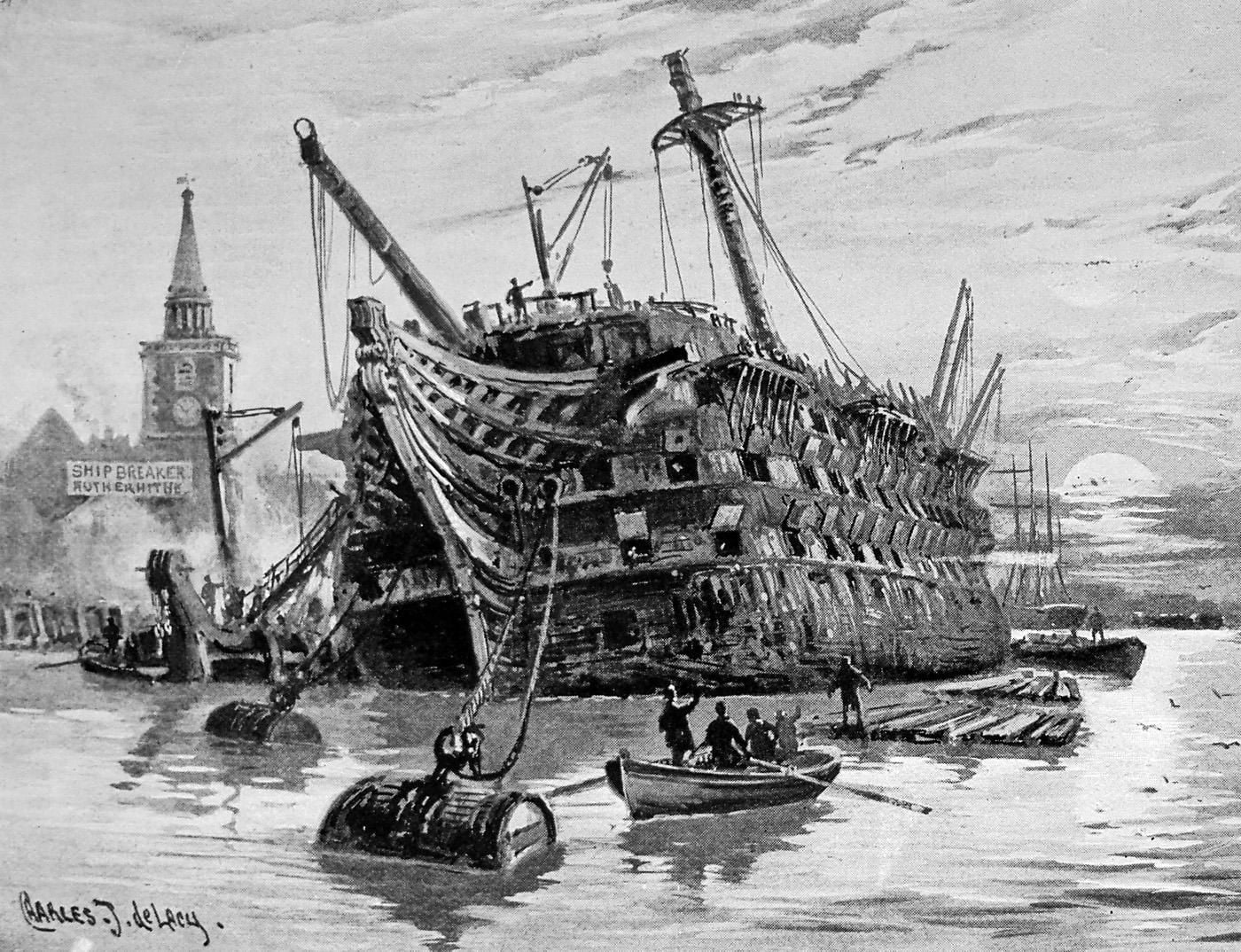
Timber from specific ships was prized for making souvenirs, and the more famous the ship, the greater the demand. The Temeraire, known for her role at the Battle of Trafalgar, was sold for breaking up in 1838 to the shipbreaker and timber merchant John Beatson at Rotherhithe on the Thames.28 Two years later, the Belfast Commercial Chronicle reported that much of the timber had been sold to craftsmen:
The wood which composed the old Temeraire has fetched large prices, and a great portion of it has been converted into chairs, tables, snuff-boxes, cigar cases, ladies’ workboxes, and other articles. The family of the gallant Admiral Harvey, who took such a distinguished part in the great naval victory of Trafalgar, have had numerous pieces of ornamental furniture manufactured out of the oak of the Temeraire ... Admirals, captains, and other naval officers, have eagerly sought relics of the Temeraire, and some thousands of snuff-boxes have been made out of her remains.29
One intriguing story of ship souvenirs relates to the Betsy Cains, though the very first issue of The Mariner’s Mirror in 1911 debunked the legend surrounding her. It was claimed that she was built in the early 17th century as the Princess Mary and in 1688 brought the Prince of Orange to England – the start of the Glorious Revolution and his reign as King William III. This royal yacht was subsequently sold and used for trade with the West Indies under the name Betsy Cains. Later on she was converted to a collier, carrying coal from Newcastle to London, until she was wrecked on the Black Midden rocks near the mouth of the River Tyne in February 1827. According to various Lloyd’s Registers, the Betsy Cains was actually built in the King’s Yard in 1720, so there was no connection with William III.30 News of the wreck nevertheless spread far and wide, focusing on the legendary association, as The Leisure Hour explained some three decades later:
The news of her disaster excited a very lively sensation throughout the country ... As soon as the news of her wreck became known throughout the country, the people of Shields were inundated with applications for portions of her remains. The applications on the part of the Orange Lodges were especially importunate. Snuff-boxes and souvenirs of various kinds were made in large numbers, and brought exorbitant prices.31
When rumours circulated in 1922 that the hulk of the Glory of the Seas at Seattle was to be scrapped, a campaign began to buy, refit and rerig the vessel and use her as a maritime museum. Instead she was burned on the beach by the shipbreakers Nieder & Marcus at Endolyne near Seattle on 13 May 1923 in order to recover the metal fittings. A local maritime artist, W Francis, reported that very few people witnessed the event, which would have attracted thousands had they known:
The bow of the Glory was almost under the trees that grow on the high banks and when I arrived there the hull had been burning a few hours. However, nothing was left of her but a fire-punctured shell, a section of which would occasionally fall into the water with a dull explosion. The badly charred fore and main masts had fallen alongside, while the mizzen was hanging over the port quarter, the whole mixed up with bolts, wire and remnants of another burned hull ... The day was gloomy and threatening, the water calm and silent and the scene rather melancholy, so that riding home I felt as though returning from the funeral of an old friend.32
The historic vessel could not be rescued, and there were no souvenirs, only memories and a destructive method of dealing with the remains of an old timber ship. As iron and steel took over from wood, the way of life in coastal settlements changed, as did shipbreaking, and a completely new recycling industry developed.
Disclaimer: The views and opinions expressed in this article are those of the author and do not necessarily represent those of the Lloyd’s Register Group or Lloyd’s Register Foundation.
T C Lethbridge 1952 Boats and Boatmen (London and New York: Thames and Hudson), pp 45–6; Robert Greenhalgh Albion 1926 Forests and Sea Power: The Timber Problem of the Royal Navy 1652–1862 (Cambridge: Harvard University Press), pp 11–16, 306–7; Michael Stammers 2004 End of Voyages: The Afterlife of a Ship (Stroud: Tempus). A key study into abandoned watercraft, with a focus on Australia, is Nathan Richards 2022 (2nd edn) Ships’ Graveyards: Abandoned Watercraft and the Archaeological Site Formation Process (Society for Historical Archaeology).
Some 288,000 cubic feet of timber was used for the hull of HMS Temeraire, in addition to masts and spars. See Peter Goodwin 2005 The Ships of Trafalgar: The British, French and Spanish Fleets October 1805 (London: Conway), p 41; and Sam Willis 2009 The Fighting Temeraire (London: Quercus), pp 90–8.
Roland Ennos 2021 The Wood Age: How one material shaped the whole of human history (London: William Collins), pp ix–xiv; Albion 1926, pp 27–32.
Dan Atkinson 2007 Shipbuilding and Timber Management in the Royal Dockyards 1750-1850: An Archaeological Investigation of Timber Marks (University of St Andrews), pp 64, 104–5 (see https:hdl.handle.net/10023/472). See also pp 147–8 and plate 10 of Jonathan Coad 1982 ‘Historic Architecture of Chatham Dockyard, 1700–1850’ The Mariner’s Mirror 68, pp 133–88; Jonathan Coad 2013 Support for the Fleet: Architecture and engineering of the Royal Navy’s bases 1700–1914 (Swindon: English Heritage), p 143; and Robert Prescott and Dan Atkinson 2013 ‘Ship to Shore: Race Marks, Timber Management and the Recycling of Ship Timbers in the 18–20th Centuries’ Scottish Woodland History Conference: Notes XVII: Woods, Trade and Boats, pp 30–8.
Cited in Prescott and Atkinson 2013, p 30.
Oak of 70 to 80 years was deemed adequate for merchant ships. The report was done by the Land Revenue Office. See pp 280–1 of ‘The Eleventh Report of the Board of Land Revenue’ in Journals of the House of Commons 47 (1803, for 31 January to 15 November 1792), pp 264–374.
The New Times (London) 24 July 1818, p 4, taken from the Plymouth Telegraph.
See pp 201–12 of Ben Ford 2013 ‘The Reuse of Vessels as Harbor Structures: A Cross-Cultural Comparison’ Journal of Maritime Archaeology 8 (no 2), pp 197–219; Heracleion, 20 miles north-east of Alexandria, was also referred to as Thonis and is now submerged. Damian Robinson 2018 ‘The Depositional Contexts of the Ships from Thonis-Heracleion, Egypt’ The International Journal of Nautical Archaeology 47, pp 325–36.
See pp 201–12 of Ben Ford 2013 ‘The Reuse of Vessels as Harbor Structures: A Cross-Cultural Comparison’ Journal of Maritime Archaeology 8 (no 2), pp 197–219; Heracleion, 20 miles north-east of Alexandria, was also referred to as Thonis and is now submerged. Damian Robinson 2018 ‘The Depositional Contexts of the Ships from Thonis-Heracleion, Egypt’ The International Journal of Nautical Archaeology 47, pp 325–36.
Ford 2013, pp 203–4; The Bryggen Papers Supplementary Series No. 7: Ships and Commodities 2001 (University of Bergen); p 134 of H H Van Regteren Altena 1970 ‘The Origins and Development of Dutch Towns’ World Archaeology 2, pp 128–40; Tim Tatton-Brown 1974 ‘Rescue excavation on the Old Custom House Site, Part 1– Medieval and later’ London Archaeologist 2 no 6, pp 136–41; David Saxby and Damian Goodburn 1998 ‘Seventeenth-Century Ships’ Timbers and Dock on the Thames Waterfront at Bellamy’s Wharf, Rotherhithe, London SE16’ The Mariner’s Mirror 84, no 2, pp 173–92; Giles Dawkes, Damian Goodburn and Penelope Walton Rogers 2009 ‘Lightening the Load: Five 19th-Century River Lighters at Erith on the River Thames, UK’ The International Journal of Nautical Archaeology 38, pp 71–89; Bowen 1936a, pp 1330–5.
For an overview of reused vessels, mainly from North America and Europe, including prison hulks, see Ford 2013. See also Roy and Lesley Adkins 2006 The War for All the Oceans: From Nelson at the Nile to Napoleon at Waterloo (London: Little, Brown), pp 315–19; and Clive L Lloyd 2007 A History of Napoleonic and American Prisoners of War 1756–1816: Hulk, Depot and Parole (Woodbridge: The Antique Collector’s Club).
R-M Pillet 1818 Views of England, During a Residence of Ten Years; Six of Them as a Prisoner of War (Boston: Parmenter and Norton), p 228.
James Hardy Vaux 1819 Memoirs of James Hardy Vaux: Written by Himself,vol 2 (London: W Clowes), pp 108–9; William Baldwin and Andrew Knapp 1826 The New Newgate Calendarvol 4 (London: J Robins), pp 400–49 (see especially p 444); Australian Dictionary of Biography Online on James Hardy Vaux (1782–1841) – https://adb.anu.edu.au/biography/vaux-james-hardy-2756. The Retribution prison hulk at Woolwich in 1809 was actually a captured Spanish ship, which in 1813 was replaced by HMS Edgar, a 74-gun ship launched in 1779, though the name Retribution was retained. See also Stammers 2004, pp 31–4.
Felix Farley’s Bristol Journal 3 April 1847, p 8.
Ford 2013, pp 200–12; Richards 2022, pp 28–31; Roy and Lesley Adkins 2017 Gibraltar: The Greatest Siege in British History (London: Little, Brown), pp 136–9, 272–6, 290–9, 305–8, 314–42.
The Glory of the Seas was 240 feet long, with a beam of 44 feet and a gross weight of 2,103 tons. See Basil Lubbock 1930 (2nd edn) The Down Easters: American Deep-water Sailing Ships 1869–1929 (Glasgow: Brown, Son & Ferguson), pp 61–7; F C Matthews 1922 ‘The Glory of the Seas: Donald McKay’s Last Merchantman, the Days of Her Glory and Her Inglorious End’ Pacific Marine Review May 1922, pp 274–8.
The Times 26 July 1939, p 13. The Java was owned by Joseph Somes, who sold it to J Hall in 1857, who is shown as the owner until the vessel disappears from Lloyd’s Registers in 1864. In ‘The Last East Indiaman’ Sea Breezes 24 (1939), pp 255–6, she was said to have been sold to W H Smith of Smith, Imossi & Co in ‘about 1856’. She is sometimes said to be have been built in 1811. See Bowen 1936a, pp 1329–30, and Richard J M Garcia 2022 Making a Difference: The Life and Times of John Mackintosh (Gibraltar: Trustees of the Estate of John Mackintosh), pp 45–53, 87–107, figs 40–1. The vessel was used as a coal hulk by Smith, Imossi & Co, who sold her in 1939 as she was unlikely to survive another winter storm. At Genoa she was blown up by limpet mines as practice by Italian divers. For the use of hulks in Australia, see Richards 2022, pp 127–36.
Charles Dickens 1863 Works of Charles Dickens, Household Edition: David Copperfield, vol 1 (New York: Sheldon and Company), p 49. This novel was first published from 1849 in serial form.
Dickens 1863, p 50.
Walter White 1859 (2nd edn) Northumberland, and the Border (London: Chapman and Hall), p 234. The Avercamp painting dates to c 1608. See figure 1 of Dariusz Brykała, Paweł Marek Pogodziński and Robert Piotrowski 2023 ‘Traces of disappearing heritage: upcycling of wooden vessels preserved in the vernacular architecture of a large river valley in Central Europe’ Rural History 34, pp 243–61.
Daniel Defoe 1726 A Tour Thro’ the whole Island of Great Britain, Divided into Circuits or Journies (London: G. Strahan), Letter 1, p 107.
Prescott and Atkinson 2013; Richard Holme 2026 Shipbreaker Extraordinaire: Harry Pounds of Portsmouth (Seaforth), pp 12–15, on teak from HMS Donegal that was sold in 1926 for reuse in the Old Ship Inn at Brighouse, Yorkshire.
Shipping & Mercantile Gazette 20 November 1846, p 1.
Frank C Bowen 1936b ‘The Shipbreaking Industry’ Shipping Wonders of the World volume II (London), pp 1265–74. See also Richards 2022, pp 160–3, and Stammers 2004, pp 84–9, 96.
Captain Ed Shields 1972 ‘Nieder and Marcus, Marine Salvage Yard’ The Sea Chest (Puget Sound Maritime Society), republished online at https://saltwaterpeoplehistoricalsociety.blogspot.com/search/label/Nieder%20and%20Marcus?m=0. James Edward Shields lived 1916–2002. For shipbreaking in Portsmouth, see Peter N Lockyer 2003 Wooden Ships in Hampshire – Launching, Breaking and Disposal 1700–1850 (University of Portsmouth MA dissertation).
Adkins 2006, pp 386–93; Atkinson 2007, pp 158–78; Prescott and Atkinson 2013, pp 32–3; Lockyer 2003, pp 45–6, 50–1. Joshua Holmes broke ships at Portsea on land called the Pesthouse.
See Prescott 2013,p 33, and Bowen 1936a. HMS Hindostan (80 guns) was ordered in 1819, laid down in 1828 at Plymouth, launched in 1841 and became an auxiliary to the Britannia training ship at Dartmouth in 1865, went to Portsmouth in 1905 (and was renamed Fisgard III), then reverted to Hindostan in 1920. HMS Howe was launched in 1860 at Pembroke Dock, intended to have 121 guns, but never saw sea service. In 1885 she was renamed Bulwark and became a training ship, then was renamed Impregnable in 1886 and became a training ship at Plymouth, but in 1919 reverted to Bulwark. J B Garnham took over Henry Castle and Sons in 1906.
The Times 13 September 1838, p 6. John Beatson paid £5,530 for the Temeraire, and the vessel being towed to the breaker’s yard was immortalised by Turner in his painting ‘The Fighting Temeraire’. She is shown with her masts intact, when in reality they had already been removed at Sheerness, turning the Temeraire into a hulk (Willis 2009, pp 225–6, 236).
The Belfast Commercial Chronicle 5 August 1840, p 1.
William III was actually conveyed to England on board the 30-gun frigate Brill (or Den Briel). W Senior 1911 ‘The Legend of the “Betsy Cains.”’ The Mariner’s Mirror 1 no 4, pp 340–5; 1912 ‘The Betsy Cains’ The Mariner’s Mirror 2 no 1, p 57; Serena Cant 2013 England’s Shipwreck Heritage: From logboats to U-boats (Swindon: English Heritage), pp 176–7. The spellings Betsey and Cairns are also found. The vessel was rated as E1 (second class). The Lloyd’s Registers that are often cited (for example, 1805) give the age of the vessel, rather than the year of construction, which may have added to the confusion (see LR Foundation Infosheet No. 34 – https://lloyds-production.s3.amazonaws.com/_file/general/34-early-registers-3.pdf.
The Leisure Hour 5, 1856, p 336.
Cited by F C Matthews in ‘The Passing of the Glory of the Seas’ Pacific Marine Review 20 (July 1923), p 315. See also F C Matthews ‘The Famous Glory of the Seas: Will She be Rebuilt or Is Her Total Destruction at Hand?’ Pacific Marine Review 20 (February 1923), p 55. The vessel was stripped of its fittings by the shipbreakers Maingault & Graham in February 1922 at the wharf of The Glacier Fish Company and then apparently sold to Nieder & Marcus for breaking up.
Explore the behind the scenes process of filming the Argentina, a 'votive', the Aeolus and the East Indiaman ship models at the National Maritime Museum, Sweden.
Explore the behind the scenes filming of the Cold War Rail Ferry, Oasis of the Seas, Stena Drillmax and Olympic Loyalty ship models at the IMO's headquarters.
A behind the scenes look at the process of filming HMS Vanguard, HMS Prince, Campania and Océan at the Science Museum's National Collections Centre, Swindon.

