


Theme 4: Equity & Transparency – Forgotten Voices and Hidden Figures
Uncovering overlooked stories to build a more inclusive narrative that fosters trust and fairness across global maritime history.
This page is approximately a 7 minute read
Sarah Starkey, Lead Archivist, National Museums Liverpool
Sarah Starkey is Lead Archivist for Maritime and Slavery Collections at the Archives Centre, National Museums Liverpool. She oversees the preservation and interpretation of historically significant records relating to Britain’s maritime heritage and the transatlantic slave trade. After completing a Master’s in Archives and Records Management at the University of Liverpool, Sarah worked at Liverpool Central Library and Archives before joining National Museums Liverpool. Her work includes curating collections, supporting research, and contributing to projects such as Rewriting Women into Maritime History, which highlights overlooked narratives in seafaring life. Sarah regularly writes for museum publications and blogs, sharing insights into archival discoveries and their role in understanding global history.
Step aboard the world of Anne Smith, a stewardess whose letters and diaries open a window into life at sea during the 1920s and 1930s. This online exhibition, part of the Rewriting Women into Maritime History initiative, brings together personal writings and photographs preserved by the Archives Centre at National Museums Liverpool. Through Anne’s vivid accounts of global travel and cultural encounters, discover a unique perspective on women’s roles in maritime history and the social fabric of early 20th-century seafaring life.
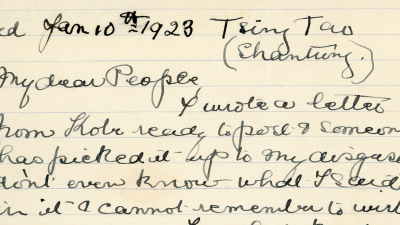
In her heartfelt letters, Anne Smith writes to loved ones about her experiences as a stewardess at sea during the 1920s and 1930s. She shares vivid impressions of distant ports, cultural encounters, and the excitement of global travel, revealing a deep curiosity about the world beyond Britain. Rather than focusing on her duties, Anne’s words convey a sense of adventure and personal discovery, offering a rare glimpse into the social and cultural dimensions of maritime life. Her correspondence captures both the challenges and joys of seafaring, highlighting the overlooked role of women in shaping maritime history.
Anne appears to be fairly well off and educated. Her letters are confidently written with correct spelling and grammar, and she does not appear to find letter writing a chore or a difficulty. Her comments about life at home include ‘I am glad to hear Lady Eveline is engaged to Mr. Aryles, I don’t know why! but I always thought it would be a match.’ (DX/1560/2/4) and ‘when are the tenants due to leave Holmwood, it would be rather nice if I could spend a little time there after this trip’ (DX/1560/2/7). Perhaps had the First World War not removed so many potential husbands from British society, Anne would have been travelling as a middle class passenger and a wife, but instead she is making her own way in the world and managing to combine her interest in travel with her need for employment.
It may sound alright to say one is working one’s passage round the ship but it isn’t all rosy & fair sailing by any means, but then hardly anyone’s life is that so must not grumble & on the whole I must be pretty lucky/
In her letters Anne writes more about the places she and the passengers visit, because that is where her interest lies. She is also trying to write in an interesting and entertaining manner to her family. Indeed she apologises for what she feels is poor content ‘I am sorry it is not as interesting as it ought to be really, but of course we have our work to do here on board not like the passengers who have all their trips planned out etc. & go off carefree with nothing to do but sight-seeing, however! beggars cannot be choosers’ (DX/1560/2/3). From a history point of view, we may wish that Anne had written more about her work on board, her relationships with fellow crew and with the passengers, but historians are not Anne’s audience, so we are left to glean what we can about her working life and what evidence that provides about the lives and work of stewardesses in general.
The collection also includes two partial diaries, which were also written to be sent home, so again were written by Anne for a specific family audience, with explanations and details that would not be included if she was writing purely for herself. Diaries appear to be a common feature of Anne’s voyages, in a letter from 1922 she writes ‘I have not yet started a diary yet but must really begin if possible’ (DX/1560/2/1) while the two diaries that are in the collection come from voyages in 1927 and 1928. While the letters say relatively little about work, the diaries, with their daily entries, reveal a little more about the day-to-day stresses and strains of working life and how it impacts on Anne.
These are all quotes from the diary of a voyage on the Cunard ship Carinthia, 1927-1928 (DX/1560/3/1) ‘We worked until 12 p.m. & then knocked off & had a much-needed rest’, ‘very tired tonight shall be so glad to say goodbye to the passengers for a few days’, ‘The ship is very quiet, nothing much to do, I have five rooms on the go & to keep the empty rooms dusted’. Unsurprisingly there appears to be a lot of tiring physical work, drudgery and repetitiveness involved in the work of a stewardess. Other parts of the role is attending to the needs and demands of the passengers ‘my time has been very fully occupied although a few ladies they are very exacting, one sees human nature in its true light placed as I am, & it does not always tend to make one admire same’ (DX/1560/2/10). There is also the crossover between maid and nursemaid ‘I have a lady in bed, Mrs. Garlick, she also stayed in bed yesterday, nothing the matter but nerves all tied up in a bunch hard, dreadful really’ (DX/1560/3/1). The nursing background of the role of ships’ stewardesses is shown when Anne buys her uniform. The collection contains 2 receipts for clothing purchased by Anne in 1933; the supplier of stewardesses’ uniforms is the Nurses Outfitting Association with branches across the UK.
Finally, what can the collection tell us about the other women at sea on Anne’s voyages, the passengers? Anne is sailing at the top end of the cruising hierarchy. She is working for Cunard on luxury liners undertaking lengthy cruises. She visits, and writes from, a dizzying array of ports and locations around the globe, see the list of ticked off ports from the itinerary of Carinthia World Cruise, 1933 (DX/1560/4/3/1). Her female passengers are often American and have the money to undertake this type of globetrotting. ‘It does make me wonder to see these American people with such a plenty of money, but they are real good sports & seem to enjoy spending & distributing it around, anyway it is much better than hoarding it up like a good many would do’ (DX/1560/2/2). They are travelling not for business as is often the case on a transatlantic voyage, but for sightseeing, and appreciate a packed itinerary ‘Americans just must keep doing something & soon get fed up with the quietness of ships life’ (DX/1560/2/8). Cruising during the 1920s of course allowed Americans to escape the prohibition laws, this was a big selling point for shipping companies and a big attraction for passengers. ‘The passengers had a great time on board during the Xmas holidays, plenty of drink knocking about & incidentally sore heads!’ (DX/1560/2/3).
Anne includes a few remarks about demanding passengers, but broadly seems unperturbed by their presence, except when it prevents her doing her own sightseeing, ‘I have one old lady still in bed, keeps me hanging around otherwise I could get off today, for a few hours, there is generally something’ (DX/1560/2/10). Given the means and opportunity, you feel sure she would gladly take their place. For at her heart she is a traveler, and seafaring is a means for her to achieve this end. ‘We might possibly get a chance to go to Cairo for one night from Alexandria, but must wait & see, it would be lovely to go to Cairo again although I of course have been once, no, twice before, still it calls you back’ (DX/1560/2/9).
Anne’s letters and other documents relating to her seafaring career are held at The Archives Centre of the Maritime Museum in Liverpool and are available to the public through our Searchroom. Copies of the collection catalogue and transcripts are available on request, but unfortunately not yet online.
Explore the historical stories contributed by individuals and UK institutions as part of the Rewriting Women into Maritime History programme.
Explore moreUncovering overlooked stories to build a more inclusive narrative that fosters trust and fairness across global maritime history.
The career of Betzy Shell, as part of the wider SHE_SEES component of the Rewriting Women into Maritime History exhibition.
The career of Honor Frost as part of the Rewriting Women into Maritime History initiative.

