
This page is approximately a 9 minute read

A Lieutenant’s Gravestone: Uncovering a Lost Maritime Story

Collection Learning from the Past Maritime History

Page author

Ülkü Çifci, Art Historian and Lecturer

Ülkü Çifci completed a double major in Art History and History at Uludağ University, followed by a Master’s degree on the influence of late Ottoman architecture on Istanbul’s social structure. She researches Ottoman urban history, gravestones, traditional architecture, and port city planning, while teaching architectural history and Ottoman arts at various universities. She served as an art history consultant for the restoration of the Bursa Yeşil Mosque and the German Fountain in Istanbul. Accompanied by her husband, an ocean-going master mariner, and their daughter, she has traveled to port cities across several continents, gaining an insider's perspective on the maritime world.

Introduction

In the Haydarpaşa Commonwealth War Graves Cemetery in Kadıköy, Istanbul (historically part of the Scutari district), stands the memorial to a father's last and hardest duty to his child: the  gravestone of a young lieutenant who died at the age of 26 during the Crimean War. Henry Crofton Singer… His stone speaks to the bitterest face of war: to be the one who departs, leaving the world without even being able to say farewell to those left behind. Gravestones are the enduring witnesses to the great suffering of those who remain. This study began as an attempt to trace the gravestone of Henry Crofton Singer. It grew into a multidisciplinary subject that connects maritime history, naval engineering analysis, Lloyd's Register casualty records and the history of navigational safety with a maritime disaster that occurred on a single day of a three-year war.
 

The gravestone reads:

"SACRED TO THE MEMORY of HENRY CROFTON SINGER. LIEUT AGED 26 YEARS WHO WAS KILLED IN A COLLISION AT SEA OCTOBER 2 1854 ON HIS RETURN FROM CRIMEA, INVALIDATED. THIS MONUMENT IS ERECTED BY HIS FATHER JOSEPH HENDERSON SINGER BISHOP of MEATH"1


All the data in this research have been developed from the information written on this stone.

Weathered flat gravestone inscribed "Sacred to the Memory of Henry Crofton, Bishop of Meath."
Figure 1: The gravestone of Henry Crofton Singer

The Crimean War

The Crimean War (1853–1856) was fought between the Allied bloc, made up of the Ottoman Empire, the United Kingdom, France and the Kingdom of Sardinia, and Tsarist Russia. The British Cemetery at Haydarpaşa took shape around the buildings in Üsküdar that served as hospitals during the war, in the area where British soldiers who died of disease and wounds were buried. A noteworthy point is that the cemetery lies on Ottoman soil, yet holds the soldiers of a foreign, non Muslim state. The care the Ottoman administration showed this site is reflected in the archival documents. In a document of 1856–57, it was submitted to the Sultan that the burial expenses for the British soldiers who had died would be met from the treasury.2 In 1864, the gut-string workshop (kirişhane)3 near the Haydarpaşa Hospital was relocated, purchased from its owners, and the site was left to the British soldiers' cemetery.4 Another document, of 1892, records the procedure carried out for the transfer of British soldiers buried in Beykoz to Haydarpaşa.5 The most striking proof of this care is a letter dated 8 October 1923. Although the Ottoman Empire and Britain had stood on opposing sides in the First World War, and Istanbul had remained under occupation for years, the letter asked that the perpetrators of the damage done in the cemetery be found, and stressed in particular that the graves belonged to the British who had fought side by side with Turkish soldiers in the Crimean War.6 The enmity of one war did not erase the shared memory of the previous one. Singer's stone has reached the present day under the shadow of this sensitivity.

Handwritten document in Arabic script on aged paper, with a red dashed rectangle highlighting a section.
Figure 2: Ottoman document of 8 October 1923 asking that the perpetrators of the damage to the graves be found, stressing that the dead were British soldiers who had fought side by side with Turkish soldiers in the Crimean War (BOA, HR.İM..)

Singer's Biography

Historical newspaper births announcement listing births in Dublin, including Stephen's Green and Mountjoy Square.
Figure 3: The birth notice of Henry Crofton Singer in the Kilkenny Moderator, 24 January 1829

The biographical foundation of this study is the birth notice in the 24 January 1829 issue of the Kilkenny Moderator. The notice announces only the birth of a son to the Rev. Dr. Singer and does not name the child; because its date, the Mountjoy Square address and the father match what is known of Henry Crofton Singer, it is taken here as his birth notice. On this reading, Henry Crofton Singer was born on 18 January 1829 in Mountjoy Square, Dublin, the son of Joseph Henderson Singer, one of the leading theologians of the day and later Bishop of Meath. On this basis Singer was 25 years old when he died, whereas the gravestone says 26. The birth notice, information on his life, and the press cuttings reporting his death were obtained through correspondence with the YouWho platform in Ireland.7

19th-century lithograph of Anglo-French fleets entering the Black Sea via the Bosphorus, with crowds on a hillside.
Figure 4: The Allied fleets entering the Black Sea from the Bosphorus (1854)  

With the outbreak of the Crimean War, the Bosphorus and the Sea of Marmara became the scene of the heaviest military and logistical sea traffic of the era. This congestion, together with bad weather, made maritime accidents unavoidable. The Evening Freeman and the Evening Mail of 20 October 1854 report that in the Sea of Marmara the French8 screw steamer Ganges collided with Persian, that the accident occurred around midnight, and that its cause was the weather. Both newspapers name the Royal Artillery officer who was killed while asleep in his cabin as "Lieutenant N. C. Singer".9 The initials differ from those on the gravestone (H. C.); the identification with Henry Crofton Singer rests on the Newry Telegraph report below, which names the dead officer as the Bishop of Meath's son. A special letter dated 5 October, published in the 26 October 1854 issue of the Newry Telegraph, states explicitly that the dead officer was the son of the Bishop of Meath. According to the letter, Singer had left Üsküdar the day before to return to England, and was crushed in his cabin after the ship Persian was struck on the way. The news also reached New Zealand, appearing in the 24 January 1855 issue of the Nelson Examiner and New Zealand Chronicle, which reports that the collision brought down the mizzen mast and that, besides Singer's death, six or seven passengers were more or less injured. Although the gravestone records the event as 2 October 1854, the press of the period indicates that Persian left port on 3 October and that the accident took place on the night of 3–4 October.

Black and white engraving of two tall sailing ships on choppy seas, with a coastal tower in the background.
Figure 5: The French steam warship Charlemagne passing Rumelihisarı and Anadoluhisarı at Istanbul (1854). Not connected with the accident; shown only to illustrate the period's Bosphorus traffic  

Persian: The Ship and Lloyd's Register Records

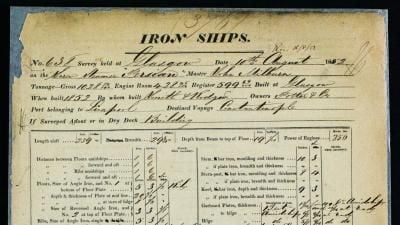
Aged 1852 Lloyd's Register survey form for iron ships, handwritten details for the vessel "Persian" built in Glasgow.
Figure 6: The Survey Report of Persian, Lloyd's Register Foundation, LRF-PUN-IRON430A-0257-R

Persian was launched on 3 July 1852 at Smith & Rodger's Middleton yard in Govan (yard no. 26) and completed in August 1852. Because, in the practice of the period, machinery and fittings were installed afloat after the hull had been launched, the report was drawn up while the ship was still in a stage of construction. Registered in the names of William Dixon (Liverpool) and Lewis Potter (Glasgow / Potter & Co.), this 237-foot iron screw steamer was built as a general cargo ship and measured 1,075 grt / 599 nrt.10 She is recorded in the Lloyd's Register Survey Report (No. 638) of 10 August 1852.11 In 1854 she was chartered by Glass, Elliot & Co. to lay the Spezia–Corsica and Corsica–Sardinia submarine telegraph cables, and on 19 April 1857 she passed to the Pasha of Egypt. In the same year her recorded tonnage appears as 1,114 grt / 636 nrt.

Examining the Astronomical Conditions on the Night of the Event

Examining the astronomical data for the date of the accident, and since the date is not certain in the historical sources, the nights of 2 to 5 October have been considered. At midnight on 2 October 1854 the sky held a waxing gibbous Moon approaching full, with an illumination of about 84%; on the nights of 3–5 October the Moon was closer still to full (about 92–99%), and the full Moon occurred on 5 October.12 Despite this brightness, which in theory should have offered clear visibility on the sea surface, the fact that the accident happened points to two possibilities. If the sky was covered with storm clouds, the moonlight must have been cut off entirely and visibility reduced. If the sky was clear, the failure to avert the collision in spite of bright moonlight brings to mind causes such as inattention, watch-keeping errors or the human factor (fatigue).

Analysis of the Accident through a Seafarer's Eyes

The professional opinion of Ocean-Going Master Murat Çifci was sought in order to evaluate the news reports and Persian's records.13 The comments below are the inferences of an expert ship's master, and are separate from the facts directly reported by the sources. 

The mizzen mast. The sail inventory in Persian's survey report, made while she was under construction, lists only the fore and main mast sails. Captain Çifci interprets this as a two-masted auxiliary sailing rig (schooner/brigantine). He states that under Lloyd's survey practice a ship's mast arrangement had to be entered in the record, and therefore, had a mizzen mast been added to Persian later, it should appear in the records. The press of the period, however, reports that the mizzen mast fell. The increase of the ship's registered tonnage to 636 net tons in 1857 may point to a modification, but it may equally stem from re-measurement; the record does not state the reason. It is also possible that local alterations went unrecorded because there was no Lloyd's Register Surveyor in Istanbul at the time. It therefore remains unresolved whether the press statement reflects a loose use of the term for the aftermost mast or an unrecorded modification. 

The nature of the contact. The newspapers give no information on the angle or speed of the collision. Based on the fact that the 600-ton iron-hulled Persian did not break in two and stayed afloat, and on the existence of her watertight bulkheads, Captain Çifci judges that the contact was not a right-angled broadside blow but a low-speed, tangential scrape. It is also part of this inference, on the assumption that Ganges had a high bow structure, that this structure struck the after accommodation and caused the death of Lieutenant Singer, who was sleeping in his cabin; the newspapers report only that Singer was crushed in his cabin. 

Storm and fatigue. If the sky was covered with storm clouds, visibility must have fallen considerably when moonlight and the effects of rolling are considered together. Even with a clear sky, despite the bright moonlight, the rolling and the roll periods would have been a major factor. Taking into account the fatigue of the watch personnel, and of all personnel exposed to heavy weather, it is indicated that these causes led to the accident. Had the ships been proceeding at full speed, it would have been much harder to reduce their momentum, and the real disaster might then have occurred. The reduced speed, under the influence of the storm, averted the catastrophe. Rolling, low speed and inertia: according to the captain, these three concepts are very important for understanding the event. 

During rolling, supervising deck equipment becomes harder, lashings work loose, and navigation lights can become indistinguishable amid wave spray, which may have weakened decision-making. The sources of the period, however, cite only the weather as the cause of the accident; they give no information on the condition of the crew or on the lights.
Conclusion

Starting from a single inscription in the Haydarpaşa British Cemetery, this study has read the death of Lieutenant Henry Crofton Singer together with the history of the cemetery, the press of the period, ship records and a seafarer's commentary. The Ottoman archival documents show that the administration cared for the graves of the fallen Allied soldiers over many years. The newspaper cuttings and ship records have illuminated the details of the accident, while also pointing to unresolved questions of date, name and equipment. 

These uncertainties show that nineteenth-century maritime accidents cannot be reconstructed from a single source. When the gravestone, the press, the registry records and professional commentary are read together, the wartime sea traffic and safety conditions behind a single death can be better understood.

Bibliography

A. Archival Sources 

  • Presidential Ottoman Archives (BOA), Istanbul: 
    • BOA, A.}AMD (Sadaret Amedî Kalemi Documents), 1856–1857. 
    • BOA, A.}MKT.MHM (Sadaret Mektubî Kalemi, Mühimme Odası Documents), 1864.
    • BOA, Y..PRK.ASK (Yıldız Perakende Sadaret Maruzatı Documents), 1892.
    • BOA, HR.İM.. (Ministry of Foreign Affairs, Istanbul Delegation Documents), 8 October 1923.
  • Lloyd's Register Foundation Heritage Centre, London: 
    • Lloyd's Register Survey Report, "Iron Ships" Form No. 638, Glasgow, 10 August 1852 (Persian). 

B. Periodicals and Newspaper Archives 

  • Evening Freeman (20 October 1854).
  • Evening Mail (20 October 1854). 
  • Kilkenny Moderator (24 January 1829). 
  • Nelson Examiner and New Zealand Chronicle (24 January 1855). 
  • Newry Telegraph (26 October 1854).
  • The Illustrated London News, 25, no. 702 (9 September 1854). 

C. Digital Databases and Printed Sources 

  • Commonwealth War Graves Commission (CWGC): Haydarpaşa British Cemetery records. 
  • YouWho Platform: Irish Biography and Genealogy Archive (Singer family birth and genealogy records). 
  • Scottish Built Ships database (Caledonian Maritime Research Trust), clydeships.co.uk: Persian (1852), ref. 21634. 
  • Lloyd's Register of Shipping, 1855–56 (London). 
  • Provost, A., Entrée des Flottes Anglo-Française dans la Mer Noire à la Sortie du Bosphore (print). 
  • Moon Data, 1854: moonblink.info/Eclipse/astro/table/1854.

Other articles in the series

Handwritten Ottoman Turkish document with reference number İ.DH 1155/90313.

The second life of a Lloyd's Register Surveyor in the Ottoman Navy

In the second article in our series on Lloyd’s Register and the Ottoman Empire, discover the fascinating story of Sir Henry F. Woods, a Lloyd’s Register surveyor who became an admiral in the Ottoman Navy and spent decades navigating life between two empires.

Collection Learning from the Past Maritime History
Historical technical drawing of SS "Ernesto Fasolo" ship profile showing drilling points for 6th survey, dated May 1920.

Lloyd’s Register at Galata Quay: A Historic Photograph

Discover the first in our series exploring the historic connections between Lloyd’s Register and the Ottoman Empire, uncovering the people, places and maritime stories preserved within the archives.

Collection Learning from the Past Maritime History
  • 1

    The inscription is reproduced exactly as it appears on the stone. "Invalidated" is used here in its period sense: sent home from the front as unfit for service because of illness (invalided).