


Behind the scenes: Ship Models at Sweden’s Maritime Museum
Explore the behind the scenes process of filming the Argentina, a 'votive', the Aeolus and the East Indiaman ship models at the National Maritime Museum, Sweden.
This page is approximately a 6 minute read
Ülkü Çifci, Art Historian and Lecturer
Ülkü Çifci completed a double major in Art History and History at Uludağ University, followed by a Master’s degree on the influence of late Ottoman architecture on Istanbul’s social structure. She researches Ottoman urban history, gravestones, traditional architecture, and port city planning, while teaching architectural history and Ottoman arts at various universities. She served as an art history consultant for the restoration of the Bursa Yeşil Mosque and the German Fountain in Istanbul. Accompanied by her husband, an ocean-going master mariner, and their daughter, she has traveled to port cities across several continents, gaining an insider's perspective on the maritime world.
In a Lloyd's Register corporate letter dated 6 December 1890, the head office secretariat in London addressed the recipient directly as: "Admiral Woods Pasha, Constantinople"1. This document marks the point at which Woods's civilian surveying post and his military rank in the Ottoman Navy first appear side by side in official institutional records. Yet only three years earlier, in May 1887, the same man had signed his survey report on the ship Mesudiye under his civilian identity alone, simply as "Resident Ship Surveyor"2. This shift in title between two official documents encapsulates just how deeply Henry F. Woods's position within the Ottoman state had come to be embedded.
Henry Felix Woods arrived in Istanbul in 1869 as a Royal Navy officer aboard the Caradoc3, later becoming an Ottoman Ferik and knighted "Sir"4. His memoirs trace a straight line — Caradoc to teaching at the Imperial Naval School5, confirmed by 1869–70 documents6 — but omit a parallel career as Lloyd's Register's Istanbul surveyor. Correspondence from 1887–19017 shows him holding both posts at once, including an early test on the International Commission of the Bosporus (est. 1866), mooring a lightship there by 1869.8
Woods last used his civilian title in reports on the Tevfik (4 January 1890) and a Black Sea registration; by a letter on the S.S. Sayad (14 February 1901), London had struck the civilian prefix, leaving simply "Woods, Pasha, Constantinople."
Lacking any machine to test anchor chains, Woods relied on an experienced hammer blow, a trained ear, and his own judgment:
The phrase "Please address" carries no harsh command; it is a distanced, polite formula typical of British official correspondence of the period. Yet Woods placed his military title immediately after this courteous phrasing, dictating his status in a diplomatic register and delivering a subtle warning to his correspondents.
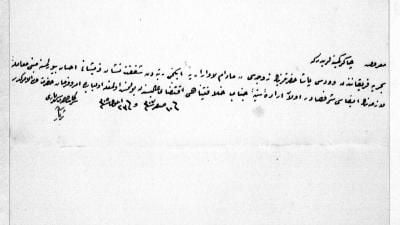
A note dated March 1890, held in the Ottoman Foreign Ministry archive, asks for Woods Pasha's address12. The answer is preserved in Woods's own letters: he asks that his correspondence be sent to the British Post Office in Galata. Not a fixed residence, but a postbox — the deliberately chosen personal space of a man living between two empires.
The strong ties he built with the Ottoman court also had deep roots within his family. Henry Woods, still only a lieutenant at the time, attended to matters concerning the family residence during a sultan's visit, and in 1870 married Sarah, granddaughter of Charlton Whittall. A family tree for Sarah Whittall and Henry Woods survives in the archive. These records show that the family had four children, and that members of the second generation carried the surnames Woods and Pearson13.
Woods sat on the Military Inspection Commission beyond merchant classification, exchanging technical notes with Admiral Fisher14 as a direct channel between two navies.
His court influence showed in protocol too: presented to the Prince of Wales as an Ottoman admiral15, sent to a royal wedding by Abdülhamid II16, and defending the Ottoman state on the Armenian question in The Times17.
The Sultan rewarded this service: pay arrears were settled via the Ottoman Bank18; once, lacking cash, he was paid in Hereke fabrics19.
A Family's Honours (Three Generations of Favour)
The Ottoman archive documents the court's trust in the family, notably the Order of Şefkat (1878), for women only.
No single archive tells Woods Pasha's story fully: Ottoman records show a Pasha and defender of empire abroad; Lloyd's Register shows an engineer applying international standards — together, a man between two empires.

| 
| 
|
Sir Henry F. Woods (Woods Pasha) lived in Istanbul for nearly 45 years, 1869–1914. Though he suffered injustices from Ottoman bureaucracy and self-interested foreign circles, he never blamed the Turkish people, expressing his affection for them in these words:
In those days Istanbul was home to the most hospitable people in the world. In spite of everything, I loved this country and its people. I attributed the injustices I suffered not to the Turkish nation itself, but to certain scheming individuals who set me apart from them.23
Retiring in July 1909, he stayed on given his wife's deep family roots there — until the Goeben and Breslau entered Ottoman service on 3 August 1914, making war with Britain all but certain. He left for home that month; his Ottoman military ties were severed by imperial decree on 27 October 1914.
Ottoman Archives — T.C. Presidency, State Archives of the Republic of Türkiye, Department of Ottoman Archives (BOA), Istanbul. Online catalogue: https://katalog.devletarsivleri.gov.tr/
Lloyd's Register Foundation Heritage & Education Centre, London. Survey report and correspondence series LRF-PUN-CPL1109. Online: https://heritage.lrfoundation.org.uk/
Published Works
Web Sources
Correspondence concerning the steamer Ernesta Foscolo, LRF-PUN-CPL1109-00090-L.
LRF-PUN-CPL1109-0006-L.
Woods, Turkish Memoirs, p.195.
İ..TAL. 256/51, 1901–02.
Turkish Memoirs, pp. 299, 334.
İ..HR.. 241/14307; HR.MKT. 673/34.
LRF-PUN-CPL1109 series.
Schemper, 2024, pp. 10–11; Finkel, 2020, p. 389.
LRF-PUN-CPL1109-0002-L.
LRF-PUN-CPL1109-0126-L.
LRF-PUN-CPL1109-0167-L.
HR.SFR.3… 364/63.
Üstün, 2023, p. 1682.
Y..PRK.KOM. 10/64.
HR.SFR.3… 369/47.
Y..PRK.ASK. 49/102.
Y..PRK.TKM. 17/16.
BEO 845/63315.
ML.EEM. 353/56.
“I. Derece Murassa Şefkat Nişanı ve Şemsesi Tam Takım, 19. Yüzyıl Osmanlı.” Art Hill Müzayede. https://www.arthill.com.tr/urun/9217498/i-derece-murassa-sefkat-nisani-ve-semsesi-tam-takim-19-yuzyil-osmanli-i-derece.
Curator's note (Art Hill): a complete first-class jewelled (murassa) Order of Şefkat and its sunburst badge, with original ribbon and case; gold with red and green enamel, set with diamonds and rubies; centred on Sultan Abdülhamid II's tughra, dated 1295 AH, with the cartouche legend ‘İnsaniyet, Muavenet, Hamiyet’ *Humanity, Assistance, Devotion]. Instituted 1295 AH (1878 CE) for women only; first conferred on Lady Layard, wife of British ambassador Sir Henry Layard; later recipients include Rukiye Sabiha Sultan, Halide Edip, Fatma Aliye, the poet Nigâr, Makbule Leman, and Countess Olga Sergeyevna. Refs.: Osmanlı Madalya ve Nişanları (2001, M. Üreten); Osmanlı Nişan ve Madalyaları Tarihi (Osmanlı Bankası, 2004, E. Eldem). Badge 50×53.5 mm/17 g; sunburst 83×82 mm/63 g.
“Osmanlı Dönemi 3. Derece Mecidi Nişanı.” https://www.bayrakmuzayede.com/osmanli-donemi-3-derece-mecidi-nisani.html
“Osmanlı Dönemi 4. Derece Nişan-ı Osmani Madalyası.” https://www.bayrakmuzayede.com/osmanli-donemi-4-derece-nisan-i-osmani-madalyasi.html
Turkish Memoirs, p. 95
Explore the behind the scenes process of filming the Argentina, a 'votive', the Aeolus and the East Indiaman ship models at the National Maritime Museum, Sweden.
Explore the behind the scenes filming of the Cold War Rail Ferry, Oasis of the Seas, Stena Drillmax and Olympic Loyalty ship models at the IMO's headquarters.
A behind the scenes look at the process of filming HMS Vanguard, HMS Prince, Campania and Océan at the Science Museum's National Collections Centre, Swindon.

