


Behind the scenes: Ship Models at Sweden’s Maritime Museum
Explore the behind the scenes process of filming the Argentina, a 'votive', the Aeolus and the East Indiaman ship models at the National Maritime Museum, Sweden.
This page is approximately a 5 minute read
Ülkü Çifci, Art Historian and Lecturer
Ülkü Çifci completed a double major in Art History and History at Uludağ University, followed by a Master’s degree on the influence of late Ottoman architecture on Istanbul’s social structure. She researches Ottoman urban history, gravestones, traditional architecture, and port city planning, while teaching architectural history and Ottoman arts at various universities. She served as an art history consultant for the restoration of the Bursa Yeşil Mosque and the German Fountain in Istanbul. Accompanied by her husband, an ocean-going master mariner, and their daughter, she has traveled to port cities across several continents, gaining an insider's perspective on the maritime world.
This study reads survey records from the Lloyd’s Register Foundation Archive alongside Ottoman archival documents as complementary systems of recording. Beginning from a photograph of Galata Quay dated to the early 1900s, it argues that technical oversight and administrative governance in the port of Istanbul can only be understood through their intersection. Foscolo, Mango & Co. is not treated as a central subject but as an analytical case through which institutional structures visible in the photograph can be interpreted. The focus is not on corporate history but on how commercial actors became legible within overlapping regimes of regulation.
If you were standing at the Karaköy end of the Galata Bridge at the beginning of the 1900s and looking at the port, the first things that would catch your eye would be the smell of the sea, the shouts of the street vendors, and variety shows1. At first glance, this view looks like an ordinary port image documenting the commercial fabric of the period. However, if you lifted your head a little and looked carefully, you would see three different institutional signs appearing together on the waterfront: Lloyd’s Register and Foscolo, Mango & Co. stacked on the facade of the same stone building, with Gilchrist Walker & Co. positioned right alongside them on the adjacent structure.
For those looking from the outside, these large-lettered signs were like a massive British commercial showcase pulled to the Galata Quay. But behind these signs lay a multi-layered oversight relationship between the uncompromising technical bureaucracy of the Lloyd’s Register (LR) Headquarters in London- the rule-maker of world shipping and the entity ensuring ships sailed safely- and the Ottoman state apparatus’s administrative, legal, and sanitary sovereignty rights in the Port of Istanbul, which served as the lifeblood of global trade routes connecting the Mediterranean and Black Sea ports.
Survey reports in the Lloyd’s Register Foundation Archive and Ottoman archival documents reveal a dual system of maritime governance. LR's survey operations in Istanbul functioned as an intermediary mechanism between London classification standards and local administrative enforcement.
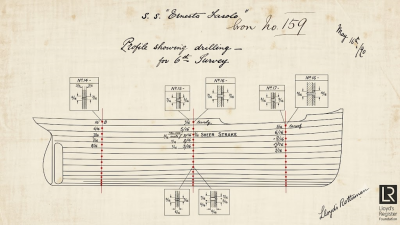
The case of the s.s. Ernesto Foscolo illustrates this structure. In 1883, even minor defects were classified in London as serious breaches of standards2. During 1890–1891, surveyor George R. Warren delayed procedures due to charter agreements and dry-docking costs3, while London demanded acceleration to preserve technical discipline4.
Ottoman quarantine regulations further disrupted inspections. Cholera-related sanitary regimes suspended technical surveys and tied hull inspections to health permissions5. As a result, technical evaluation became dependent not only on engineering standards but also on public health governance.
To overcome the delays, London activated diplomatic channels, including correspondence involving Admiral Sir Henry Felix Woods6. Woods Pasha served the Ottoman Empire for 45 years (1869–1914); he rose to the rank of Vice Admiral (Ferik), was appointed Honorary Aide-de-Camp to the Sultan (Yaveran-ı Şehriyariden), and his salary was structurally secured through customs revenues (Rüsumat) by imperial decrees7. He was decorated with a state merit medal (the Order of the Mecidiye) and a senior jeweled state decoration (the Murassa Order of the Osmanieh). His senior position on the High Military Inspection Board (Teftiş-i Askerî Komisyon-ı Âlisi), combined with his authority over torpedo and naval security matters, gave him the institutional influence needed to cut through rigid port bureaucracy and expedite Lloyd's technical operations.
Ottoman archival records demonstrate that the port was governed through administrative, legal, and sanitary systems rather than purely technical regulation. Quarantine enforcement8, visa procedures9, and commercial regulations10 structured maritime circulation.
In 1898, the entry of the steamer Ernesto without a sanitary patent triggered escalation to the Grand Vizierate11. This incident also appeared in Lloyd’s records as a procedural delay12. Similarly, the seizure of ships in 1895 due to ammunition discovery13 shows how maritime security intersected with diplomacy. Between 1898 and 1907, repeated administrative interventions created prolonged delays in Lloyd’s survey procedures.
Foscolo, Mango & Co. shifted between British, Greek, and Austrian identities to navigate legal constraints. Within this context, the official reply from the British Consulate to an Ottoman inquiry underscores Britain's bureaucratic boundaries, proving they did not blanketly endorse every local commercial actor. The Consulate confirmed they had no knowledge of a British subject named Gilchrist Walker, while explicitly stating that Foscolo Mango & Co. was not under British protection14. This institutional distance proves that nationality was not a fixed legal category, but a strategic commercial shield against imperial oversight.
The survey history of the s.s. Ernesto Foscolo reveals that governance at Galata Quay was not centralized but distributed across overlapping systems of authority. Lloyd’s Register enforced technical classification standards from London, while the Ottoman state regulated maritime movement through quarantine, customs, and administrative law.
These systems did not operate independently but continuously interacted. Diplomatic correspondence, sanitary regimes, and administrative interventions shaped the timing and outcome of technical inspections. The result was a fragmented but interconnected structure of maritime oversight in which global standards and imperial sovereignty co-produced port governance.
Archival Sources:
Book and Visual Sources:
Karaköy Quay Photograph: Osman Öndeş, Türk Armatörler Tarihi, Vol. III, Istanbul, 2020, p. 274
Remarks of the Chief Surveyor to the Classing Committee for Ernesta Foscolo, 31 March 1890, Lloyd's Register Foundation, LRF-PUN-CPL1109-0095-L
Correspondence regarding Ernesta Foscolo, 10 September 1888, LRF-PUN-CPL1109-0096-L
Remarks of the Chief Surveyor to the Classing Committee for Ernesta Foscolo, 29 December 1890, LRF-PUN-CPL1109-0091-L
Cumhurbaşkanlığı Devlet Arşivleri Başkanlığı Osmanlı Arşivi (BOA) [Presidency of the Republic of Türkiye, Directorate of State Archives, Ottoman Archive], BEO, 1174-88024-0
Correspondence from A G Dryhurt, Assistant Secretraty of Lloyd's Register London to Admiral Woods Pasha regarding Ernesta Foscolo, 6 December 1890, LRF-PUN-CPL1109-0090-L
BOA, HR.UHM, 280/17, 17.10.1891.
BOA, BEO, 1174/88024.
BOA, Y.MTV., 160/106.
BOA, BEO, 644/48280.
BOA, HR.İD, 206782.
Correspondence from Henry F Wood, Lloyd's Register surveyor at Constantinople to A G Dryhurst, Assistant Secretary of Lloyd's Register London regarding Ernesta Foscolo in quarantine, 14 December 1890. LRF-PUN-CPL1109-0089-L; Correspondence from A G Dryhurt, Assistant Secretraty of Lloyd's Register London to Admiral Woods Pasha regarding Ernesta Foscolo, 6 December 1890, LRF-PUN-CPL1109-0090-L
BOA, BEO, 976/73144.
BOA, HR.UHM, 280/17, 17.10.1891.
Explore the behind the scenes process of filming the Argentina, a 'votive', the Aeolus and the East Indiaman ship models at the National Maritime Museum, Sweden.
Explore the behind the scenes filming of the Cold War Rail Ferry, Oasis of the Seas, Stena Drillmax and Olympic Loyalty ship models at the IMO's headquarters.
A behind the scenes look at the process of filming HMS Vanguard, HMS Prince, Campania and Océan at the Science Museum's National Collections Centre, Swindon.

