


Behind the scenes: Ship Models at Sweden’s Maritime Museum
Explore the behind the scenes process of filming the Argentina, a 'votive', the Aeolus and the East Indiaman ship models at the National Maritime Museum, Sweden.
This page is approximately a 11 minute read
Dr Jo Horton, Historian, maker, and heritage consultant
Dr Jo Horton FRSA FTLS is a historian, maker, and heritage consultant whose research focuses on textiles, fashion, and uniform. A Caird Fellow she has a special interest in the tailoring, embroidery, regalia, and ubiquitous tiddly suit of the wartime Women’s Royal Naval Service. Based at Royal Museums Greenwich-National Maritime Museum and Prince Philip Maritime Collections Centre she pursued her passion for material culture and interviewed several Wrens who served in World War 2 and post war. Jo presented this work by invitation at the Barbara Pym Annual Conference 2024 at St Hilda’s College, Oxford.
Jo recently interrogated the practical lived experiences of uniform and bricolage of clothing and fabrics that built the nursing professions uniform, co-curating the exhibition ‘In Uniform’.
It is 2022 and I am on enroute to the Prince Philip Maritime Collections Centre, Royal Museums Greenwich. I am to view the object identified in its catalogue as TXT0219, a tablecloth, ordered from the Collections Stores, where it has been kept rolled up away from view and the ravages of time. Described in its entry as an embroidered tablecloth showing devices associated with branches of the Women’s Royal Naval Service (WRNS), the main fabric is beige cotton with a blue cotton border added, measuring in total 2.3 metres by 1.6 metres. The tablecloth consists of individual embroidered panels joined together, with blue herringbone stitch covering the joins, and embroidered signatures are positioned around the edges.
The tablecloth is described as associated with the vessel1 HMS Leigh, which was a shore base during the Second World War (in civilian terms it was known as Southend Pier). In September 1939 the pier was commissioned by the Royal Navy, renamed HMS Leigh (with surrounding areas being renamed HMS Westcliff) and, was decommissioned in 1945.
HMS Leigh served as a crucial naval control point for the Thames Estuary (The Nore Command) and a mustering point for convoys with 3,367 convoys, comprising 84,297 vessels departing from HMS Westcliff alone (Blade Education, 2021).
HMS Leigh and HMS Westcliff were manned by the WRNS (known as the Wrens) in a variety of roles, such as wireless telegraphists and radio operators. The women that were stationed there, between 1939-1945, included Chief Officer Janet Gawler Poulden shown in Figure 3, who was listed first as a schoolmistress and then WRNS 2nd Officer, in the 1939 census2.
Although information on the Wrens who served in the Second World War is sparse, as records are not yet available via The National Archives and www.ancestry.co.uk, Joyce Palmer, Joan Rule and Irene Plummer are named on social media pages that are linked to the HMS Leigh community-led heritage and arts project developed by Blade Education in 20193,4. Furthermore, Hans Houterman and Jeroen Koppes (initiators of the website www.unithistories.com) record one HMS Leigh Wren, Leading Wren Constance Mary Spencer as stationed there.
I hope, at this point in my preliminary research, that more will be revealed about the individuals who served at HMS Leigh, because of the work I am about to do on an object biography of the tablecloth. It is tempting to speculate if any serving Wrens were among the embroiderers of the tablecloth I am about to view. Furthermore, from a textile history context, if I can glean if any of these Wrens took part in special courses in household repairs, needlework, dress design and creative textiles known to have taken place on shore bases, and used their skills as illustrated in Figure 45.
A large room, with a substantially sized table, is set aside for me by the collections storage officers in the Prince Philip Maritime Collections Centre building (a place which had an important part to play in the Second World War, being the site of RAF Kidbrooke, No.1 Balloon Centre6).
The collections storage officers carefully unroll the tablecloth from its protective materials, and I am astounded by its size and the embroidered narrative that it displays. There is no sense of the impact of the tablecloth from the description given and, of course, the lack of a photograph in the online object catalogue aids my surprise.
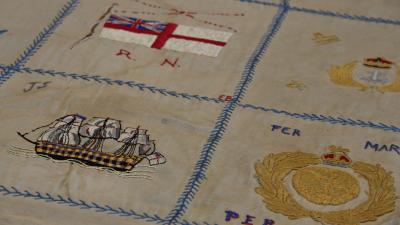
The tablecloth, illustrated in Figure 5, tells a visual story of the Wrens and there is bold considered stitching (although with some variation of skill) used to chronicle roles and emblems of people’s military service. The tablecloth is punctuated by a series of designed icons, some reminiscent of WRNS rank and trade badges (worn on the right sleeve of their uniform), others personalised vignettes of service activities together with the unfinished central motif of what appears to be an Association of Wrens badge. Embroidered signatures on the borders provide a personalised element and a panel with a half-finished banner with the text HMS Leigh stitched in blue locates the possible place of production or the shore base with which the embroiderers were associated.
I spend hours examining the tablecloth with the view to discerning the story behind its creation and the insight that might be given on those who stitched it. Clare Hunter argues that the English have a history of skilful woman embroiderers7 and this generation of women would have been taught embroidery and needlework in schools, as well as by family members8. But who were these embroiderers and why did they create the tablecloth?
The signatures, as far as I can decipher, include Tilly Waugh (illustrated in Figure 6), W.A. Fawcett, M. Green, J.W. Stewart, M. or W. Whitehouse, L. Crabtree, M.W. Kent, and many more. Indeed counting the signatures (on two and a half of the borders) 24 individuals were responsible for the tablecloth.
There are initials stitched into over 17 of the embroidered panels, which I speculate belong to those responsible for each panel. I am particularly taken with the work of PW and the gardening motifs they created (illustrated in Figure 7), most likely a reference to recreational activity but also necessity given war time food shortages9.
I concluded that I cannot confirm if the embroiderers were serving or de-mobbed Wrens, however it is unlikely they were civilians given the presence of the Association of Wrens emblem. However, I hope to confirm their identities in future research when service records are made accessible.
It is the creativity and decision making behind the stitching in addition to the diversity of needlecraft that now takes my eye. There are many meaningful symbols that represent the Wrens and the Royal Navy present in the design of the tablecloth. For instance, the skilled interpretations by JS of a sailing ship that resembles the Cutty Sark, a selection of Royal Navy signal flags, the White Ensign flag, the motto of HMS Leigh and Southend on Sea, Per Mare Per Ecclesiam (Through the Sea Through the Church) and many more including the Red Ensign flag, representing the Merchant Navy.
There are illustrations representing nursing and the sick bay, and tools and equipment used in fire and rescue (illustrated in Figure 9 and Figure 10). However, only one solitary figure is featured on the tablecloth and is, as far as I can discern, part of a heraldic emblem.
The depiction and commemoration of important war time activities and military symbols and emblems is fascinating. Throughout the history of textiles the use of cloth and its decoration as a visual source of messaging reoccurs, not just as boredom relievers, but also with hidden messages and secret codes, branding or political statements10.
Indeed, Christopher Breward in the edited volume Quilts 1700-2010 Hidden Histories, Untold Stories discusses the genre of the military quilt and the patchwork objects sewn by men, and wives, sisters and daughters that marked family and regimental traditions in terms of their choices of colour, patterning, motifs and in the fine quality of the craftsmanship present in many examples11.
A few questions come to my mind that centre around the conditions, location and companiable sewing that led to the large unfinished piece I am examining. One of the benefits of hand sewing as a pursuit is that it can be done both in company and alone, and it can be produced whilst taking part in conversation, in an informal social setting.
As Clare Hunter reflected on the benefit of a 20th century community group project, ‘there was something unique in sewing together... it created a physical proximity that generated goodwill and camaraderie in an atmosphere of mutual support, of affection even’12 (2019, p.179).
I begin to envisage that the driver behind the HMS Leigh tablecloth was making as a method of reviving one’s spirit through self-expression, similar to examples cited by Linda Parry when describing 18th and 19th century quilt making by women13. The stages of production, in the case of the HMS Leigh tablecloth, perhaps stitching to offset what would have been challenging war time experiences, and perhaps even helping to heal what we would now call post-traumatic stress disorder (PTSD). Indeed, David Cutler discusses the significant therapeutic role of stitch that continues today14.
However, conversely it occurs to me that it is possible that the tablecloth was for another purpose entirely. Sewn, autographed cloths, often tablecloths, have been a popular way to raise funds and support for social causes since the 19th century, with a continuing history of textile commissions by the wealthy, titled or the Church to support veterans in the 20th century15. Indeed, the latter was evidenced in several projects including Ernest Thesiger’s initiative The Disabled Soldiers Embroidery Industry16 which operated from 1918-1955.
Whatever the answer, which I hope future research will reveal, I decide to celebrate the ambition of the embroiderers, and to design, colour, pattern and hand stitch a contemporary evocation of the tablecloth based on my research as Caird Fellow.
On the 17 June 2022, I organised and co-hosted a display, seminar and embroidery workshop at the Prince Philip Maritime Collections Centre Royal Museums Greenwich. The day involved fashion, textiles and art historians, social historians, researchers, curators, designers and students coming together to view a display of the results of a university student design competition, devised and mentored by me, together with a visit to the Collections Stores.
A seminar programme was included whereby I, Professor Pat Kirkham, Emma Trealeaven and Dr Danielle Sprecher presented short talks. These were followed by an informal roundtable discussion about uniform and the themes that emerged from the presentations, together with a film kindly provided by Lucy Adlington.
I was able, with the support of Royal Museums Greenwich, to devise with textile artist Nigel Cheney17, a group embroidery workshop for the participants. The Wrens uniform themed workshop explored the process of stitching, whether by an experienced embroiderer or a total beginner. Individual panels were pre-prepared with digitally printed images and text sourced from the Caird Library and Collections Stores by me and by Cheney from his connections with ex-Wrens and Royal Navy service women.
What occurred was a companiable meeting of the speakers, with attendees and Royal Museums Greenwich staff, led by Cheney, each person finding a fabric swatch they identified with, and stitching onto the cloth to make a piece with special meaning to them as the maker. This workshop was especially poignant for one attendee who had served in the military. After some time, and with the assistance of Cheney’s instruction, it was apparent that excited conversation had settled to quiet engagement with needles, thread, scissors and cloth (illustrated in Figure 11).
From this communal experience I felt that the group crafting of the HMS Leigh tablecloth was seemingly being evoked, with the added opportunity to take a swatch home afterwards thus creating a personal keepsake (mentioned so often in Wren’s memoirs) and reminder of the importance of studying women’s uniform. Cheney added to the legacy of the workshop in putting together the remaining and donated any donated panels to create a large tablecloth (illustrated in Figure 12). This has since been added to via his ongoing workshops and activities with local embroiderers in his hometown of Market Harborough, Leicestershire.
As this article outlines this research is a work in progress, with several important questions unanswered, with the intention that the story of the object will unfold in time. However, I propose that the HMS Leigh tablecloth could well give important insight into Wrens’ lives through their depiction of an intimate knowledge of the roles, tools, and geography of serving on shore and at sea and their commitment to its creation in the first place.
The object is (and I suggest this with some caution) despite its size, a personal commemoration rather than a public commission piece. There is no carbon copy of regulation motifs or authorisation or commissioning information. It is unfinished, and demonstrates a variation of skill but, it is altogether charming in its repertoire of stitches, in the style of drawing that different threads can produce as opposed to printed materials.
There is much to speculate on the process and any documentation that might have been involved in its design, planning, sketching, colour palette, and overall collective and creative consensus when working together in companiable synergy.
If anyone knows more, please contact Dr Jo Horton.
Blade Education. VE-76 HMS Leigh The bravest pier in the world. https://www.blade-education.co.uk/hms-leigh (Accessed: 12 October, 2025).
Breward, C. (2010) ‘Sewing soldiers’ in S. Prichard (ed.). Quilts 1700-2010: Hidden histories, untold stories. London: V&A Publishing. pp85-87.
Cutler, D. (4 July 2022). The therapeutic stitch. Blog. https://baringfoundation.org.uk/blog-post/the-therapeutic-stitch/
Douie, V. (1950). Daughters of Britain. Oxford: George Ronald Publishers.
Griffith, E. (1944). A manual of plain needlework. Oxford: Oxford University Press.
HMS Leigh. (13 July 2021). HMS Leigh’s post. Facebook. https://www.facebook.com/HMSLeigh/posts/so-our-next-wrns-star-is-irene-plummer-who-also-worked-at-hms-westcliff-thanks-t/359363608890440/
HMS Leigh. (13 August 2021). Chief Officer J G Poulden. Facebook. https://www.facebook.com/photo/?fbid=378454426981358&set=a.106913354135468
Houtermann, H, and Koppes, J. (no date). World War II unit histories and officers. https://www.unithistories.com/ (Accessed: 14 May 2022).
Hunter, C. (2019). Threads of life: A history of the world through the eye of a needle. London: Sceptre.
Minns, R. (1980). Bombers & mash: The domestic front 1939-1945. London: Virago Press Limited.
Parker, R. (1984). The subversive stitch: Embroidery and the making of the feminine. London: The Womens Press Ltd.
Parry, L. (2010) ‘Complexity and context: Nineteenth century British quilts’ in S. Prichard (ed.). Quilts 1700-2010: Hidden histories, untold stories. London: V&A Publishing. pp58-83.
Southend and South Essex History with Chris. (21 March 2025). On this day in 1940…. Facebook. https://www.facebook.com/Christoryonthethames/photos/on-this-day-in-1940-the-commanding-officer-of-hms-leigh-southend-pier-signed-an-/668596012200325/
The Wartime Memories Project (no date). HMS Leigh during the Second World War. https://www.wartimememoriesproject.com/ww2/ships/ship.php?pid=8816 (Accessed 11 September 2025).
Wylie, D. (10 May 2020). HMS Leigh VE75 Service Booklet. https://saintmargaretsleigh.org/wordpress_g/wp-content/uploads/2020/05/HMS-leigh-VE75-service-booklet.pdf
Objects
Collection Objects, The Prince Philip Maritime Collections Centre, Royal Museums Greenwich. Tablecloth ID: TXT0219. https://www.rmg.co.uk/collections/objects/rmgc-object-71034
Figure List
Figure 1 Naval Map Southend, Westcliff and Leigh 1943 topology
Figure 2 The bravest pier in the world. Anti-aircraft crew manning guns during an air raid on HMS Leigh © Essex Echo https://www.facebook.com/Christoryonthethames/photos/on-this-day-in-1940-the-commanding-officer-of-hms-leigh-southend-pier-signed-an-/668596012200325/
Figure 3 HMS Leigh: In the front row, Chief Officer Janet Gawler Poulden https://www.facebook.com/photo/?fbid=378454426981358&set=a.106913354135468
Figure 4 Wrens sewing at leisure: The Women's Royal Naval Service during the Second World War. A group of Wrens, in Liverpool, make toys from scraps of old clothing as Christmas gifts to the children of local sailors.
Figure 5 The tablecloth shown in situ at the Prince Philip Maritime Collections Centre
Figure 6 Signature of Tilly Waugh
Figure 7 Gardening motifs
Figure 8 Flags
Figure 9 Nursing and the sick bay
Figure 10 Fire and rescue
Figure 11 The Wrens themed workshop in situ
Figure 12 The Legacy Tablecloth by Nigel Cheney
Shore bases have historically been assigned a small named vessel which then legally made the entire establishment a vessel, allowing them to be governed by the same naval discipline laws as ships at sea.
HMS Leigh. (13 August 2021). Chief Officer J G Poulden. Facebook. https://www.facebook.com/photo/?fbid=378454426981358&set=a.106913354135468
Blade Education developed the project to connect people of all ages with the history of Southend Pier, also known as HMS Leigh. Supported by the National Lottery Heritage Fund, the Arts Council and Southend Borough Council the project was created as part of the VE 75 celebrations in 2020 and survived to be one of the first local post pandemic lockdown in-person events in September 2021. A long list of those who were involved included the Royal British Legion, SEN Trust Southend, and other local organisations.
HMS Leigh. (13 July 2021). HMS Leigh’s post. Facebook. https://www.facebook.com/HMSLeigh/posts/so-our-next-wrns-star-is-irene-plummer-who-also-worked-at-hms-westcliff-thanks-t/359363608890440/
Douie, V. (1950). Daughters of Britain. Oxford: George Ronald Publishers.
RAF Kidbrooke housed the No.1 Balloon Centre, which deployed and managed large hydrogen filled barrage balloons tethered to defend London and other targets from low flying German bombers. The site played a crucial role in the national barrage balloon aerial defence scheme, and the work was very dangerous due to the cables and gas bags involved. RAF Kidbrooke was also reputed to be a centre for trainee spies.
Hunter, C. (2019). Threads of life: A history of the world through the eye of a needle. London: Sceptre.
Griffith, E. (1944). A manual of plain needlework. Oxford: Oxford University Press.
Minns, R. (1980). Bombers & mash: The domestic front 1939-1945. London: Virago Press Limited.
Parker, R. (1984). The subversive stitch: Embroidery and the making of the feminine. London: The Womens Press Ltd. Hunter, C. (2019). Threads of life: A history of the world through the eye of a needle. London: Sceptre.
Breward, C. (2010) ‘Sewing soldiers’ in S. Prichard (ed.). Quilts 1700-2010: Hidden histories, untold stories. London: V&A Publishing. pp85-87.
Hunter, C. (2019). Threads of life: A history of the world through the eye of a needle. London: Sceptre. p179.
Parry, L. (2010) ‘Complexity and context: Nineteenth century British quilts’ in S. Prichard (ed.). Quilts 1700-2010: Hidden histories, untold stories. London: V&A Publishing. pp58-83.
Cutler, D. (4 July 2022). The therapeutic stitch. Blog. https://baringfoundation.org.uk/blog-post/the-therapeutic-stitch/
Hunter, C. (2019). Threads of life: A history of the world through the eye of a needle. London: Sceptre.
Ernest Thesiger proposed a morale boosting charity project for disabled combatants providing training and employment for injured veterans, that grew from small sewing kits to the production of highly desirable luxury textiles (Cutler, 2022).
Cheney details his work on the project and embroidery workshop in his post on his website https://nigelcheney.com/more-than-a-uniform-2/?v=7885444af42e
Explore the behind the scenes process of filming the Argentina, a 'votive', the Aeolus and the East Indiaman ship models at the National Maritime Museum, Sweden.
Explore the behind the scenes filming of the Cold War Rail Ferry, Oasis of the Seas, Stena Drillmax and Olympic Loyalty ship models at the IMO's headquarters.
A behind the scenes look at the process of filming HMS Vanguard, HMS Prince, Campania and Océan at the Science Museum's National Collections Centre, Swindon.

