


Behind the scenes: Ship Models at Sweden’s Maritime Museum
Explore the behind the scenes process of filming the Argentina, a 'votive', the Aeolus and the East Indiaman ship models at the National Maritime Museum, Sweden.
This page is approximately a 5 minute read
Anna Grybenyuk, Researcher
Anna Grybenyuk graduated from the University of St Andrews with a degree in Modern History and Russian in 2016, then again with an MLitt in Museum and Gallery Studies in 2020. Much of her knowledge of fishing and maritime activity comes from working at the Scottish Fisheries Museum, and from living so long by the coast. She currently works in Oxford, managing digital collections for the Pitt Rivers Museum and History of Science Museum. It is far from the sea, but she will take any opportunity to head back to the coast to spot birds and boats alike.
Fishing is often seen as a man’s job. It is true that, even today, the majority of fishing boat crews are men. Step off the boat and step back in time, however, and it becomes clear that many critical tasks were done by women.
Nowhere was this more apparent than in the Scottish fishing industry in the 19th and early 20th centuries. Women here served two broad, overlapping roles:
Their skills and essential contributions afforded them a degree of respect and freedom that was unheard of for women at the time. This Women’s History Month, it is only right to shine a spotlight on these remarkable, spirited fisherwomen.
Fishwives have a reputation in popular understanding for being loud and brash. This is unfair: like any good salesperson, the fishwife had to be loud and persuasive, doubly so considering how quickly fish spoils.
In Newhaven in East Lothian, she sold the fish her husband had caught, carrying it on her back to Edinburgh in a basket that weighed up to 55 kg 1. They had to be strong, not just in body but in mind. As the seller, the fishwife controlled the family finances, which, combined with her husband’s long absences, gave her a lot of independence and freedom, especially compared to women at the time.
Selling fish was not the only way fishwives kept the industry going. They did everything to ensure their husbands could catch fish, from mending nets to baiting lines. Baiting 1300 hooks was no easy task, and required both speed and skill 2. Fortunately, many of these women had deft, practised hands, not only from working the nets and lines but also knitting.
A fisherman’s wife would knit clothes for the whole family, most notably her husband’s signature workwear- a sweater called a gansey- which would protect him from the elements, reducing risk of illness 3. Given their long, difficult hours at sea, it was vital a fisherman be kept warm and dry as long as possible. The most extreme demonstration of this comes from Whitehills, near Banff, where the wife would carry her husband on her back from shore out to his boat! 4No work was off limits for her!
On top of her work, a fisherman’s wife was expected to do the usual household chores expected of a woman at the time, such as looking after the home and children. All of this combined made her a vital partner in her husband’s enterprise. He could not work without her.
However, women did not only keep the fishing going on a local level. When the herring industry boomed in the 19th and early 20th centuries, there suddenly became demand on a mass scale for one particular type of female worker, one that was equally strong and independent: the herring gutter.
Herring’s high fat content means it needs to be processed quickly after catching to prevent spoilage. Before refrigeration, this meant brining, the highest quality of which was the ‘Scotch cure’, a technique of gutting and packing the fish in salt.
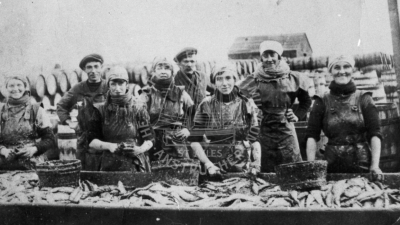
During the herring season, this job was done on an industrial scale by women colloquially called ‘fisher lasses’, though they could be of any age. Mothers, daughters, sisters, grandmothers, and aunts all worked together, gutting, and packing the catch brought in by their fathers, brothers, and husbands. These family bonds gave them a strong sense of community and camaraderie.
Working in teams, two gutters would hand fish to a single packer who would place it into a barrel with a layer of salt. An experienced gutter could typically manage 40 fish a minute, though some could go even higher. 5They had to keep up the pace, as teams were paid per barrel.
A typical workday was from 6 am to 6 pm, though if the catch was good, the women could work as late as midnight. 6It was difficult, gruelling, and dangerous work. With such long hours and working with a sharp knife at fast pace, cuts were inevitable.
To make matters worse, the salt created ulcers which could easily become infected. A woman whose hands were injured could not work, which meant no money for her team and her family. The gutters would therefore tie rags from sacks around their fingers to provide some protection.
Despite the hard work, gutting was a desirable job for fisherwomen. And why not? It was well paid, gave them freedom few women at the time had, and allowed them to travel. As the herring moved down the East Coast from Shetland to Yarmouth, the gutters followed. To keep up their spirits, they sang as they worked, and as a result, often became a tourist attraction. What little spare time they had, they spent going to dances or, as one woman recalled, even pubs! 7
These women were vital to the herring fishing, and they were treated as equal to the men. Their strength, stamina, and skill were respected, and their great freedom gave them a strong sense of independence.
The herring industry declined when demand fell after the First World War. By the 1960s, these remarkable women had lost their way of life completely. The role of fishwife changed too, as fish began to be sold wholesale to supermarkets. However, the legacy of these strong, skilled women lives on. Their daughters and granddaughters commit their memories to paper to preserve them.
The fisherwoman lives on as a vital part of the identity of fisherfolk to this day. 8She serves as a symbol of not just the community’s strength, spirit, and skill, but of the strength and independence of the women who carried the fishing industry on their backs, both metaphorically and literally.
Find more blogs on the topic of women in maritime history.
“To the Creel. Fisherrow Fishwives and Their Baskets.” Woven Communities, University of St Andrews and Scottish Basketmakers' Circle, http://wovencommunities.org/collection/to-the-creel-fisherrow-fishwives….
“The Fisherrow Fishwives.” John Gray Centre Library, Museum, and Archive, East Lothian Council, https://www.johngraycentre.org/people/east-lothian-folk/the-fisherrow-fishwives/.
“Use.” Scottishgansey.org.uk, Scottish Fisheries Museum, 23 Sept. 2020, https://scottishgansey.org.uk/ganseys/use/.
“The Sea - The Women of the Fishing Villages .” North East Folklore Archive, Aberdeenshire Council, http://www.nefa.net/archive/peopleandlife/sea/fisherfolk.htm.
“Herring Gutters.” Nucleus: The Nuclear and Caithness Archives, High Life Highland, 9 Sept. 2022, https://www.highlifehighland.com/nucleus-nuclear-caithness-archives/wk-history-of-a-harbour/online-exhibitions-wk-history-of-a-harbour/herring-gutters
Kajaste-McCormack, Minna. “Herring Lasses and Their Silver Darlings.” Art UK, 20 Oct. 2021, https://artuk.org/discover/stories/the-scottish-fisheries-museum-herring-lasses-and-their-silver-darlings.
Telford, Susan. 'In a World a Wir Ane': A Shetland Herring Girl's Story. Shetland Times, 1998.
Nadel-Klein, J (2000), ‘Granny baited the lines - Perpetual crisis and the changing role of women in Scottish fishing communities’, Women’s Studies International Forum, 23 (3): 363-372
Explore the behind the scenes process of filming the Argentina, a 'votive', the Aeolus and the East Indiaman ship models at the National Maritime Museum, Sweden.
Explore the behind the scenes filming of the Cold War Rail Ferry, Oasis of the Seas, Stena Drillmax and Olympic Loyalty ship models at the IMO's headquarters.
A behind the scenes look at the process of filming HMS Vanguard, HMS Prince, Campania and Océan at the Science Museum's National Collections Centre, Swindon.

