


Theme 4: Equity & Transparency – Forgotten Voices and Hidden Figures
Uncovering overlooked stories to build a more inclusive narrative that fosters trust and fairness across global maritime history.
This page is approximately a 5 minute read
Explore the Women in Shipbuilding exhibition.
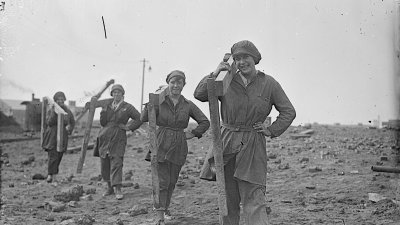
Explore the Women in Shipbuilding exhibition, which highlights the role that women played in shipbuilding and marine engineering in north east England during the First World War.
Women have worked in maritime trades for many centuries, but in the First World War their direct involvement in shipbuilding and repair increased significantly. Women participated in war work not only in assembly line roles making munitions, but also in skilled and heavy engineering.
Although these portraits are finely detailed, the names of the women are not known. We would like your help in identifying these women and finding out their stories.
As well as the women pictured, we would like to hear about other women in marine engineering in the north east in the First World War. If you have stories, documents, photographs, or other memorabilia then we would be very grateful if you could get in touch. Women’s role in shipbuilding and marine engineering in the past has been overlooked and we think it is important to rediscover their stories and acknowledge their contribution.
These women in shipbuilding were photographed in 1918 in several shipyards on the Tyne – in Wallsend, Hebburn, Howdon, and Elswick – and building a new shipyard at Haverton Hill on the Tees.
The women worked alongside thousands of men – and boys – in the shipyards. The heritage of shipyards, marine engineering and other maritime trades in the north east continues to enrich places and communities today and contributes to their future vitality.
The photographs were taken for the Ministry of Information, mostly by Horace Nicholls – a former freelance photographer – who had been appointed Official Photographer of Great Britain. At the end of the war, the photographs were transferred to the Imperial War Museum You can explore them online at IWM Collections.
The photographs were taken as a record of the contributions being made to the war effort across society, and some appeared in newspapers at the time. Nicholls photographed women and men involved in all sorts of war work on the home front. He was an experienced photographer before the war, providing images for illustrated magazines. As well as documenting these women’s work, the photographs are carefully framed and semi-posed to create eye-catching and absorbing images.
In most cases the women are directly engaged in their tasks so the photographs show the detail of their work. The images also illustrate their distinctive workwear – uniform bonnets, dresses, smocks, and trousers– which stand out from the men in their work suits. Several women are wearing jewellery such as rings and beads, and some have ‘On War Service’ badges to show they were engaged in urgent war work.
At the end of the war, women were obliged to leave shipbuilding to make way for men returning from military service.
‘Great hopes were entertained by many women that a new profession was open to them, where they could earn good wages and where they would have some scope for their skill and intelligence’. ‘But with the signing of the Armistice all such pleasant hopes were destroyed …’
Katharine, Lady Parsons, co-founder of the Women’s Engineering Society, North-East Coast Institution of Engineers and Shipbuilders, 9th July 1919
Women who had campaigned for women to have careers in shipbuilding and other forms of engineering set up the Women’s Engineering Society (WES) in 1919 to promote engineering as a rewarding job for women. WES recently celebrated its centenary and continues to support women in engineering to fulfil their potential, and to support the engineering industry to be inclusive.
Women in shipbuilding in the First World War are one of the foundations for women in maritime careers today.
Aerial photographs from the 1920s and 1930s show the shipyards and their surrounding communities alongside coal staithes and other quays and docks. You can look at these photographs and many others using Historic England’s Aerial Photo Explorer.
The shipyards built and repaired warships and merchant vessels. There was a desperate need for shipping to counter the U-boat war. Merchant ships were being targeted by U-boats including on the essential east coast coal trade to which mines and staithes in the region were contributing so much. Warships on escort and patrol duties against U-boats were also being sunk in large numbers. Seafarers from the north east in the Mercantile Marine and the Royal Navy were on the front line as soon as they left harbour.
Women working in shipyards had a vital role in defeating the U-boat blockade by replacing losses and expanding the fleet of warships and merchant vessels. Many of these vessels had long and successful careers before being broken up and recycled. Although they left no physical trace, Lloyds Register Foundation has a rich historical record of these vessels in drawings and documents that can be explored in its online collection of Ship Plans and Survey Reports.
Very few ships from this period were preserved. Most of the ships that survive are, paradoxically, those that were sunk. The war at sea was global, so ships built in the north east can be found all around the world. Historic England helps to protect historic wreck sites around our coast by highlighting their significance, sharing their stories and applying legal controls. Historic wrecks are an important part of the industrial heritage of these women shipbuilders and the north east.
Uncovering overlooked stories to build a more inclusive narrative that fosters trust and fairness across global maritime history.
The career of Caro Warwick-Evans, as part of the wider SHE_SEES component of the Rewriting Women into Maritime History exhibition.
The career of Else Dannatt MBE as part of the Rewriting Women into Maritime History initiative.

