


Behind the scenes: Ship Models at Sweden’s Maritime Museum
Explore the behind the scenes process of filming the Argentina, a 'votive', the Aeolus and the East Indiaman ship models at the National Maritime Museum, Sweden.
This page is approximately a 15 minute read
Part 3 in the Women's Royal Navy Service series
Dr Jo Horton, Historian, maker, and heritage consultant
Dr Jo Horton FRSA FTLS is a historian, maker, and heritage consultant whose research focuses on textiles, fashion, and uniform. A Caird Fellow she has a special interest in the tailoring, embroidery, regalia, and ubiquitous tiddly suit of the wartime Women’s Royal Naval Service. Based at Royal Museums Greenwich-National Maritime Museum and Prince Philip Maritime Collections Centre she pursued her passion for material culture and interviewed several Wrens who served in World War 2 and post war. Jo presented this work by invitation at the Barbara Pym Annual Conference 2024 at St Hilda’s College, Oxford.
Jo recently interrogated the practical lived experiences of uniform and bricolage of clothing and fabrics that built the nursing professions uniform, co-curating the exhibition ‘In Uniform’: https://www.fitzroviachapel.org/series/in-uniform-stories-of-nurses-and-their-clothing/.
The actor Mark Rylance described hats as expressing ‘the spirit of a person.(and) the true business of a person in this life’ and that wearing a hat that belonged to one’s family evoked ‘something of those ancestors’ 1. Nearly all of the headwear featured in this article originates from the early to mid 20th Century, when not only social status, respectability and fashionable style but military service, status, and role was discerned by wearing hats. Iterations of the hat styles and patterns from the period are still being worn today in the Royal Navy, evoking a sense of history and pride in tradition for those that wear them.
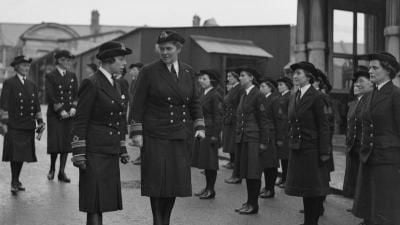
Many thousands of women joined the Women’s Royal Naval Service (WRNS) during the world wars, from when it was formed in 1917 through to 1919 and again from 1939 when it was reformed. The many photographs, recruitment posters, illustrations and popular representations that exist from these years are striking. From an Officer standing proud and supremely efficient in her tricorne hat ready to be saluted by the Director of the WRNS Mrs Vera Laughton Mathews (shown illustrated in Figure 1), or a Wren pictured adjacent to Admiral Horatio Lord Nelson, on the cover of Woman magazine June 1942 (Figure 2), to a First World War Ratings in her cap and ensemble outfit; patriotic, a siren calling women to service while evoking the emotions that war time brings (Figure 3). They and their uniform have become a symbol of the triumph of wartime naval service for women and for democracy over fascism.
During both world wars WRNS were established to ensure that crucial roles and responsibilities were met to enable men to be redeployed. By the end of the Second World War, women found themselves serving at sea, often in dangerous waters. They were carrying out over 90 specialist categories of work that could be static, port based, land locked, on the road, or in the air2. Having re-established their position as an integral part of the military, Captain Pilkington, Civil Lord of the Admiralty remarked on the mettle of the Second World War Wrens he had encountered, “I have no doubt that if you gave the W.R.N.S. half a chance they would be perfectly prepared to sail a battleship”3. Pilkington’s assessment of this expertise, capability and stamina, of no surprise to those who knew a Wren, finally came to fruition in 1993 when the WRNS was finally integrated into the Royal Navy paving the way for women serving in combatant roles at sea4.
This increasingly mobile wartime force of women undertook vital challenging work to ensure that Royal Naval forces were informed, transported, fed and defended in all terrains, weathers and locations, often working very long hours in difficult circumstances. The character of this work was impactful in many ways, it could be physical, practical and operational; driving, piloting and maintaining ships, boats and weapons. Or, by contrast, cerebral and instinctive when expertly recording, reporting, interrogating and helping to identify the realities behind Nazi Germany’s manoeuvres and misinformation activities.
It is no surprise to note that women nursed in the Queen Alexandra’s Royal Naval Nursing Service. A few women are also recorded as being Medical Officers serving in the Medical Branch of the Royal Navy and the Admiralty Medical Department5. The often-astonishing designs of nurses’ caps demand special interest and they deserve further attention beyond this article. The appearance and construction are fascinating but are even more so because, poignantly, the combined wartime nursing services suffered the greatest loss of female life, providing much needed care in active waters and by battlefields, while wearing their iconic and instantly recognisable caps.
The distinctive attractive kit of the Wrens was first given approval by King George V on the 26 November 1917. Later the revived style of uniform hats was approved by Queen Elizabeth the Queen Mother, with King George VI approving designs of the skirts and overcoats. The latter soon became a listed item on standard issue uniform kit in recognition of the nature of the work being undertaken and the British weather6.
In researching this article, I was struck by how much the regulation hats, caps, helmets and headscarves worn by Wrens shaped their daily working lives, and their personal and public identity when carrying out naval work on the shores and sea-lanes of Great Britain, areas of free Europe, the Middle East and the Far East. Exchanges and personal accounts, oral histories and memoirs provide evocative insights central to the events and activities that meant regulation headwear was essential and give tangible links to the objects I have examined.
The First World War Wrens were provided with a stitched cap with a brim made in navy cloth (sometimes dubbed unflatteringly as the pudding basin), with a cap tally7 initialised with WRNS. There was a white cap cover for the summer as part of their best uniform. Officers were given grants to purchase a black wool velour, fur felt8 or felt blend tricorne hat with a Royal Navy officers cap badge, distinguished by the laurels embroidered in azure blue rather than scarce gold thread. Aside from supply issues the use of gold was seen by the Admiralty to be a waste on women and the prerogative of men9.
A label on one of two Petty Officer tricorne hats in the Prince Philip Maritime Collections Centre, Royal Museums Greenwich identify it as sold by Woodrow Hatters (London), agents for the manufacturer, with the pattern dating from 1917. This hat, illustrated in Figure 4, evoking history and tradition with early modern capability, was made of dark navy fine felt, with a medium brim edged with Petersham, wool braid hat band and cap badge, unlined and with a deep inner band. I was delighted to see it was in immaculate condition, and clearly treated with reverence by its original owner, when I was lucky enough to examine it in the archive store. The other is unlabelled, but I found it equally as interesting as it only keeps its three-cornered folded form because a bootlace has been threaded between the round domed crown and the brim, another example of Wren ingenuity.

| 
|
Other hats worn by First World War Wrens included a peaked or deep brimmed cap for motor drivers and other transport Wrens (shown in Figure 5), dark cloth headscarves for storekeepers and white headscarves or traditional white chef’s hats for bakers and cooks. The somewhat baker-boy style motoring cap was made with a soft crown with extended stiffened brim, not the most protective of objects when traffic fatalities were possible, especially when restricted street lighting, during blackout, was in place10.
During the Second World War each probationary Wren was provided with a general issue free standard uniform kit which included a Ratings hat or cap, significantly only loaned on successful completion of her training in naval routine, terminology , personal defence, fitness and drill. Before August 1942, Ratings below Petty Officer were issued with a soft brimmed soft crowned gabardine hat with the wartime initials H.M.S embroidered on the hat band, described with abhorrence as a ‘chummie’ and ‘as a cross between a sou-wester and a child’s sun hat’11 and a ’wilting, gabardine monstrosity’12.
Inspired by male Rating’s caps, the more popular post-1942 style sloping cap (illustrated in Figure 6) was constructed using very dark blue serge and comprised a black mohair band, leather chin strap, soft unstiffened crown (often quilted inside), leather interior sweatband, with standard ribbon tally or, less confidentially, with ships or establishment names instead. Ratings in Royal Marines establishments wore a Royal Marines cap badge and red flash13.
In accordance with naval tradition, tricorne hats were bought by Officers out of their pay and allowances, with a grant of £55 (worth around £3,500 today) towards the cost of their overall uniform kit and Second World War service dress, unless this was tropical when an additional £10 was made to help in the purchase of white felt hats14. The standard tricorne hat patterns were marginally different to the First World War hats, less matronly and heavy by all accounts, but maintained the Royal Navy cap badge and had useful leather or artificial silk sweatband incorporated.
Former wartime Wren, Christian Lamb, being ‘hat minded’ from a very early age15was terribly disappointed to find that she had to wait until she was promoted beyond ‘the lowest rung of the ladder’ to wear the most desirable of naval hats, the tricorne, with its history rooted in practicality. Indeed, the three cornered, folded brim style was designed for visibility and mobility. The original crescent shaped two cornered bicorne cocked hats, with centre crease to enable folding flat, dated from around the early 17th century. These and the tricorne were artfully crafted from compacted, beaten and washed beaver and rabbit fur (fur felt) then wool felt, due to felt’s durability and, in theory, its water resistance.
While Wrens were engaged in an impressive range of duties, the crucial raw materials for the clothing they wore, including cotton and cotton drill, wool and worsted cloth, and cork, leather and wood pulp for other objects, were planned for well by the government, learning from First World War production crisis points16. However, silk, mohair and fur felt were more of an issue. Even with the best planning, changeover of civilian garment factory space to military uniform production, and pre-war accumulation of raw materials, there were shortages (for example cross bred wool for greatcoats). Factories making Wren uniforms were regularly bombed, interrupting supply of kit to uniform distribution centres and loan clothing stores17.
Atherstone, in Warwickshire, was one of the major British centres for hat and helmet manufacture. By 1900, it had seven active hat factories alone thus occupying a similar reputation to Stockport as a hatting town, where the Woodrow Hatters (J Woodrow & Sons) manufactory was based. One of the Atherstone hat factories was Vero & Everitt Ltd who manufactured a substantial number of military items during the world wars and their immediate aftermaths.
The process involved in making a tricorne hat was fascinating, laborious and not high tech, still reliant on the equivalent of a low tech large steam kettle which did not impair the phenomenal output of factories. The felt hood (former) that would eventually became a hat would have been prepared by blending (bowing) the wool or fur, carding, forming, hardening, settling, bumping, bleaching/dyeing, planking, stiffening, then blocking on a wooden block, trimming and finishing – polishing and dusting. The resultant hood would then be sold to a hat manufacturer or made in house to a specific design, and then sorted, stored and transported to a central distribution centre, agent, department stores like Simpsons of Piccadilly, or outfitters, port tailors, travelling tailors like Hector Powe, and Savile Row.
Hats were not only worn for best or general duties but as components of working uniforms and specialised branch activities. The arrival of active duties meant that not only were flat topped circular sailor’s caps (with band and tally, tied in a bow over the left ear), worn but black berets too.
Dark blue headscarves, staples of the everyday woman’s wardrobe of the Second World War, were fashioned turban style to keep hair clean (and if not clean to begin with then heavily disguised) and safely away from machinery and when loading weapons and, in the dirtiest work, like painting and boat cleaning. These were sometimes substituted or re-purposed into navy blue kerchiefs (known as sweat rags) around the neck, worn with the boiler suits that were, as Vonla McBride recounted, in the case of the least known branch of the WRNS the Fleet Air Arm (FAA) Wren Air Mechanics, highly necessary to counter the oil and dirt that they encountered ‘as they crawled over the aircraft’18.
It became apparent when women took over completely from male naval dispatch riders in 1940, denoted as Wren Dispatch Riders (Motor Transport Branch), that these Wrens were at particular risk19. When a Wren carried vital letters and memos on a heavy 500cc motorbike, this was physically demanding with its long hours and tight deadlines. Indeed, this was the case for actor Honor Blackman who, aged 15, rode a British made Triumph when delivering messages from the Home Office, London to a naval base in Grimsby, during the Second World War. Below in Figure 8 is a Wren dispatch rider in her wet weather kit.
The heads of Wrens, like those in other services, were initially protected by a peaked cap plus a crash helmet made of toughened wood pulp and rubber or an adapted brimmed steel helmet that was notorious for neck injuries. This was thankfully swiftly followed post-July 1943 by a far superior steel crash helmet, likely based on a parachutist’s helmet, with patterns having wool padding inside, adjustable liner, sweatband and leather side curtain, chin strap and ear flap assembly for comfort20.
As recounted by L.C. Bagley in the Women of Glory girl’s storybook21 (the true account of Wren Pamela McGeorge getting her dispatches through a devastated Plymouth against the odds is an example of the critical need for specialist headwear. Like others she was contending with bomb damage, the Blitz and bombs landing, other traffic, no lights, poor roads and a plethora of other hazards including riding across isolated challenging terrain (illustrated in Figure 9). Wren McGeorge was awarded the British Empire Medal 1941 for her bravery and dedication to duty.
War time Wrens ensured that they met authoritative vocal and written naval decrees on the need to maintain a military level appearance, even when working in the depths of the engine of a motor torpedo boat. In this they were aided by advisory pamphlets and Second World War booklets like Life in the WRNS. In terms of headwear this was sometimes achieved by wearing their hair short to aid hat and cap wearing, or putting up hair to no longer than collar length with tools like rolls and use of braided styles, although from amusing accounts of wearing curlers under tin helmets this seems to have been more hindrance than help.
Changing circumstances in the theatre of war post-1941 meant that the tropical uniform issued to the first group of Wrens to serve overseas (other an exceptional few who served in the First World War), had to suit the hot and humid climate of locations like Singapore and Egypt. Dorothea Collett Wadge details tropical kit as: Officers wearing white felt hats with gilt metal hat badge; Ratings wearing tropical hats with white hat covers, in sailors cap patterns. She expands on Wrens Air Stations kit where, due to the location of some bases in the Middle East, khaki tropical kit was supplied instead of white. This again brought into view the importance of the design, manufacture and provision of cloth, materials and headwear that was fit for purpose.
In both world wars Wrens travelled across Britain and beyond its shores to work in their neat uniforms, workwear and variety of headwear. These objects were worn, cleaned, mended, replaced (but only when completely worn out) and in the case of loan items returned, sometimes offered for sale or kept as symbols of a vivid time and way of life. Military style hat designs fed into civilian fashion and everyday clothing, as patriotic tributes to those serving by those heroically supporting at home.
It is striking that hats, helmets and headwear continued to be a significant component in post war WRNS uniforms and later in the Royal Navy. Today the headwear has updated practicality, function and protection to suit modern-day needs while acknowledging the phenomenal legacy and significance of unique hat patterns in the contemporary formal No.1 (best uniform) women’s kit. As Jo Stanley outlines, when so evocatively detailing the progress of women in the Royal Navy, current uniforms also are in step with 21st century technology and service. The women of the Royal Navy are for example piloting helicopters wearing the highest specification crash helmets or sporting a regulation workwear cap when involved in a refuelling at sea operation. And women are finally wearing gold braid – though this can be seen as both a gain and a loss, with so much history attached to the colour blue22.
Books:
Adie, K. (2013). Fighting on The Home Front: The Legacy of Women in World War One. London: Hodder & Stoughton.
Adlington, L. (2019). Women’s Lives and Clothes in WW2: Ready for Action. Yorkshire: Pen & Sword Books Ltd.
Bagley, L.C. (1960). The Girl Who Wouldn’t Give Up. In C. Makins (ed.) Women of Glory. London: Longacre Press, pp. 105-109.
Beesley, I, and Vero, J. (1989). Warwickshire Hatters. Halifax: Ryburn Publishing.
Brayley, M. (2002). World War II Allied Nursing Services. London: Osprey Publishing.
Brayley, M, and Ingram, R. (2021). World War II British Women’s Uniforms in Colour Photographs. Marlborough: Crowood Press Ltd.
Collett Wadge, D. (2003). Women in Uniform. London: Imperial War Museum Department of Printed Books.
Edwards, N. (2015). Dressed For War: Uniform, Civilian Clothing and Trappings, 1914 to 1918. London: I.B. Tauris & Co. Ltd.
Ewing, E. (1975). Women in Uniform through the Centuries. London: B.T. Batsford Ltd.
Gregson, P. (1993). Ten Degrees Below Seaweed. Ludlow: Merlin Books Ltd.
Hardy, C. and Linton, D. (2021). Women in Wartime Britain 1939-45. Manchester: iNostalgia.
Hopkins, A, and Hopkins, V. (2020). Headwear: Hats, Bonnets and Caps from the Hopkins Collection c.1700-1955. London: The School of Historical Dress.
Lamb, C. (2007). I Only Joined for the Hat: Redoubtable Wrens at War…their Trials, Tribulations and Triumphs. London: Bene Factum Publishing Ltd.
McBride, V. (1966). Never at Sea Life in the WRNS. Berkshire: Educational Explorers Ltd.
Minns, R. (1980). Bombers & Mash: The Domestic Front 1939-45. London: Virago Press Ltd.
Raynes, R. (1971). Maid Matelot. Lymington: Nautical Publishing Company.
Roberts, H. (2020). The WRNS in Wartime: The Women’s Royal Naval Service 1917-1945. London: Bloomsbury Academic.
Sheridan, D. (2000). Wartime Women: A Mass Observation Anthology 1937-1945. London: Phoenix.
Stanley, J. (2018). A History of the Royal Navy Women and the Royal Navy. London: I.B. Tauris & Co. Ltd.
Storey, N.R. (2017). WRNS: The Women’s Royal Naval Service. Oxford: Shire Publications.
Summers, J. (2016). Style in the Second World War: Fashion on the Ration. London: Profile Books.
Thomas, L. and Howard Bailey, C. (2002). WRNS in Camera: The Women’s Royal Naval Service in the Second World War. Stroud: Sutton Publishing Ltd.
Various. (2012). 70 Years of Trust: An Illustrated History of the Women’s Royal Naval Service Benevolent Trust 1942-2012. Portsmouth: WRNS BT
Wood, M. (1989). We Wore What We’d Got: Women’s Clothes in World War II. Warwickshire Books.
Objects:
The Prince Philip Maritime Collections Centre, Royal Museums Greenwich.
Object file: DAU/220 Caird Library, National Maritime Museum.
WRNS Scrapbooks - large, loose-leaf scrapbook of newspaper and magazine cuttings, 1940-1945, miscellaneous subjects re: the WRNS.
WRNS Scrapbooks - large, loose-leaf scrapbook of newspaper and magazine cuttings, 1940-1945, miscellaneous subjects re: the WRNS. Also some drawings and photographs of WRNS in uniform.
Web pages:
BBC News. (6 April 2020). Obituary: Honor Blackman.
https://www.bbc.co.uk/news/entertainment-arts-11162866
Gov.UK. (16 April 2015). The Women of the Second World War.
McAleer, B. (6 October 2021) The Flying Wrens: All Female Dispatch Riders of WWII.
Neville, J. (n.d.). Hatting in Atherstone. Our Warwickshire. https://www.ourwarwickshire.org.uk/content/article/images-of-hatting-in-atherstone
Pullen, R. (2021). Head PROTECTION. Key Military. https://www.keymilitary.com/article/head-protection#:~:text=Cairns%20began%20a%20detailed%20study,brim%20digging%20into%20the%20ground
Thurman, M. (n.d.) Wilson and Staffords Memories. Our Warwickshire. https://www.ourwarwickshire.org.uk/content/article/wilson-staffords-memories
Oral histories:
Imperial War Museums. https://www.iwm.org.uk/collections/search?query=oral+histories+wrens&pageSize=&media-records=records-with-media
Interview with Thelma Doreen Stollar. https://www.iwm.org.uk/collections/item/object/80029078
Interview with Valerie Style. https://www.iwm.org.uk/collections/item/object/80030377
Taylor, Louise (Oral history). https://www.iwm.org.uk/collections/item/object/80025692
Seeley, Margaret Kathleen Mitford (Oral history). https://www.iwm.org.uk/collections/item/object/80011480
Hopkins, A, and Hopkins, V. (2020). Headwear: Hats, Bonnets and Caps from the Hopkins Collection c.1700-1955. London: The School of Historical Dress. p. 3.
Storey, N.R. (2017). WRNS The Women’s Royal Naval Service. Oxford: Shire Publications.
Collett Wadge, D. (2003). Women in Uniform. London: Imperial War Museum Department of Printed Books, p.61.
Stanley, J. (2018). A History of the Royal Navy Women and the Royal Navy. London: I.B. Tauris & Co. Ltd.
Collett Wadge, D. (2003).
Storey, N.R. (2017). Adlington, L. (2019). Women’s Lives and Clothes in WW2 Ready for Action. Yorkshire: Pen & Sword Books Ltd.
The tally on a sailor's cap is a ribbon usually bearing the name of a ship or some other establishment to which they belong.
Fur felt is a smooth, durable, non-woven textile made from animal hairs.
Storey, N.R. (2017).
Sheridan, D. (2000). Wartime Women A Mass Observation Anthology 1937-1945. London: Phoenix.
Gregson, P. (1993). Ten Degrees Below Seaweed. Ludlow: Merlin Books Ltd. p.13.
Houston, quoted in Adlington, 2005, p.133.
Brayley, M, and Ingram, R. (2021). World War II British Women’s Uniforms in Colour Photographs. Marlborough: Crowood Press Ltd.
Collett Wadge, D. (2003).
Lamb, C. (2007). I Only Joined for the Hat Redoubtable Wrens at War…their trials, tribulations and triumphs. London: Bene Factum Publishing Ltd, p.3.
Summers, J. (2016). Style in the Second World War Fashion on the Ration. London: Profile Books.
Summers, 2016; Adlington 2019.
McBride, V. (1966). Never at Sea life in the WRNS. Berkshire: Educational Explorers Ltd, p.69.
Roberts, H. (2020). The WRNS in Wartime the Women’s Royal Naval Service 1917-1945. London: Bloomsbury Academic.
Brayley, M, and Ingram, R. (2021).
Bagley, L.C. (1960). ‘The Girl Who Wouldn’t Give Up’, in C. Makins (ed.) Women of Glory. London: Longacre Press, pp. 105-109.
Stanley, J. (2018). A History of the Royal Navy Women and the Royal Navy. London: I.B. Tauris & Co. Ltd.
Explore the behind the scenes process of filming the Argentina, a 'votive', the Aeolus and the East Indiaman ship models at the National Maritime Museum, Sweden.
Explore the behind the scenes filming of the Cold War Rail Ferry, Oasis of the Seas, Stena Drillmax and Olympic Loyalty ship models at the IMO's headquarters.
A behind the scenes look at the process of filming HMS Vanguard, HMS Prince, Campania and Océan at the Science Museum's National Collections Centre, Swindon.

