


Behind the scenes: Filming ship models at the Science Museum
A behind the scenes look at the process of filming HMS Vanguard, HMS Prince, Campania and Océan at the Science Museum's National Collections Centre, Swindon.
This page is approximately a 7 minute read
Anna Grybenyuk, Researcher
Anna Grybenyuk graduated from the University of St Andrews with a degree in Modern History and Russian in 2016, then again with an MLitt in Museum and Gallery Studies in 2020. Much of her knowledge of fishing and maritime activity comes from working at the Scottish Fisheries Museum, and from living so long by the coast. She currently works in Oxford, managing digital collections for the Pitt Rivers Museum and History of Science Museum. It is far from the sea, but she will take any opportunity to head back to the coast to spot birds and boats alike.
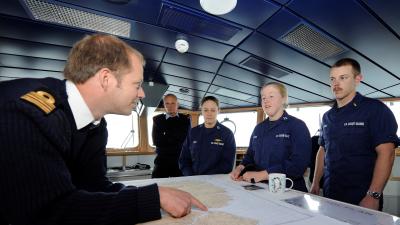
Given it is a job that involves travel across the planet, it should come as no surprise that seafarers come from all over the world. One estimate says that 80% of the world’s fleet over the last 20 years is manned by multicultural and multilingual crews, mainly from South Asia, South-East Asia, and Eastern Europe1.
On a practical level, a multicultural, multilingual crew comes with its own problems, such as miscommunication due to cultural or language barriers, which can impact crew cohesion and safety. It is therefore important to examine the issue of language barrier in seafaring and how it can impact seafarer safety and careers, as well as some solutions on how to overcome it.
While most sailors seem happy working in multinational crews, they do acknowledge that language barriers have caused problems such as strained relationships, frustration with not knowing words critical to their job, social exclusion when some crew revert to their own native language, and even accidents or near-misses2. It has been shown that communication issues contribute to 35% of accidents, with not just sailors but passengers affected, such as on the Scandinavian Star where crew’s inability to convey safety instructions during a fire led to over 100 fatalities3. A common language that all can understand is therefore a priority among multilingual crews.
One solution is a standardised use of English known as Standard Marine Communication Phrases, commonly called Maritime English. This consists of standard words and phrases that are implemented in routine situations, all designed to reduce the chances of miscommunication as much as possible. It was adopted by the IMO in November 2001 as Resolution A.9184. When spoken, any phrase is prefaced with a message marker used to state intention, such as “Question”, “Answer”, or “Warning” to reduce ambiguity, with answers being mirrors of the question. Other examples of this would be parts of the ship referred to with only technical terms such as bow or stern5. The amount of words is limited and numbers are spoken as individual digits6. Standardisation like this removes the ambiguity from words spoken by native speakers of English, who were found to be less direct and cautious in their wording, leaving room for misinterpretation7. Maritime English is a mandatory part of formal maritime education and is considered a minimum proficiency of English required to be hired aboard commercial vessels and cruise ships
Maritime English is widely used, and overall seems to be well-received among sailors. A study in 2023 by Iris Heslop in the Philippines showed it was acknowledged as helping with safety, although opinions on its impact varied, with officers rating it more highly than lower ranking crew8. The use of the internet has overall made it easier to study anything, including Maritime English, with courses available for varying fees. It is generally recommended that some basic English proficiency is gained before a teacher begins to expose students to Maritime English and its vocabulary9. English proficiency is often a requirement for a career in maritime, with those who speak it well potentially getting extra training opportunities and more prestigious contracts10. Seafarers therefore do learn it and use it, with no recorded patterns of abstention showing up in the research.
Despite the adoption of Maritime English, problems from language barriers continue to arise. Maritime English is very rigid, meaning sailors may not find it natural and thus not be keen to learn. Its enforcement from above may also cause issues. A top-down enforcement of the use of English among non-English speakers, even in waters of non-English speaking countries, can cause backlash and resentment, such as what happened when the Norwegian Coastal Administration angered masters and pilots by trying to mandate English in its coastal waters. Pilots argued that being able to use their mother tongue to a fellow Norwegian would improve safety as they could communicate better, stating that daily reality often makes it more practical11. At the end of the day, professionals in a situation need to have some room to use their judgement and experience. No rigid guidelines can ever prepare for all situations.
As it is a specific, professional language used only during work, Maritime English will not solve the issue of social isolation or lack of good relations among the crew, being rated lowest for helping form interpersonal relationships. Storytelling and discussing their mental health are important for a sailor’s social bonds with their crew mates12; they cannot do it with the very precise boundaries of Maritime English. It is a great tool for professionalism, but for forming bonds among crews, knowledge of a common language is required. Cultural differences too, cannot be understated, as they do play a factor in how different people understand certain words and concepts, a well as life experiences that can create or alienate one from relationships, such as holidays or faith13. However, overcoming and managing cultural differences aboard ships is a whole other topic entirely, deserving of its own article.
The issue of communication is not a simple one to solve, and no matter how good a methodology is applied, people will always have misunderstandings. Maritime English is a good solution, but it is a tool to be used, not a cure-all. English proficiency does help, and despite its flaws and misgivings about its colonial history or how crude English can be, many mariners do agree that it is the shared working language, and overall support its use14. General strategies used in non-marine business to eliminate miscommunication, such as slower, clearer speech, checking for understanding, and using simple words you know the listener understands, would also help15. Hand gestures with prior agreed upon meanings are also an idea16. The aim should, above all, be safety and the well-being of crews. With such a large issue like language barriers, a lot of approaches and some degree of flexibility around individuals is needed. Complex problems require complex, multi-faceted solutions.
Ahmmed, Raju. “The Approaches of Teaching and Learning Maritime English: Some Factors to Consider.” Bangladesh Maritime Journal, vol. 2, no. 1, 2018, pp. 105–120,https://doi.org/10.70279/bmj-v2-i1-1105.
Draper, Andrew. “Safe Language? English may be Mandated in Norwegian Waters.” Nautilus International, 14 Sept. 2021, www.nautilusint.org/en/news-insight/telegraph/safe-language-english-may-be-mandated-in-norwegian-waters/.
Editorial Team. “Language Differences Onboard: A Barrier to Ship Safety?” SAFETY4SEA, 13 May 2020, https://safety4sea.com/cm-language-differences-onboard-a-barrier-to-ship-safety/.
Henderson, Nikki. “Effective Communication on Board.” Outremer, 17 May 2024, https://catamaran-outremer.com/en/effective-communication-on-board/.
Heslop, Iris Q. “Seafarers’ Perception on Maritime English Utilization On Board.” International Journal of Science and Management Studies (IJSMS), 31 Aug. 2023, pp. 171–178, https://doi.org/10.51386/25815946/ijsms-v6i4p120.
“IMO Standard Marine Communication Phrases.” International Maritime Organization,www.imo.org/en/ourwork/safety/pages/standardmarinecommunicationphrases.aspx. Accessed 21 Mar. 2026.
“Importance of English Language for Seafarers. ” AVANT, 17 Nov. 2025, https://tcsavant.com/en/vazhlivist-angliyskoyi-movi-dlya-moryakiv/.
Inegol, Gani Mustafa, and Umut Yildirim. “Conflicts Due to Cultural Differences in Multicultural Ships.” Australian Journal of Maritime & Ocean Affairs, vol. 17, no. 1, Informa UK Limited, Jan. 2025, pp. 67–93, https://doi.org/10.1080/18366503.2024.2310188.
John, Peter, et al. “Speech Acts in Professional Maritime Discourse: A Pragmatic Risk Analysis of Bridge Team Communication Directives and Commissives in Full-Mission Simulation.” Journal of Pragmatics, vol. 140, Jan. 2019, pp. 12–21, https://doi.org/10.1016/j.pragma.2018.11.013.
Kaye, Sheldon. “Why Maritime English Testing is Paramount to Effective Communication & the Safety of Vessels.” VIRSEC, 8 Oct. 2024, https://virsec.org/news/why-maritime-english-testing/.
Maheshwar, Chilukuri. “Overcoming Language Barriers.” SAFETY4SEA, 8 Feb. 2022, https://safety4sea.com/overcoming-language-barriers/.
Manaadiar, Hariesh. “Do You Speak Maritime English..??” Shipping and Freight Resource, 13 Mar. 2021, www.shippingandfreightresource.com/do-you-speak-maritime-english/.
Pauksztat, Birgit. “Informal Relations and Communication about Work-Related Problems in Two Multilingual Crews.” Marine Policy, vol. 130, Aug. 2021, p. 103767, https://doi.org/10.1016/j.marpol.2019.103767.
Riyanto, Budi, et al. “Indonesian Seafarers’ Intercultural Communication Challenges with Multinational Crews.” Journal of Intercultural Communication, 8 Mar. 2023, pp. 76–81, https://doi.org/10.36923/jicc.v23i1.92 .
Sampson, Helen, and Minghua Zhao. “Multilingual Crews: Communication and the Operation of Ships.” World Englishes, vol. 22, no. 1, Wiley, Feb. 2003, pp. 31–43, https://doi.org/10.1111/1467-971x.00270.
Saunders, Thomas. “Maritime English: An Introductory Guide.” Marine Society, 25 Sept. 2020, www.marine-society.org/posts/maritime-english-a-introductory-guide.
Schriever, Ulf. Maritime Communication in an International and Intercultural Discourse. 2008, University of Tasmania, PhD dissertation, https://doi.org/10.25959/23245388.v1. Accessed 22 Mar. 2026.
Theotokas, Ioannis, and Maria Progoulaki. “Cultural Diversity, Manning Strategies and Management Practices in Greek Shipping.” Maritime Policy & Management, vol. 34, no. 4, Informa UK Limited, Aug. 2007, pp. 383–403, https://doi.org/10.1080/03088830701539198.
Tyron, Olena M. “Determinants of Successful Everyday Communication of Sailors in International Crews.” Journal of Educational and Social Research, 1 Sept. 2013, https://doi.org/10.5901/jesr.2013.v3n3p209.
“What is Seaspeak?” National Oceanic and Atmospheric Administration, US Department of Commerce, 20 Jan. 2016, https://oceanservice.noaa.gov/facts/seaspeak.html.
Theotokas, Ioannis, and Maria Progoulaki. “Cultural Diversity, Manning Strategies and Management Practices in Greek Shipping.” Maritime Policy & Management, vol. 34, no. 4, Informa UK Limited, Aug. 2007, pp. 383–403, https://doi.org/10.1080/03088830701539198.
Sampson, Helen, and Minghua Zhao. “Multilingual Crews: Communication and the Operation of Ships.” World Englishes, vol. 22, no. 1, Wiley, Feb. 2003, pp. 31–43, https://doi.org/10.1111/1467-971x.00270.
Editorial Team. “Language Differences Onboard: A Barrier to Ship Safety?” SAFETY4SEA, 13 May 2020, https://safety4sea.com/cm-language-differences-onboard-a-barrier-to-ship-safety/.
“IMO Standard Marine Communication Phrases.” International Maritime Organization, www.imo.org/en/ourwork/safety/pages/standardmarinecommunicationphrases.aspx. Accessed 21 Mar. 2026.
Manaadiar, Hariesh. “Do You Speak Maritime English..??” Shipping and Freight Resource, 13 Mar. 2021, www.shippingandfreightresource.com/do-you-speak-maritime-english/.
“What is Seaspeak?” National Oceanic and Atmospheric Administration, US Department of Commerce, 20 Jan. 2016, https://oceanservice.noaa.gov/facts/seaspeak.html.
John, Peter, et al. “Speech Acts in Professional Maritime Discourse: A Pragmatic Risk Analysis of Bridge Team Communication Directives and Commissives in Full-Mission Simulation.” Journal of Pragmatics, vol. 140, Jan. 2019, pp. 12–21, https://doi.org/10.1016/j.pragma.2018.11.013.
Heslop, Iris Q. “Seafarers’ Perception on Maritime English Utilization On Board.” International Journal of Science and Management Studies (IJSMS), 31 Aug. 2023, pp. 171–178, https://doi.org/10.51386/25815946/ijsms-v6i4p120.
Ahmmed, Raju. “The Approaches of Teaching and Learning Maritime English: Some Factors to Consider.” Bangladesh Maritime Journal, vol. 2, no. 1, 2018, pp. 105–120, https://doi.org/10.70279/bmj-v2-i1-1105.
“Importance of English Language for Seafarers..” AVANT, 17 Nov. 2025, https://tcsavant.com/en/vazhlivist-angliyskoyi-movi-dlya-moryakiv/.
Draper, Andrew. “Safe Language? English may be Mandated in Norwegian Waters.” Nautilus International, 14 Sept. 2021, www.nautilusint.org/en/news-insight/telegraph/safe-language-english-may-be-mandated-in-norwegian-waters/.
Tyron, Olena M. “Determinants of Successful Everyday Communication of Sailors in International Crews.” Journal of Educational and Social Research, 1 Sept. 2013, https://doi.org/10.5901/jesr.2013.v3n3p209.
Inegol, Gani Mustafa, and Umut Yildirim. “Conflicts Due to Cultural Differences in Multicultural Ships.” Australian Journal of Maritime & Ocean Affairs, vol. 17, no. 1, Informa UK Limited, Jan. 2025, pp. 67–93, https://doi.org/10.1080/18366503.2024.2310188.
Schriever, Ulf. Maritime Communication in an International and Intercultural Discourse. 2008, University of Tasmania, PhD dissertation, https://doi.org/10.25959/23245388.v1. Accessed 22 Mar. 2026.
Maheshwar, Chilukuri. “Overcoming Language Barriers.” SAFETY4SEA, 8 Feb. 2022, https://safety4sea.com/overcoming-language-barriers/.
Henderson, Nikki. “Effective Communication on Board.” Outremer, 17 May 2024, https://catamaran-outremer.com/en/effective-communication-on-board/.
A behind the scenes look at the process of filming HMS Vanguard, HMS Prince, Campania and Océan at the Science Museum's National Collections Centre, Swindon.
This is a miniature model of the GDR's rail ferries. They were constructed at the height of the Cold War to transport freight between Germany and Lithuania.
Explore the behind the scenes process of filming the Argentina, a 'votive', the Aeolus and the East Indiaman ship models at the National Maritime Museum, Sweden.


_Headquarters_-_2.jpg)