


Behind the scenes: Ship Models at Sweden’s Maritime Museum
Explore the behind the scenes process of filming the Argentina, a 'votive', the Aeolus and the East Indiaman ship models at the National Maritime Museum, Sweden.
This page is approximately a 8 minute read
A guest exhibition by the Lloyd's Register Foundation Thomas Chapman Scholars Peter Phillipson and Sam Wright, the University of Hull.
Peter Phillipson, PhD Student
Dr. Sam Wright, Maritime History & Heritage Consultant
The city of Hull is justifiably proud of its 800 year seafaring history. This story focuses on one lesser-known aspect of this, which has emerged during our PhD research as Lloyd’s Register Foundation Thomas Chapman scholars. The uncharted story of Hull’s connection with Lloyd’s Register goes back over 250 years and continues to this day. It is illustrated in the timeline which follows.
1760 saw the foundation of the Society for the Registry of Shipping at Lloyd’s Coffee House, Lombard Street, London.
The earliest surviving Register Book (1764-1766) included survey data for many Hull vessels. Staff details and office addresses are not provided in early Registers. However, Hull was at this time one of the UK’s largest ports and this, coupled with the large number of Register entries, suggests that the Society had a local presence.
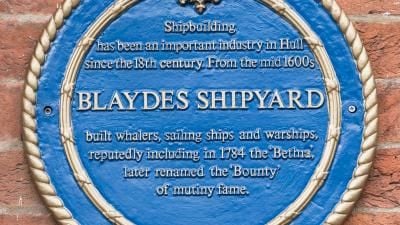
The Register Book for 1784-1787 included an A1 classification for Bethia, a collier built at Blaydes Shipyard on the River Hull and later renamed HMAV Bounty following purchase by the Admiralty. In 1789, disaffected crewmen seized control of the Bounty while on a voyage in the south Pacific, an infamous mutiny which would later inspire two films.
Our postgraduate research base, the Blaydes Maritime Centre, is housed in the former home of the Blaydes family, situated adjacent to the site of their Shipyard.
In 1807 John Marshall, a Hull ship-owner and insurance broker, relocates to London. Marshall subsequently becomes an emigration agent, facilitating assisted passages to Australia. Marshall plays a role in trying to resolve the 'red book vs green book' dispute at Lloyd's Register. This dispute was the intense disagreement between underwriters and ship-owners over classification rules and lead to the formation of a rival Society. He publishes a report in 1826 but his recommendations prove contentious and the dispute carried on, with competing Registers published annually, until a resolution in 1833.
A biography of Marshall by Elizabeth Rushen has just been published by Anchor Books Australia.
The Inquiry’s reform proposals are finally implemented. The Society for the Registry of Shipping is reconstituted as Lloyd’s Register of British and Foreign Shipping on 21 October 1834 and the publication of competing Registers comes to an end.
The first Register Book produced following the reconstitution lists 13 exclusive Lloyd’s Register surveyors for the entire UK, of whom two (James North and William A. Bingham) are responsible for Hull, Gainsborough, Goole, Selby Thorne and Grimsby. Hull’s significance is further emphasised by the inclusion of a member to represent the port on Lloyd’s Register’s newly-appointed General Committee.
Annual Registers show two Lloyd’s Register exclusive surveyors covering Hull and nearby ports.
Lloyd’s Register’s long involvement with Earle’s Shipbuilding, Hull’s largest shipyard, began in 1853 and continued until the company’s closure in 1931.
Ships were surveyed by Lloyd’s Register while under construction and in service, with many Earle’s vessels awarded the class of ✠100A1. These include Navarino (1873), built for the Wilson Line, and T.S.S. Sir Richard Grenville (1931), the last vessel to leave the yard.
In 1900, Earle’s was purchased by the Wilson Line, Hull’s most famous shipping enterprise and at one stage the largest private ship-owning company in the world, with whom Lloyd’s Register also has strong links.
Lloyd's Register invested in the Hull Dock Company to assist the development and improvement of Hull's port infrastructure. This investment came at a crucial moment when the Company is preparing to construct St. Andrew's Dock, which opens in 1883 and adds 10.5 acres to the water area of Hull's port facilities. Although originally intended for the handling of coal, St Andrew’s Dock subsequently becomes home to the port's famous fishing fleet.
Two exclusive surveyors, James McNeil and John Stevens, were based at the Hull office in Bank Chambers on the Land of Green Ginger.
One vessel classed by McNeil was the iron ship Adventure. Documents held in the Heritage Centre's collection include this report from 1886.
The Hull trawler Viola was built in 1906 in Beverley under Lloyd’s Register survey, forming part of the Hellyer fleet.
The Viola Trust is currently endeavouring to return the vessel from South Georgia to her home port. After restoration, it is intended that Viola, the oldest surviving steam trawler in the world with her engines intact, will be exhibited at the regenerated North End Shipyard alongside the Arctic Corsair, Hull’s last surviving sidewinder distant-water trawler, built in 1960 and now included on the National Register of Historic Vessels.
Hull office moved to Ocean Chambers, 54 Lowgate (now the offices of Burstalls Solicitors) in 1911 and listed a compliment of five surveyors, led by the Principal Surveyor, A. B. Wilson.
The Heritage Centre website we have 14 documents from Wilson whilst at the Hull survey office; including this 1904 letter to the Secretary for Lloyd's Register, London, regarding the lack of a double bottom ballast tank on City of York.
The number of Lloyd’s Register surveyors based in Hull increased to ten during the First World War (1914-1918).
You can view 156 documents from the Hull survey office during this turbulent period; including this 1917 plan for the vessel Steel Age.
At this time Hull was one of the world’s largest fishing ports, but the prosperity that the fishing industry provides comes at a great cost in terms of deaths and injuries.
In recognition of the particularly hazardous nature of trawl fishing, Lloyd’s Register published Rules and Regulations for the Classification of Steel Trawlers. Prior to this, critical items of trawler equipment had undergone special surveys but the vessels themselves had not been subject to a specific set of Rules. Widespread adoption of these new regulations resulted in many new trawlers being classed by Lloyd’s Register, both during construction and while in service, improving the quality of the fishing fleets of Hull and other trawling centres.
The Heritage Centre's records for Hull built trawlers stretch all the way back to the 1890 Achilles. It was constructed by Earle's Shipbuilding & Engineering Co Ltd.
The number of Lloyd’s Register surveyors based in Hull rised to thirteen during the course of the Second World War. Hull was subjected to numerous bombing raids and was among the most severely damaged UK cities. Despite being situated in a key target area, within the city centre and close to the docks, Ocean Chambers survived intact.
The Heritage Centre's digitised document collection holds 214 documents from the Hull office for this period; including this intricate 1942 plan for the vessel Saint Sunniva. The vessel was built in Aberdeen in 1931 but was lamentably recorded missing in 1943.
The annual Register Book indicates that Lloyd's Register moved its Hull base from Ocean Chambers to Festival House at 93 Jamieson Street in 1956, where a name plaque remains today, although these premises are no longer occupied by Lloyd's Register.
The following year in 1957, fishing still remained a key industry for the city of Hull but was still a very hazardous occupation.
In 1951, the Sea Fish Industry Act had established the White Fish Authority (WFA), whose function was to reorganize, develop and regulate all aspects of the white fish industry. The WFA’s remit included the improvement of working conditions and in 1957 it makes funding aid for trawler construction conditional upon Lloyd’s Register classification.
The Arctic Corsair, arguably Hull’s most famous distant-water trawler, was built in 1960 for the Boyd Line under Lloyd’s Register survey at the Cook, Welton & Gemmell shipyard in Beverley.
In many ways, the subsequent history of this vessel mirrored the decline of Hull’s fishing industry.
After setting a world record for landing of cod and haddock in the White Sea in 1973, the Arctic Corsair was holed below the waterline during a collision with an Icelandic patrol vessel in the Cod Wars of 1976. Following the Cod Wars, the Arctic Corsair was converted to midwater trawling in 1978, but was laid up for long periods.
Triple Trawler Tragedy - Between 11 January and 4 February 1968, three Hull trawlers go down in extreme conditions off the coast of Iceland. Although built and maintained under Lloyd’s Register survey with a ✠100A1 classification, the St. Romanus, Kingston Peridot and Ross Cleveland capsize due to a fatal combination of icing up and hurricane force winds. One crew-member from the Ross Cleveland was the only survivor as fifty eight local men lose their lives.
The Board of Trade establishes a Committee of Inquiry into Trawler Safety on 5 March 1968, to which Lloyd’s Register and industry bodies including the WFA were invited to submit evidence. The Committee’s Report, published in May 1969, made extensive recommendations on the construction of trawlers, safety and fishing equipment.
With support from Hull City Council, the port’s last surviving sidewinder distant-water trawler opens to the public in 1999 as a floating museum moored on the River Hull, following restoration by volunteers. Arctic Corsair is currently undergoing extensive refurbishment at Alexandra Dock. The vessel will then be moved to a new permanent dry dock in the redeveloped North End Shipyard, as part of the Hull: Yorkshire’s Maritime City Project.
Hull: Yorkshire's Maritime City is a five-year, £27.4 million programme and one of the North of England’s largest heritage projects. It will explore and celebrate the many facets of the port’s seafaring past.
Lloyd’s Register still maintains an active presence in Hull – their office is now located on the north bank of the Humber estuary at Waterside Business Park, Hessle.
The Thomas Chapman PhD scholarships, funded by the Lloyd’s Register Foundation and based at the Blaydes Maritime Centre at the University of Hull, now add to this historical relationship with the city. The Blaydes Maritime Centre is housed in the former home of the Blaydes family, situated adjacent to the site of their Shipyard.
Explore the behind the scenes process of filming the Argentina, a 'votive', the Aeolus and the East Indiaman ship models at the National Maritime Museum, Sweden.
Explore the behind the scenes filming of the Cold War Rail Ferry, Oasis of the Seas, Stena Drillmax and Olympic Loyalty ship models at the IMO's headquarters.
A behind the scenes look at the process of filming HMS Vanguard, HMS Prince, Campania and Océan at the Science Museum's National Collections Centre, Swindon.

