


Theme 1: Lloyd’s Register Collection - Safeguarding Old Knowledge, and Corporate Memory
Ensuring preservation and sustainability of historic records, while fostering trust and accessibility to make the collection available worldwide.
This page is approximately a 5 minute read
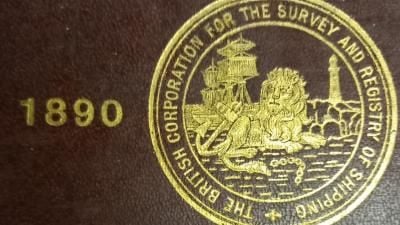
The British Corporation for the Survey and Registry of Shipping (BC) was a company founded in Glasgow in 1890 in association with ship builders and owners in direct competition with Lloyd’s Register. Legislation in 1890 officially registered BC, the French classification society, Bureau Veritas and Lloyd’s Register as load line authorities. BC’s aim was to provide alternative agency for marine classification and freeboard assignment and to improve, develop and patent new designs in ship construction. It would make significant contributions at various points to UK governmental and to international committees, e.g. the International Load Line Conference of 1930, and the 1939 International Congress of Classification Societies. The collection can be found under the reference “BCR1."
Producing their first set of rules and regulations for ship construction in 1892, BC then began an
nually publishing their Register of Ships, an alphabetical list of classed vessels. BC publications can be found within the series “BCR1/6.” BC’s governance was administered by a Committee of Management responsible for overall policy and activity, headed by a President (later honorary) and a Secretary. Minutes for the Committee of Management can be found under “BCR1/1/1.”
Technical rules for building and maintenance were formulated and continually amended by a Technical Sub-committee headed by a Chief Surveyor. Minutes for the Technical Committee can be found under “BCR1/1/2.” Surveyors posted at ports around the world produced survey reports documenting the condition of vessels as seen at the time of their inspection. Records relating to surveys can be found within “BCR1/4”, certificates under “BCR1/3” and various indices for classed vessels, reports, and builders’ yards can be found within the series “BCR1/5.” In 1912 a separate Committee at Liverpool was formed. Minutes for this committee can be found under “BCR1/1/5.”
Prior to the First World War, BC assisted in providing guidance to the Italian Registry (Registro Italiano Navale) regarding classification, with subsequent surveying based upon BC rules. Between 1910-1920, similar requests for guidance were later received from the United States of America (American Bureau of Shipping), and from Japan (Nippon Kaiji Kyokai). In each instance, these associates adopted BC’s standards of strength, and surveying procedures. By 1939, approximately half of the world’s merchant tonnage under construction was to the BC standard, either surveyed by BC directly or via one its three associate organisations.
From 1927-1937 BC entered the aircraft inspection, modifying its constitution and title to become British Corporation Register of Shipping and Aircraft. Later in 1932, following a recommendation from the Air Ministry, BC’s Aviation Committee merged with Lloyd’s Register’s Aviation Advisory Committee. In 1937, the responsibilities vested in this Joint Aviation Advisory Committee were transferred by the government to an autonomous body, the Air Registration Board. For the minutes of the Aviation Committee see “BCR1/1/6.”
As was the case in the First World War, at the outbreak of the Second World War, BC, alongside Lloyd’s Register, provided crucial assistance to the UK government and formally agreed to lend surveyors to both the Admiralty and the Ministry of War Transport. BC surveyors helped to oversee the inspection of newly constructed and damaged vessels, extending to the survey of small naval craft, up to and including minesweepers, corvettes and frigates. Survey reports and plans for naval built Castle Type trawlers during the First World War can be found under “BCR1/4/5.” With the development of the naval and merchant shipbuilding programme in Canada, BC also provided additional support.
Following prolonged talks between BC and Lloyd’s Register of Shipping, on 28th March 1949 an amalgamation was achieved between the two bodies under the revised title Lloyd’s Register of Shipping United with the British Corporation Register. The assets and finances of BC were finally concluded in 1951, and a new Scottish Committee was formed, though BC rules and practices remained until 1954 with the introduction of a revised set of rules. Within this settlement, all records of the business were transferred to Lloyd’s Register of Shipping. BC’s name finally ceased to appear in official documentation and publications in 1960. For details of the amalgamation between Lloyd’s Register and BC, records can be found under “LR/1/7/2.”
Cataloguing is underway for further records of BC survey reports and plans received through a transfer of ownership. Further information to follow.
The Lloyd’s Register of Shipping includes entries for vessels over 100 tons, regardless of class from 1874/75. From 1890, with the formation of the British Corporation Register of Shipping, all vessels classed with BC can also be found here. Additionally, surveyors of the British Corporation Register of Shipping that were then subsequently employed by Lloyd’s Register can be found with the Register of Ships’ List of Officers.
Survey reports, certificates and other correspondence for Lloyd’s Register classed vessels that joined the British Corporation Register of Shipping class, as well as those that were carried over to Lloyd’s Register class following the amalgamation.
Records of British Corporation Register of Shipping staff that were re-employed by Lloyd’s Register can be within LR/4 titled “Staff.” This includes lists of officers and staff ledgers, letterbooks and notebooks, personal papers, directories, office books and diaries, pensions and salaries, training, awards and scholarships, and social clubs.
Ensuring preservation and sustainability of historic records, while fostering trust and accessibility to make the collection available worldwide.
Learn more about the Dunedin, part of our First and Famous collection.
The Heritage Centre embarked on a three-year digitisation project to open access to its Ship Plan and Survey Report collection.

