


Theme 1: Lloyd’s Register Collection - Safeguarding Old Knowledge, and Corporate Memory
Ensuring preservation and sustainability of historic records, while fostering trust and accessibility to make the collection available worldwide.
This page is approximately a 5 minute read
This page was published on
Zach Schieferstein, Archivist
Zach has 5+ years’ experience across various Museums, Archives, and heritage institutes, with a passion for the preservation and care of heritage collections.
The Heritage Centre recently finished cataloguing a collection of deposited records relating to the Furness Shipbuilding Company (reference FSC). These were deposited with the HC by a researcher who had worked at the shipyard prior to it closing in the 1960’s, he gained permission from the shipyard owners to salvage the records when the yard closed and years later deposited them with LR alongside the research that went into a publication on the history of the company.
Following a project to appraise, list and catalogue the Lloyd’s Register Archives in 2022-2024, we also identified other collections deposited with us or acquired by us that remained uncatalogued. Like many archives, we have a backlog of uncatalogued material within our collections and the FSC records were part of this.
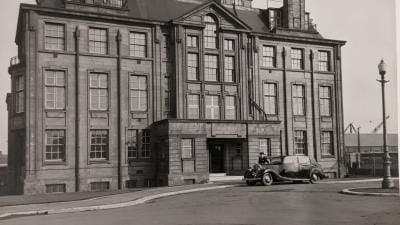
The yard was laid down in 1918, north of the River Tees. Viscount Furness pulled together shipbuilder, engineers and naval architects to design the shipyard and it was capable of building some of the largest ships of its time. As a result of fears of lack of a worker force, accommodation and spaces for work and recreation were built near the shipyard to attract workers from around the UK. The keel of the first vessel was laid in May 1918. At the end of the 1920’s they were tasked with building the whale factory ship Sir James Clark Ross, which went to the Antarctic every year of its service from 1930-1967. This ship was classed by Lloyd’s Register, and the surveying and construction records can be found here.
The shipyard underwent modernisation and redesign in the early 1960’s and was finished by 1965. However, the growth of overseas shipyards and shipbuilders and the slowing down of UK manufactured ships led to the FSC closing down in 1968. It was subsequently bought by Swan Hunter who continued to build vessels on the Haverton Hill yard until 1978 when all production was ceased. The last vessel to be built in the shipyard was the New Zealand Star.
Alongside building ships, FSC also provided steel and material for infrastructure and buildings throughout the UK including bridges, gas works, rail supplies and steel platforms for Rail stations.
The records include administrative papers covering minute books, seal books and register of directors. Financial papers, staff records, shipyard plans and building plans. There are multiple files of shipbuilding records containing specifications for designs, reports and contracts. Alongside these are publications and correspondence files and multiple photograph albums and loose photographs capturing ships built on the yard or the shipyard itself.
These aren’t the complete records for the company, sadly some were lost, and other related records survive in archives elsewhere, but they do provide a good example of it’s operations. Papers of the Furness family were deposited with the North Yorkshire record office in the 1990s and records for the Furness Withy shipowners are held at National Maritime Museum: The Caird Library and Archive.
The copies of photographs showing the construction of the yard are especially interesting as they depict women working in an environment where they have historically been largely left out of the narrative. There are no surviving staff records for these women in the records we hold, so they cannot be identified by name using the records we have. Copies of these photographs were used as part of the Lloyd's Register Foundation Heritage Centre, Rewriting Women into Maritime History project, and from part of a wider discourse refocusing the role women have played in the maritime sectors, past, present and future.
Uncovering female shipping expertise, experience and leadership to promote gender equity, diversity and inclusion. Founded in the UK, the project is now global.
Find out more on the programmeNot only is there a wider maritime heritage link between Lloyd’s Register and the Furness Shipbuilding Company records, but there is a direct link between the two organisations as Lloyd’s Register also classed (or surveyed) many of the ships built at the Haverton Hill shipyard. Including the steamship Politician (initially called the London Merchant), made famous by the Whiskey Galore films, and the whale factory ship the Antarctic mentioned earlier.
The records for FSC highlights the activity of a prominent 20th century shipbuilder and can show how the decline in the industries impacted the coastal communities and areas which were once dominated by the trade. The administrative records have a wealth of information on how a shipyard operated in this period, and also covers the vital role that merchant shipping (and wider industries) played during the second world war. The designs and specifications for ships compliment the Lloyd’s Register ship plan and survey report collection in recording the developments in shipbuilding from the age of sail, to steam, to iron and more modern shipbuilding technologies. The various photographs of the shipyard and ships, show a visual representation of the construction and activities of the shipyard and can help to facilitate family history research.
The records have been catalogued and the catalogue will be available to browse from our catalogue on the website link below. The Heritage Centre reading room is currently closed to visitors but the records will be available to view by request when we re-open in 2026.
Ensuring preservation and sustainability of historic records, while fostering trust and accessibility to make the collection available worldwide.
Learn more about the historic Thermopylae, part of our First and Famous collection.
Uncover the story of Newman Mumford’s 25-year surveying career across Asia and Europe in the late 19th century.

