


Theme 1: Lloyd’s Register Collection - Safeguarding Old Knowledge, and Corporate Memory
Ensuring preservation and sustainability of historic records, while fostering trust and accessibility to make the collection available worldwide.
This page is approximately a 3 minute read
This page was published on
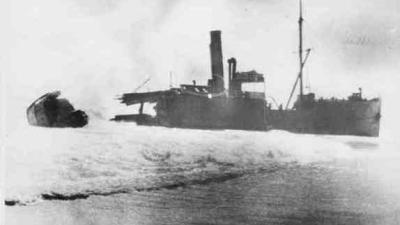
The SS Ferret, a steamer that was deceptively taken on a fake cruise and secretly repainted and renamed to avoid detection. The ship’s crew attempted to sell cargo under false pretences across multiple continents before being discovered and arrested in Australia. After its recovery, the Ferret continued operating until it ran aground in 1920, ending its dramatic journey.
Built in 1871 by J & G Thomson, Glasgow, Ferret was originally used as a ferry on the River Clyde and as she was not classed by Lloyd’s Register (LR) she did not appear in the Register of Ships until 1874-75, by which time LR was trying to include all ships over 100 tons, irrespective of class, in the Register. By that time she was owned by the Dingwall & Skye Railway Co and would subsequently become owned by the Highland Railway Co.
By 1880, the ship was undergoing work at the yard of Steel & Co., Greenock. During this time a number of gentlemen, led by James Henderson, approached her owner, Highland Railway, with a view to chartering the vessel for a Mediterranean cruise, stating that Henderson’s wife was unwell, and the cruise would benefit her. The documentation for the charter complete, the gang started to provision the vessel, which included wine to the value of £500, and also took on a new crew. After the ship had sailed it would become obvious that the money and funds used were worthless.
Ferret had sailed for Cardiff to take on coal and also Henderson’s wife. She then left, bound for the Straits of Gibraltar. Passing through the Straits, those on board ensured that they were both seen by the signal station and that their ‘All Well’ signal was acknowledged. Later, during the night the vessel, with lights extinguished, doubled back through the Straits, in order for it to appear that the vessel had been lost in the Mediterranean with all hands.
By now heading across the Atlantic for Santos, Brazil, via the Cape Verde islands, the crew of Ferret put the next part of their plan into action. The ship was repainted, while at sea, the wheelhouse and chartroom dismantled and rebuilt aft and other items that could identify her thrown overboard. Her new name was painted on her side and stern, Bentan, apparently chosen from the Register of Ships, for Bentan had been built by the same shipbuilder as Ferret in 1872 and was only slightly larger. The real Bentan was also registered in Singapore, the place the crew were told to say they were from, if asked.
Arriving in Santos on 26th December 1880, the vessel loaded coffee, ostensibly for Marseilles, but once at sea they once again used deception, changing the name of the vessel to India and sailing for Cape Town. The cargo of coffee was sold at Cape Town and the ship sailed for Port Phillip, Australia, via Mauritius, arriving at Port Phillip in April 1881. The port authorities were told that they had sailed from Bermuda.
It was at Port Phillip that the story would unravel. A wharf policeman at Queenscliff, James Davidson, had recently arrived from Scotland. He was reading a copy of The Statesman which contained an article from the Glasgow Evening Citizen about the mysterious disappearance of the Ferret. Davidson realised that the India looked remarkably similar to the Ferret and that her crew were acting strangely. Alerting his superiors, Customs officers seized the ship and discovered the name Ferret could be faintly seen under the name India. The perpetrators were arrested and tried and each received between 7 and 3.5 years in jail.
Meanwhile the true owners of the ship, Highland Railway, reverted her name back to Ferret and sold the ship to local Adelaide shipowner, William Whinham. Ferret would trade for many more years on the south Australian coast, carrying passengers and cargo. Her end came in 1920 when she ran aground on 14th November on a beach near Cape Spenser.
Ensuring preservation and sustainability of historic records, while fostering trust and accessibility to make the collection available worldwide.
The historic Missing Vessel Books, a resource documenting disappearing ships at sea, is now freely available online.
Totalling over 1.1 million documents, the ship plans and survey reports document the inspection, classification and maintenance of vessels undertaken by Lloyd’s Register surveyors.

