


Theme 1: Lloyd’s Register Collection - Safeguarding Old Knowledge, and Corporate Memory
Ensuring preservation and sustainability of historic records, while fostering trust and accessibility to make the collection available worldwide.
Rare maritime lantern slides & magic lantern history
This page is approximately a 7 minute read
This page was published on
Max Wilson, Senior Archivist
As the Senior Archivist at the Centre, Max plays a key role in overseeing the management, development, and accessibility of the archive and heritage collections. He is responsible for ensuring proper preservation and conservation of materials, as well as managing acquisitions, selection processes, and the arrangement of archival collections.
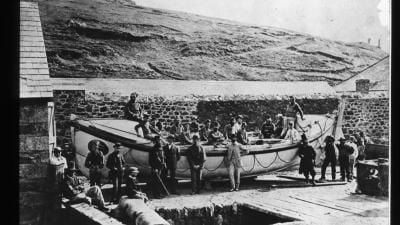
In November 2023, the attention of the Heritage Centre was caught by a BBC article highlighting a unique collection for sale at public auction; ‘hundreds’ of magic lantern slides. The collection itself, gathered and curated by shipbuilder and local historian Frank Strike, features shipwrecks, rescues and salvage operations all conducted along Cornwall’s coastline from 1890s to 1960s.
Offering potentially exceptional insight into maritime technology, safety equipment and ship/yacht building, the Foundation decided to bid and was, thankfully, successful in winning the lot for a total of £15,000. Collected from the auction house at Penzance by the Centre’s Senior Archivist (in the boot of his lemon-yellow Vauxhall Corsa) the Lloyd’s Register Foundation officially took possession in December 2023. Since then, a full catalogue of the Frank Strike Collection has been completed and the extent of this fascinating addition to our archives can be fully known and made freely available to the public.
The Frank Strike Collection is also notable as the first magic lantern slides to enter the Foundation’s archive. Dating from the first half of the 17 th century, magic lanterns, sometimes known as lanterna magica, were a pioneering form of portable image projection that reached the height of its popularity in the 19 th century, declining only with the rise of cinema. Later becoming a fixture of public education, they were originally conceived as a form of entertainment typically enjoyed by the well-to-do and middle classes. They are perhaps most famously associated with the sensational rise of phantasmagoria or horror theatre that would give semi-transparent life to apparitions, skeletons, and other demonic forces that delighted and terrified the general public. They consist of a light source, i.e. a candle or electric bulb, one or sometimes multiple lenses and most importantly, transparent (usually glass) picture slides.
In addition to the lantern slides, the purchased collection also included spare projection bulbs and, crucially, the magic lantern itself, produced by J H Steward of London. Not only have we been able to confirm that the magic lantern is in good working order, but to Frank Strike’s credit, it has also been fitted with a modern UK three-pin adapted plug!
Across five boxes, the newly catalogued collection totals 341 glass magic lantern slides. The majority are believed to have been purchased from the notable Gibson family of photographers, based at Penzance. The other main source appears to have been Alfred Herbert Hawke of Helston, who supplied only photographs, from which Frank Strike produced slides of his own. Though research and cross referencing online shows that the National Maritime Museum holds prints of 48 of the collection’s slides, the rest are believed to be wholly uncopied. Together, they comprise the following series catalogued to item level:
The bulk of the slides relate to 111 different ships in varying states of distress; those having been declared total losses, those that have run aground or stranded and those that have been taken in tow to port for repair. Covering what was a formative and pivotal period in British and world shipping, the vessels featured are staggering. They include large luxury liners such as the City of Paris (run aground in 1899 at Coverack), cargo steamers like the William Cory (wrecked at Pendeen in 1909), the steel masted Bay of Panama (wrecked off Nare Head in 1883) and the launch of lifeboats like the Daniel Draper (c.1900) and their crews. Lifesaving gear is also featured in the form of rope diagrams, rocket demonstrations, rowing equipment and other innovative apparatus employed for at-sea and coastal rescues. The slides also show the salvage of historic shipwrecks, of harbour, lifeboat scenes and local boatyards and their workers, firmly placing the emphasis on local people.
But who was Frank Strike? Born in 1895, Francis ‘Frank’ Edyvean Strike began his career as a shipwright, later becoming a builder and undertaker. In 1929 he would join the coastguard in his hometown of Porthleven where he would serve for more than forty years. In this capacity he held the Coastguard long service medal for 35 years as Number One in the life-saving team, where he was responsible for aiming and firing the small charge rockets that conveyed ropes to vessels in distress. It’s no small wonder that this rocket technology features heavily within the lantern slides of his collection.
During the Second World War he would also serve as Patrol Leader of the Porthleven Patrol and can be seen in some of the heroic rescue efforts found within his collection. He would also be heavily involved with the salvage of historic Cornish wrecks, such the 44-gun frigate HMS Anson, wrecked in 1807 at Bar Sands. Having always held a keen interest in local and maritime history, Frank Strike started his slide collection in 1947 over a twenty-year period. From that time, the slides were to be used extensively for his regular series of public lectures, and in his own published books on Cornish shipwrecks. Frank Strike passed away in 1967; the collection passing to his son, John Strike. John continued to care for the collection, conducting his own lectures and digitising the slides until the decision was finally made in 2023 to put them up for sale at public auction.
One of the most dramatic examples found in the collection is that of the Suevic, wrecked at The Lizard, on 17th March 1907. Inbound for Plymouth, the White Star Line steamer Suevic, measuring over 12,500 gross register tons, was carrying 382 passengers, 141 crew and a full cargo of sheep carcasses when she ran aground on Stag Rock, having miscalculated her position in rain and fog. Over a sixteen-hour rescue operation mounted by the Royal National Lifeboat Institute, all passengers and crew (incl. 70 babies) were safely rescued using just four open lifeboats. It remains to this day the largest rescue in the RNLI’s history. Shown across six slides, the wreck of the Suevic has been captured, including the construction of a new bow in Belfast and its transport to Southampton where it was reattached to the original stern. Within this context, the slides are thought-provoking evidence of the wreck and the landmark rescue, as well as the technology of shipbuilding at the beginning of the 20th century.
The Frank Strike Collection is also notable for the links it has with the Lloyd’s Register Foundation’s archives of ship surveying and classification. One such example is that of the 827 ton steamer Yewcroft. Built in 1929 at Bowling under special survey, Lloyd’s Register holds 27 records of her throughout her service career, e.g. survey reports, plans, correspondence and certificates, ending with her Report of Total Loss and Casualty, commonly referred to as a Wreck Report. It includes a detailed account of how she became stranded on 19th July 1956 in dense fog off Trevean Cove. Three slides within the collection document the rescue of her crew and of the wreck itself. Together with the annotations produced by Frank Strike we are offered fresh insight into wrecks, rescues and salvages like that of the Yewtree, beyond the limits of her final survey report.
Seen collectively, the slides offer tantalising glimpses of maritime communities reacting to technological changes that were impacting their lived relationship with the sea. They offer thought-provoking insight into the ever-present dangers of life at sea, as well as the legacy of sacrifice and service from ordinary working people, seaman and lifeboat crews. The next challenge for the team at the Heritage Centre is to promote awareness of and access to the Frank Strike Collection. Its uses extend to projects such as Project Tangeroa (Potentially Polluting Wrecks) as well as for wider academic research. In the original BBC article that sparked our purchase of the collection, John Strike is quoted as hoping that the slides would go to a ‘good home’ where they would be seen and enjoyed by as many people as possible. Now that they have been catalogued and can be publicly viewed in the Heritage Centre’s new reading rooms, it is our great pleasure to be able to fulfil Mr Strikes wishes, and to play a part in telling the story of this remarkable collection.
Ensuring preservation and sustainability of historic records, while fostering trust and accessibility to make the collection available worldwide.
The Heritage Centre has digitised the Lloyd's Register Technical Association papers (1920-1998), a freely available collection on maritime technical expertise.
Recalling the first voyage HMS Hecla undertook between 1819-1820. Part 1/3 in the HMS Hecla rediscovered series.

