


The GDR's rail ferries: Titan's of the Cold War
This is a miniature model of the GDR's rail ferries. They were constructed at the height of the Cold War to transport freight between Germany and Lithuania.
This page is approximately a 8 minute read
Anna Grybenyuk, Researcher
Anna Grybenyuk graduated from the University of St Andrews with a degree in Modern History and Russian in 2016, then again with an MLitt in Museum and Gallery Studies in 2020. Much of her knowledge of fishing and maritime activity comes from working at the Scottish Fisheries Museum, and from living so long by the coast. She currently works in Oxford, managing digital collections for the Pitt Rivers Museum and History of Science Museum. It is far from the sea, but she will take any opportunity to head back to the coast to spot birds and boats alike.
Most ships, big and small, start their journey in a port. All being well, the ship will end docked in a different port. In most people’s minds, the idea of a berthed ship evokes a sense of safety. We see this reflected in phrases such as ‘safe harbour’. While it is true that, most times, a port is safer than open water, the process of entering and leaving port is fraught with danger. To avoid this danger, a vessel crew must perform many checks, as well as follow a great deal of rules and regulations. On top of that, no two ports are the same. Each has its own quirks and challenges in topography, currents and weather that make the route in and out of that port unique. It is a complicated, fascinating dance that the average person hardly ever thinks about.
Typically, the master or captain of a ship that wishes to enter port must first inform the port of when they are coming, their last port of call and that they want to berth. They would check they comply with local laws and regulations and that all their safety certificates are valid. If entering a foreign country, as a courtesy, the host country’s flag is hoisted1. Equipment and systems needed for berthing would be checked; the engine, electronic instruments such as AIS or compass, communication equipment and any mechanical systems, like winches.2, 3.
In addition, information such as a passenger and crew roster, ship tonnage and any ship damage or health concerns aboard, would be provided. This would be done a few days ahead of arrival. Southampton port, for example, requests basic vessel details 96 hours (four days) beforehand, with more details about the ship’s manifest needed 24 hours before arrival4. This is where the request for a pilot, and tugs if required, would be submitted.
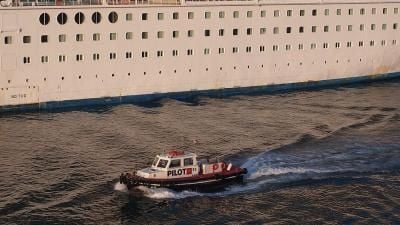
Any ship navigating to a port must have a pilot. The pilot is a person who is an expert on waters around a certain area5. They can guide the ship around any hazards, such as rocks, currents, or issues caused by local weather conditions. A pilot will always board a ship and advise the master or captain on where to go. They may also communicate and coordinate with port authorities, the coast guard or local tug boats6.
Tug boats in ports are small but powerful boats designed to help manoeuvre larger ships by either pushing on them or pulling them with a tow line. Among their duties is helping large ships navigate narrow channels or busy stretches, or help them into berth7. Depending on the ship, its condition and the destination, a tug may not be needed. This is up to the judgement of the ship’s master.
A harbourmaster at the target port would need to approve the entry request before a vessel could begin the arrival process. Without an official stamp and signature from them, the ship cannot enter, let alone berth8. This is therefore a vital step of the process, made easier with modern communications technology, as a request can be sent in advance.
Once all checks and papers are in order, the ship begins to enter. On approach, all crew would have assigned stations they would attend to. Among other duties, the ship’s master would take charge of manoeuvring, the engine crew would prepare the engine room and other mechanisms for arrival, while deck crew get ready to berth or keep lookout9. The master and pilot would work together to guide the ship, with the pilot providing information on the depth of the water, currents and how to best use the tug boats. This is a lengthy, laborious process, especially on a large ship which is slow to react and difficult to manoeuvre due to its size. When the ship approaches its designated spot, if it is too large, it does not berth immediately. Instead, tugs or thrusters would push it to berth, at which point deck crew would send out lines to pull it closer, then more lines to secure the ship10. At all times, the ship would be monitored through instruments or crew acting as lookouts. Only once the ship is secure is the process complete, and the craft is considered arrived. A gangway is lowered once the pilot and master give approval.
The reasons for entering port are many. Dropping off passengers or cargo are the most obvious ones, but it could also be to do repairs, or wait out bad weather. Sooner or later, however, a ship in good working order must leave port for further duties.
Departure shares some similarities with arrival, but there are, of course, major differences. First and most obvious, the port must be notified of the time and date the ship will leave. Then, the equipment checks must be conducted. As per SOLAS (International Convention for the Safety of Life at Sea) regulation, the steering gear must be tested within 12 hours before departure. This involves the main and auxiliary gear, as well as emergency power supply. Typically, it’s done visually and by fully moving the rudder11.
The engine too, having been idle, must be checked. Any fuel oil inside it must be warmed to about 40oC (104oF) so it is viscous enough to flow without damaging components. The levels of fuel oil and water must be inspected. Enough fuel must be calculated for departure. Crew should ensure pumps are operational. Checks should be done for any leaks. All this is done within 24 hours of departure. Just before leaving, the main air valve for the engine should be opened, so the engine is ready for use12.
On the bridge, instruments, such as radar and GPS among others, once again need checking. It is important to make sure all passengers and/or crew are present and accounted for at time of departure. If a flag was hoisted, it must now be stowed, and the destination country’s flag put up. Following on from the notification of departure, a harbourmaster or other port authority must approve it and give clearance to leave. This clearance is for a pre-determined time. In the case of a busy port like Hong Kong, the window to depart is only 10 minutes13.
Once the vessel is about to leave, the gangplank must be retracted, and any mooring lines cast off and stowed on the ship or at the berth. Anchors must be stowed, hatches closed, and anything that could come loose secured14. The ship will pull away from its berth, either with or without assistance from a tug. As with arrival, the master and pilot will guide the manoeuvre of the vessel out of port, with the pilot departing at a time and place that needs to be pre-arranged15. With the pilot and any assisting tugs having left, the ship is now underway. One final notification to port authorities that it has left, and then it’s on to the next destination, where the cycle repeats.
This is by far not an extensive list of what needs to be done during these processes, but it hopefully conveys just how complex the procedures of something as routine as arrival and departure are for a ship. Every port and vessel will have its own unique challenges and tasks that need to be done to come in to port and then exit safely.
American Bureau of Shipping. “Pre-port Arrival Quick Reference and Downloadable Check List.” https://ww2.eagle.org/content/dam/eagle/rules-and-resources/Flag-and-Port-State-Information/pre-port-arrival-quick-reference-and-downloadable-check-list-18270-a4-format.pdf, Accessed 22 September 2024.
Associated British Ports. “Vessel Booking Process.” www.southamptonvts.co.uk/Vessel_Traffic_Services/Vessel_Booking_Process/. Accessed 22 September 2024.
Ayers, Hank. “ATL 07.2.2 Pre-Arrival Departure Checklist.” Edited by Timothy Twomey, Woods Hole Oceanographic Institute, 9 July 2018, www.whoi.edu/marine/PDF/ATL 07.2.2 Pre-Arrival Departure Checklist.pdf.
Bhattacharjee, Shilavadra. “Understanding nautical flag etiquettes.” Marine Insight, 2 June 2019, www.marineinsight.com/guidelines/nautical-flag-etiquettes/. Accessed 22 September 2024
Chopra, Karan. “A detailed explanation of how a ship is manoeuvered to a port.” Marine Insight, 4 March 2021, www.marineinsight.com/guidelines/a-detailed-explanation-of-how-a-ship-is-manoeuvered-to-a-port/. Accessed 22 September 2024.
Editorial Team, “Bridge procedures: Preparations for arrival at port.” SAFETY4SEA, 12 April 2018, https://safety4sea.com/bridge-procedures-preparations-arrival-port/.
International Maritime Organization. “Regulation 26 - Steering Gear: Testing and Drills.” www.imorules.com/GUID-D53FC09F-63E6-4632-AB96-87D116DAE9E6.html. Accessed 22 September 2024.
International Maritime Pilots’ Association. “Maritime pilots.” www.impahq.org/maritime-pilots. Accessed 22 September 2024.
Kantharia, Raunek. “General procedure of preparing ships for entering ports.” Marine Insight, 2 May 2021, www.marineinsight.com/guidelines/general-procedure-of-preparing-ships-for-entering-ports/. Accessed 22 September 2024.
Kaushik, Mohit. “Ship departure checklist for engine department: What to do when a ship leaves a port?” Marine Insight, 2 September 2019, www.marineinsight.com/guidelines/ship-departure-checklist-for-engine-department-what-to-do-when-a-ship-leaves-a-port/. Accessed 22 September 2024.
Marine Department of Hong Kong. “Port operation procedures.” 27 February 2024, www.mardep.gov.hk/en/public-services/port-services/proc/index.html. Accessed 22 September 2024.
Marine Insight. “Checklist - before Arrival - Bridge.” www.marineinsight.com/wp-content/uploads/2011/06/Bridge-Checklist-Before-Arrival.pdf. Accessed 22 September 2024.
Marine Insight. “Checklist - before Departure.” www.marineinsight.com/wp-content/uploads/2011/06/Bridge-Checklist-Before-Departure.pdf. Accessed 22 September 2024.
Marine Teacher. “Pre-departure checklist for vessel.” 1 June 2020, www.marineteacher.com/post/pre-departure-procedure
Post, Allan. “I’ve captained ships into tight ports like Baltimore, and this is how captains like me work with harbor pilots to avoid deadly collisions.” Edited by Naomi Schalit, The Conversation, 26 March 2024, theconversation.com/ive-captained-ships-into-tight-ports-like-baltimore-and-this-is-how-captains-like-me-work-with-harbor-pilots-to-avoid-deadly-collisions-226700.
SafetyCulture Content Team, “Vessel arrival and departure checklists.” SafetyCulture, 23 February 2024, https://safetyculture.com/checklists/vessel-arrival-and-departure/. Accessed 22 September 2024.
Safety Culture Staff, “Vessel Departure Checklist - Engine Room.” SafetyCulture, https://public-library.safetyculture.io/products/vessel-departure-checklist-engine-room. Accessed 22 September 2024.
Safety Culture Staff. “Ship Arrival Checklist.” SafetyCulture, https://public-library.safetyculture.io/products/ship-arrival-checklist. Accessed 22 September 2024.
SafetyCulture Staff. “Ship Departure Checklist.” SafetyCulture, https://public-library.safetyculture.io/products/ship-departure-checklist. Accessed 22 September 2024.
Weve, Vincent. “Everything you need to know about tugboats, types and uses.” Dexter Offshore (blog), 25 October 2022, https://dexteroffshore.com/what-are-tugboats/. Accessed 22 September 2024.
Bhattacharjee, Shilavadra. “Understanding nautical flag etiquettes.” Marine Insight, 2 June 2019, www.marineinsight.com/guidelines/nautical-flag-etiquettes/. Accessed 22 September 2024
Safety Culture Staff. “Ship Arrival Checklist.” SafetyCulture, https://public-library.safetyculture.io/products/ship-arrival-checklist. Accessed 22 September 2024
“Pre-port Arrival Quick Reference and Downloadable Check List.” American Bureau of Shipping, https://ww2.eagle.org/content/dam/eagle/rules-and-resources/Flag-and-Port-State-Information/pre-port-arrival-quick-reference-and-downloadable-check-list-18270-a4-format.pdf. Accessed 22 September 2024
“Vessel booking process.” Associated British Ports, www.southamptonvts.co.uk/Vessel_Traffic_Services/Vessel_Booking_Process/. Accessed 22 September 2024
“Maritime pilots.” International Maritime Pilots’ Association, www.impahq.org/maritime-pilots. Accessed 22 September 2024
Post, Allan. “I’ve captained ships into tight ports like Baltimore, and this is how captains like me work with harbor pilots to avoid deadly collisions.” Edited by Naomi Schalit, The Conversation, 26 March 2024, https://theconversation.com/ive-captained-ships-into-tight-ports-like-baltimore-and-this-is-how-captains-like-me-work-with-harbor-pilots-to-avoid-deadly-collisions-226700. Accessed 22 September 2024
Weve, Vincent. “Everything you need to know about tugboats, types and uses.” Dexter Offshore (blog), 25 October 2022, https://dexteroffshore.com/what-are-tugboats/. Accessed 22 September 2024
SafetyCulture Content Team, “Vessel arrival and departure checklists.” SafetyCulture, 23 February 2024, https://safetyculture.com/checklists/vessel-arrival-and-departure/. Accessed 22 September 2024
Kantharia, Raunek. “General procedure of preparing ships for entering ports.” Marine Insight, 2 May 2021, www.marineinsight.com/guidelines/general-procedure-of-preparing-ships-for-entering-ports/. Accessed 22 September 2024
Chopra, Karan. “A detailed explanation of how a ship is manoeuvered to a port.” Marine Insight, 4 March 2021, www.marineinsight.com/guidelines/a-detailed-explanation-of-how-a-ship-is-manoeuvered-to-a-port/. Accessed 22 September 2024
“Regulation 26 - Steering gear: testing and drills.” International Maritime Organization, www.imorules.com/GUID-D53FC09F-63E6-4632-AB96-87D116DAE9E6.html. Accessed 22 September 2024.
Kaushik, Mohit. “Ship Departure Checklist for engine department: What to do when a ship leaves a port?” Marine Insight, 2 September 2019, www.marineinsight.com/guidelines/ship-departure-checklist-for-engine-department-what-to-do-when-a-ship-leaves-a-port/. Accessed 22 September 2024
“Port operation procedures.” Marine Department of Hong Kong, 27 February 2024, www.mardep.gov.hk/en/public-services/port-services/proc/index.html. Accessed 22 September 2024
SafetyCulture Staff. “Ship Departure Checklist.” SafetyCulture, https://public-library.safetyculture.io/products/ship-departure-checklist. Accessed 22 September 2024
“Checklist - Before Departure.” Marine Insight, www.marineinsight.com/wp-content/uploads/2011/06/Bridge-Checklist-Before-Departure.pdf. Accessed 22 September 2024
This is a miniature model of the GDR's rail ferries. They were constructed at the height of the Cold War to transport freight between Germany and Lithuania.
Explore the behind the scenes process of filming the Argentina, a 'votive', the Aeolus and the East Indiaman ship models at the National Maritime Museum, Sweden.
Explore the behind the scenes filming of the Cold War Rail Ferry, Oasis of the Seas, Stena Drillmax and Olympic Loyalty ship models at the IMO's headquarters.


.jpg)
_as_the_vessel,_loaded_with_24th_Infantry_Division_equipment_bound_for_Saudi_Arabia,_departs_from_-_DPLA_-_81cd73334b9a0f9abbb8589a98e47ebc.jpeg)