


Behind the scenes: Ship Models at Sweden’s Maritime Museum
Explore the behind the scenes process of filming the Argentina, a 'votive', the Aeolus and the East Indiaman ship models at the National Maritime Museum, Sweden.
This page is approximately a 12 minute read
Corey Watson, PhD student
Corey is a PhD candidate at the University of Portsmouth. His project, funded by the Lloyd's Register Foundation grant, is researching Lloyd’s Register surveyors in China in the late 19th and early 20th centuries. It uses the experiences of these understudied individuals to not only develop historical understanding of the Lloyd’s Register’s role and presence in China, but also to explore broader historiographical themes such as colonialism and international maritime networks. Corey is a graduate of the University of Plymouth and he won the BCMH prizes for his undergraduate (2020) and masters (2021) dissertations.
Full name: John Lambert
Date of Birth: 19/08/1862 or 1863 – 27/11/1943
Place of Birth: Sunderland, Tyne and Wear, England, United Kingdom.
Place of Death: Pasadena, California, United States of America.
Lloyd’s Register Surveyor to: Hong Kong (03/1905-1920); Plymouth (03/1920-05/1921); and Istanbul (05/1921-07/1921).
John Lambert first appears in the 1871 UK Census as a nine-year-old living in the now-abolished parish of Bishop Wearmouth, which later merged with Sunderland, comprising part of the city’s west side. 1 He was the eldest of the then six children of William Osborne Lambert and Ann Lambert. 2 John’s father, William, was a medical doctor who had served as a naval medical officer aboard HMS Trincomalee and later as medical inspector and advisor to the Board of Trade's marine department for northern ports.3
Initially, John seemed poised to follow in his father’s footsteps. The 1881 Census records him as a medical student still living in Sunderland. The next ten years would see great changes in John’s life. Though remaining in Sunderland, John had pivoted in his career path and had established himself instead as a Chief Marine Engineer, according to the 1891 UK Census. The Sunderland Daily Echo and Shipping Gazette also reported that he was commissioned as an engineer of the 1st class in the Royal Navy Reserve (R.N.R.) in June 1889, apparently becoming the first engineer appointed to this position from Sunderland.4 His place in the R.N.R. would become an important and ever-present element of his identity throughout his life.
Helpfully for us, his R.N.R. service record details much of John’s career before becoming a Lloyd’s Register Surveyor. He worked as a shipboard engineer operating out of Sunderland, primarily on the ship Consett (1872), on which he was first made 1st Engineer in 1891. His record also shows him working on ships operating out of Penarth, New York and Shanghai, completing at least ten separate voyages in total between January 1890 and March 1896.5
Of the five ships he served on, all but one—the Bywell (1882), built in Hartlepool—were constructed in Sunderland. 6 The shipbuilding industry of John’s hometown seemed to have provided him with great opportunities for a maritime career as a marine engineer. Interestingly, John just barely missed sailing alongside the great British-Polish author Joseph Conrad, who would go on to write famous stories such as Heart of Darkness (1899) and Lord Jim (1900). Conrad had a long maritime career, and the Adowa was the final ship that he worked on, signing off it in January 1894, a year and four months before John Lambert signed on as 1st Engineer to the ship which was classed 100A1 by Lloyd’s Register.7
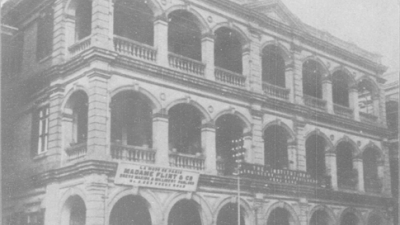
This period also brought major changes in his personal life. In late 1881, he married Dorothy Donkin, also of Sunderland. 8 In the nearly ten years of marriage between the 1881 and 1891 censuses, John and Dorothy had four children: John (8), Florence Alberta (5), William Osborne (3), and Dorothy (7/12 months). The family would be displaced however, when John’s career as a shipboard engineer came to end. In 1896, he took a job at the Cosmopolitan Dock in Hong Kong, a major dockyard in the colony built by the Hong Kong and Whampoa Dock Company at Sam Shui Po, Kowloon, where he would become superintending Engineer. 9
He would work there until 1905, when he would replace Newman Mumford as Lloyd’s Register Surveyor to Hong Kong, and it seems that he made many friends during his time at the Cosmopolitan Dock. The South China Morning Post reported on 15 April 1905, for instance, that he was “presented by his colleagues … with a massive silver salver, as a token of the esteem he is held in by all” and that his “many friends” were regretting “losing him.10 They were grateful though, that “he would still be in Hongkong” and in a “more important sphere” as a Lloyd’s Register Surveyor. To them, he was moving up in the world.
Appointed with an initial annual salary of £650 (approximately worth just under £67,000 in January 2025), John would be the surveyor to Hong Kong for most of the remainder of his working life, staying in post for nearly 15 years. The South China Morning Post reported on John Lambert succeeding Newman Mumford as Lloyd’s Register Surveyor to Hong Kong, providing some more details about his professional life and highlighting his suitability for the role. They noted that after 9 years in Hong Kong, he was “very well known in this Colony” and had “mapped out for himself a career as an engineer”. 11 John had also been on the committee of management for the local Institution for Engineers and Shipbuilders for “many years”, and also frequently worked with American Naval Engineers, even being admitted as an associate of the Society of American Naval Engineers. 12
John Lambert’s work as a surveyor kept him busy, with many of the documents he produced being available to view online in the Ship Plan and Survey Report Collection. 13 Lambert would, for instance, in addition to surveying ships, also supervise ships that were under construction. One example of his work can be found reported on by the Overland China Mail, who wrote in 1909 that the ship Kedah, built by a Chinese firm - Romanised in this newspaper as Kwong Tuck Cheung - but with British steel, had been constructed to Lloyds Register’s highest classification of 100A1 under Lambert’s supervision. 14 It further noted that in the then five years of his employed as a surveyor in Hong Kong, three other vessels had been built to this classification under his supervision, two of which were also by the same Chinese firm. 15 John led a toast to the vessels success at the ship’s launch, an example of what at the time was a seemingly positive relationship between Lloyd’s Register and Kwong Tuck Cheung.
A surveyor’s work though, could be highly varied in nature. In addition to surveying ships in port or under construction, they could also be sent out to lend their expertise to a ship in distress. In May 1915, the Dutch steamship Tjimahi had wrecked on the “North Reef of the Paracels” according to the Overland China Mail, noting that this was the “grave of many a good ship”. 16 Previous attempts by the Swedish ship Frietzhof to rescue the stranded steamer had failed, with the passengers being evacuated instead while the crew and captain waited for assistance. Equipped with salvage gear and accompanied by divers, John Lambert and the superintendent of the shipowners voyaged to the Tjimahi’s wreck to see what they could do in a situation that was reported to be potentially precarious should the weather have worsened. That is where the story seems to end in the newspapers, but the ship was unfortunately not recovered despite John’s efforts. Survey documents held by LR reveal some additional details, including a report from the LR surveyor at Surabaya, B N Powell, who noted that the Tjimahi had suffered damage to its propellor, tentatively attributed to a “foreign substance having temporarily lodged between the boss of the propellor”.17 The ship was to proceed to Hong Kong for a survey by John Lambert, where there would have been opportunity to investigate the propellor, but as we know, the ship did not make it there.
One thing that makes John Lambert fascinating that the historical record contains a lot of information about his family life in Hong Kong, giving us a valuable window into what day-to-day private life was like for a surveyor in a foreign port. When we last checked, in the 1891 UK Census, John and Dorothy Lambert already had four children, and their family would continue to expand and thrive in Hong Kong. Firstly though, they had to get there – passenger logs show Dorothy Lambert departing from Southampton for Hong Kong on 6 December 1897 aboard the Japanese ship Tosa Maru, with her now five children in tow, as Minnie Lambert had been born somewhere around 1895. These logs highlight how accessible and connected the world was becoming through maritime networks, allowing the surveyors to live with their family wherever they were employed. John and Dorothy would go on to have two further daughters, Elsie and Queenie, who were both born in Hong Kong, though Elsie would unfortunately die aged only 12, in September 1912. 18
The family was highly visible in the Hong Kong press. Queenie took on the symbolic role of christening the steamer Hanping at its launch, a ship built by Bailey and Company under John’s supervision.19 These ceremonies were popular and visible events in British culture at the time, though were more typically associated with the launch of naval ships, and involved the smashing of a bottle against the ship, for which she was gifted a gold curb bracelet as a memento.20 Her selection reflects the esteem in which the shipbuilders held John and his work.
With John’s long employment in Hong Kong though, his children grew up and began their own lives in the colony. His eldest son, John B. Lambert, left the colony for Canada in 1910, having worked in Hong Kong with major architecture firms for the previous ten years, and was appointed engineer in charge of the Victoria Breakwater.21 His other son, William Osborne Lambert, followed in his father’s footsteps into maritime engineering, appearing as a third engineer onboard the steamer Huichow in 1909, and later was employed at the Kowloon Docks in Hong Kong, eventually becoming a marine surveyor and having children of his own in Hong Kong.22 His daughters all married in Hong Kong, with Dorothy even being married twice, once to an accountant who would unfortunately soon pass away, and then to a British army Lieutenant. 23 Some of these marriages were large community spectacles and were richly described by the treaty port press, highlighting the relatively prominent position of the Lambert family in the society of colonial Hong Kong.
John and Dorothy’s oldest daughter, Florence, for instance, was married to an Arthur Heron in December 1907 in St John’s Cathedral, Hong Kong. The Cathedral was “decorated with greenery” and a “large attendance of friends” filled its hall. The fashion on display took precedence in the reporting: with Florence being described wearing “white brocaded satin with court train, trimmed with tulle and lace with French applique de soie and orange blossoms and tulle veil” while carrying a bouquet of white chrysanthemums and wearing a gold pendant set with pearls. The Lambert sisters were bridesmaids and wore white “taffeta silk trimmed with chiffon and valenciennes lace and pretty hats to match” and each wore a “gold brooch”. Dorothy Lambert, mother of the bride, wore “a dress of grey silk trimmed with white silk lace, a hat trimmed with pink roses” and carried a matching bouquet, while John proudly wore his full Royal Navy Uniform owing to his long service in the Royal Naval Reserve. 24 Not a word was written about the groom, other than his father’s name and the destination of their honeymoon, Macao. It was the Lambert family in the spotlight on that day!
John Lambert also maintained an active social life in Hong Kong, with his expertise as a marine engineer and LR surveyor playing a large role in expanding the social opportunities available to him. Like a number of other LR surveyors, John was a member of the Freemasons and was registered at the Zetland Lodge from 1887 onwards.25 He was also a member of a cricket club in Hong Kong and also attended an annual meeting of the Lloyd’s Register Cricket Club, hosted at the London Trocadero in 1908.26
The group that he probably spent most of his time with however, was most likely the Institution of Engineers and Shipbuilders in Hong Kong, where he would serve for a time as Vice-President.27 He gave several lectures there, attended billiard tournaments, and generally likely spent a good deal of time in the well-appointed facilities in the institute building with his professional peers.28 John’s time spent at the Institution may have even helped him get the job as the LR surveyor to Hong Kong, with Newman Mumford, the LR surveyor whom he would replace, also having been an influential member of the institution. There is sadly no definitive evidence of a friendship between the two engineers, but they certainly would have met each other, if not at the institution, then at the Freemason Zetland lodge where they both were members.
At the very least, in April 1901 at the institution, Mumford attended Lambert’s “highly fascinating and exhaustive treatise on the subject of ‘Liquid Fuel’, where Lambert extolled, among others, the safety and efficiency advantages of using liquid fuel over coal.29 The newspaper report indicates that the room of experts highly appreciated Lambert’s lecture, though some debated some of the points that he raised. Moments like this offer a snapshot of a turning point in maritime history—when forward-thinking engineers like Lambert were helping to nudge the industry away from coal and towards an energy transition.
John’s long stint as LR Surveyor to Hong Kong came in 1920, though several generations of Lamberts would remain in the colony after his departure. During the First World War, John saw naval service alongside his duties as a surveyor – working as a Fleet Coaling Officer on the China Station according to his admiralty service records and subsequently being retired from Naval service in March 1919.30 Two years after the conclusion of the war, John returned to Europe briefly before retiring from his position as an LR surveyor. Now in his early 50s, he worked for a year in Plymouth, and then onto his final posting in Istanbul after his short stint in Devon.
John’s Royal Navy Service Record took great care in tracking his addresses throughout his life, and thanks to this we know that after concluding his employment as a surveyor, he moved to Addlestone, Surrey, England – just on the outskirts of London. He stayed there until 1928, when he crossed the Atlantic and the USA to set up life in California, primarily in the picturesque seaside town of La Jolla, San Diego. He would come back to the UK for at least a year between 1933-34, residing at Thorpe Lea House Hotel in Egham, Surrey, but would soon reside permanently in La Jolla, where he would live until his death in 1944. As an expert and accomplished marine surveyor, and having lived by the sea his whole life, it is fitting that his final home was minutes away from La Jolla Bay.
Key:
Green = Lived
Red = Worked as LR Surveyor
1 – Sunderland, England.
2 – Hong Kong, China.
3 – Plymouth, England.
4 – Istanbul, Türkiye
5 – Addlestone and Egham, Surrey.
6 – La Jolla, California, USA.
Most of the biographical information in this chapter comes from three sources: UK Census records, Royal Navy Reserve Service Records, and Lloyd’s Register Staff Records, which are held in London.
This information has been derived from UK Census information. These have been located online, using the website Ancestry. For instance, the record for the Mumford family in the 1871 Census is here: Lambert Family 1871. This information is also available to view at The National Archives, in Kew, London. For example, the citation for the 1871 Census for the Mumford family can be found at: The National Archives; Kew, London, England; 1871 England Census; Class: RG10; Piece: 5011; Folio: 4; Page: 1; GSU roll: 847382. This information can be found in each subsequent Ancestry link by clicking on the “Source” tab of the page. Please see this research guide for further information: Census Records.
Overland China Mail, “Deaths”, November 4, 1911, 1.
Sunderland Daily Echo, “Royal Naval Reserve”, August 24, 1889, 3.
Evidence of John’s merchant marine career comes primarily from his Royal Navy Reserve service record, held by The National Archives, in Kew, London. These are searchable online here. John’s record, with the reference ADM/29/240, and is free to access digitally with an account. The other ships that he worked on were the Lumley (1872), Bywell (1882), Bea Bellido (1893), and Adowa (1882). A great website to track the history of British merchant ships is through the Crew List Index Project (CLIP): https://crewlist.org.uk/. Admiralty records of John Lambert’s service history noted the official ship number of each ship he worked on, which is an excellent way of finding a ship, but CLIP also allows for searches by name. Should you wish to try this, https://crewlist.org.uk/data/vesselsnum is where the ship number can be searched. The ships and their corresponding official numbers for the vessels that John Lambert served on are as follows. Lumley: 62668. Consett: 62642. Bywell: 85020. Bea Bellido: 101825. Adowa: 85192.
Mercantile Navy List, 1890, 182, (Ship then named as Ocampo).
Zdzisław Najder, Joseph Conrad: A Life (New York: Camden House, 2007, 187. Indeed, Lloyd’s Register’s Ship Plan and Survey Report Collection has a significant number of documents pertaining to the Adowa, including survey reports and reports of repairs. See here: https://hec.lrfoundation.org.uk/archive-library/ships/adowa-1882
Ancestry (available via subscription), John Lambert, 1881 Census.
Overland China Mail, “Hongkong Engineers Institution”, April 22, 1901, 108. A great source for the various dockyards and other industries in Hong Kong is a contemporary travel guide which has been digitised and is freely accessible online. See: Twentieth Century Impressions of Hong Kong, Shanghai, and other Treaty Ports of China, eds. Arnold Wright and H. A. Cartwright (London and others: Lloyd’s Greater Britain Publishing Company, 1908), 156. It is available online here.
South China Morning Post, “Presentation”, April 15, 1905, 2.
South China Morning Post, “Lloyd’s Surveyor: Successor to Mr. Mumford”, March 14, 1905.
South China Morning Post, “Lloyd’s Surveyor: Successor to Mr. Mumford”, March 14, 1905.
This search will take you to a number of documents produced by John Lambert, or letters that he sent.
Overland China Mail, “New Penang Steamer”, December 21, 1909, 7; It is worth noting that Romanisation of Chinese names may be incorrect or inconsistent – this period predates the Hanyu Pinyin system that is now in use. The foreign names reproduced here are exactly as they were written in the English language sources they were taken from and so may not represent exactly what they were named in the language or dialect of the region.
Overland China Mail, “New Penang Steamer”, December 21, 1909, 7.
The Paracel Islands an archipelago in the South China Sea. Overland China Mail, “Java-China Boat Ashore”, May 20, 1915, 3. See for more on Tjimahi here.
LRF Heritage, Ship Plan and Survey Report Collection, “Report of Survey for Repairs, &c for Tjimahi”, March 30, 1915, LRF-PUN-W729-0029-R. For all of the documents held by LR on the ship, see here.
Both daughters appear mostly in newspaper reports, primarily from the Overland China Mail, rather than census data. Elsie’s death was reported on here: Overland China Mail, “Death”, September 21, 1912, 1.
Overland China Mail, “Launch at Bailey and Co.s”, June 9, 1908, 9.
See for more: Jan Ruger, The Great Naval Game: Britain and Germany in the Age of Empire (Cambridge and New York: Cambridge University Press, 2007), 1-7, 31-36.
Overland China Mail, “News of the Week”, November 15, 1913, 2. The firms he worked for still exist today. He worked for eight years with Mr Danby, whose firm eventually evolved into Leigh & Orange. The second was Palmer and Turner, who he worked with for two years, and who exist today as the P&T group. The Victoria Breakwater is most likely the one at Ogden Point, Victoria, British Columbia, Canada.
William’s employment on the Huichow is found in the 1909 China Directory, accessible online here. Full reference: The Directory & Chronicle for China, Japan, Corea, Indo-China… (Hong Kong and London: The Hong Kong Daily Press Office, 1909), 1566. Evidence of William’s family and profession as a marine surveyor are found in later passenger logs. See here and here. The Shanghai Times, August 30, 1917, 7. https://www.ancestry.co.uk/discoveryui-content/view/844501:8945?tid=&pi…;
All of these were reported in newspaper reports. The individual reports are as follows. Dorothy Lambert: Overland China Mail, “A Naval and Military Wedding in Hong Kong”, July 10, 1915, 29, and; Overland China Mail, “Interesting Wedding at Kowloon”, February 18, 1911, 5; Minnie Lambert: The Shanghai Times, “Marriage Announcement”, February 18, 1918, 7; Florence Lambert: Overland China Mail, “Wedding at St. Johns”, December 10, 1907, 3.
All this information is taken from this newspaper report: Overland China Mail, “Wedding at St. Johns”, December 10, 1907, 3.
John Lambert’s membership can be seen in the Freemason Membership Registers. His specific membership entry is found here.
Lloyd’s List, “Lloyd’s Register. Cricket Club Reunion”, November 2, 1908, 3; Unfortunately, I have not been able to ascertain exactly which cricket club John Lambert was a member of in Hong Kong, but the mention of him being in a club is found here: Overland China Mail, “K.C.C. Annual Dinner”, April 15, 1911, 7.
For more about the institution, and the source of the picture of John Lambert, see: The Far Eastern Review, “Foundation and Growth of the Institution of Engineers and Shipbuilders of Hongkong”, May 1906, 338-339.
John even presented a “beautiful cup” to the winner of one such tournament. Overland China Mail, “Engineers at Billiards”, July 1, 1905, 6.
You can read more about the problems and risks of coal usage at sea in these two articles by Roy and Lesley Adkins on the LRF Heritage website. There can be found here: Roy Adkins and Lesley Adkins, “Coal at Sea: The Hazards of Overheating, Fire and Explosion”, January 14, 2025; Roy Adkins and Lesley Adkins, “Coal at Sea: The Hazards of Cargoes, Bunkers, Loading, Unloading, Trimming and Shifting”, October 30, 2024.
All subsequent information is taken from either John’s service record, ADM 240/29/40, or his entry in LR’s “List of Officers”, 502, held in London by LRF Heritage
Explore the behind the scenes process of filming the Argentina, a 'votive', the Aeolus and the East Indiaman ship models at the National Maritime Museum, Sweden.
Explore the behind the scenes filming of the Cold War Rail Ferry, Oasis of the Seas, Stena Drillmax and Olympic Loyalty ship models at the IMO's headquarters.
A behind the scenes look at the process of filming HMS Vanguard, HMS Prince, Campania and Océan at the Science Museum's National Collections Centre, Swindon.


.jpg)