



Behind the scenes: Filming ship models at the Science Museum
A behind the scenes look at the process of filming HMS Vanguard, HMS Prince, Campania and Océan at the Science Museum's National Collections Centre, Swindon.
This page is approximately a 7 minute read
Daniel Jamieson, PhD student
Daniel Jamieson is a PhD candidate nearing completion of his final year at the University of Plymouth. His research project, which is funded by a Lloyd’s Register Foundation grant, gathers oral history interviews with contemporary shipwreck survivors. His final thesis features the stories of 10 of these, whose experiences span shipwrecks from the 1950s until 2014. The main body of the thesis is a work of creative non-fiction, a ‘book’ that explores, in telling these stories of shipwreck, how to bring them to life most vividly in print; not only how best to curate each survivor’s experience but also how to juxtapose them in a way that creates a meaningful mosaic of testimony, that reveals something of what it feels like to be on a ship that sinks under your feet.
In 2023, with generous funding from Lloyd’s Register towards my research, I set out to interview around 20 shipwreck survivors, then to gather a number of their stories into a book that would reveal something of the human experience of this underreported yet surprisingly common disaster.
I was inspired in part by a ‘near-miss’ experience of my own in 2001, which I recount at the start of the book. The three-masted barque Kaskelot, on which I was sailing home to Cornwall from Iceland, was caught in a north-easterly storm. The ship had taken part in filming Charles Sturridge’s Shackleton for Channel 4. For several days the ship had to run before the storm straight out and down into the Atlantic, chased by enormous seas. I feared we would broach to the wind and waves and get knocked down, an immensely dangerous fate for a square-rigged ship, almost inevitably leading to a sinking if its watertight integrity is compromised and water floods into the body of the vessel through a hatch or port.
Luckily the storm abated and we made it safely home, but the experience left me with an abiding sense of the terror that a shipwreck might entail and a sensitivity to the invisibility of such an experience to contemporary attention. Sea traffic and mortality remain high. Although shipwrecks of commercial vessels over 100GT have fallen significantly through the last decade (by 37%), there were still on average 70 total losses a year between 2021 and the end of 2025.1 Also, since 2014, at least 35,000 migrants have drowned in small boat shipwrecks on their way towards Europe.2 Yet society suffers from ‘sea blindness’, largely unaware of the true volume of modern shipping (90% of international trade happens by sea) as well as the experience, and suffering, of contemporary shipwreck survivors.
To give something of the flavour of the research, here is a brief introduction to one of the survivors featured and the shipwreck she endured.
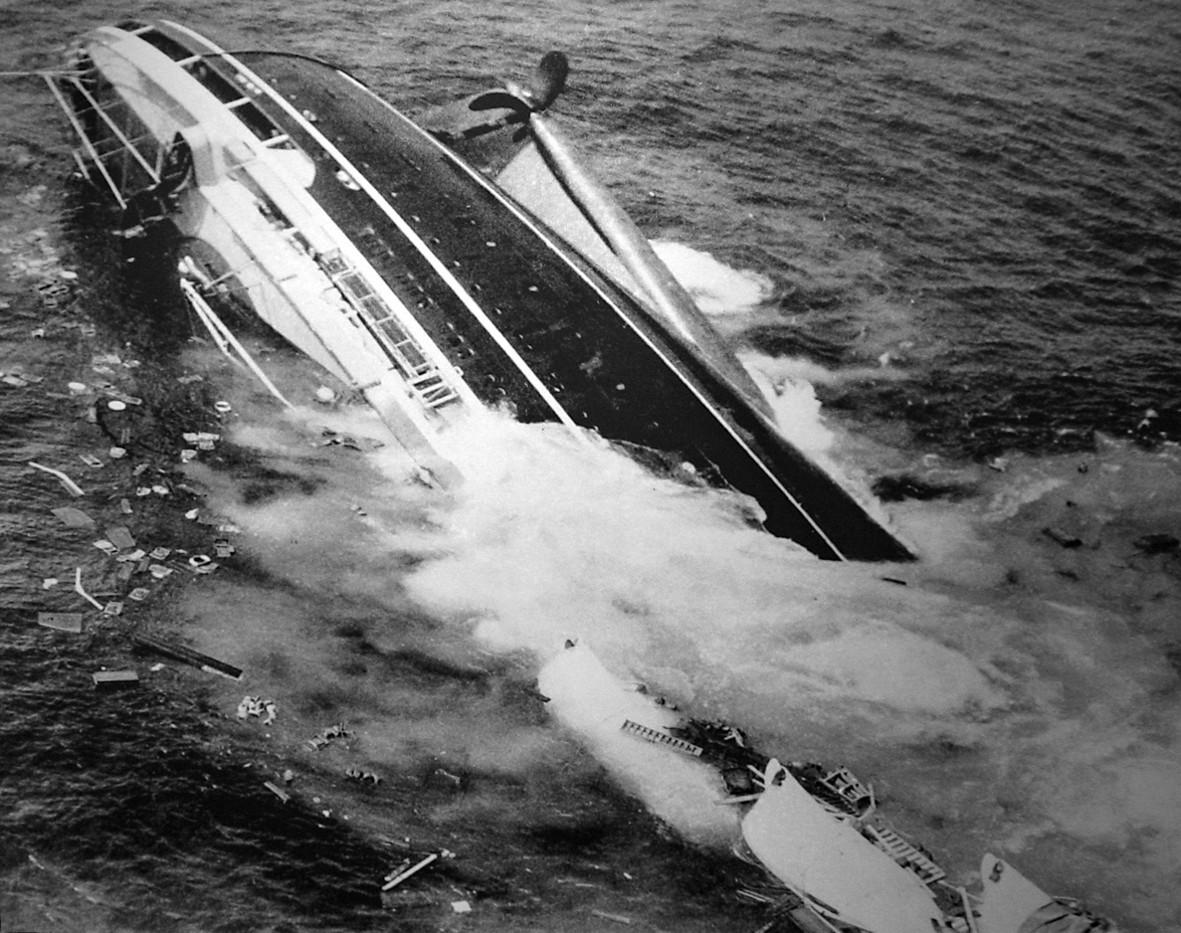
I spoke to Adalgisa DiFabio in 2023 at her home in Cranford, New Jersey, then aged 84. Adalgisa had been a passenger on the last voyage of the Italian liner Andrea Doria in 1956. On her way from Genoa into New York in thick fog, the Doria was struck by the outbound Swedish liner Stockholm en route to her home port of Gothenburg, whose reinforced, icebreaking bow cut a hole in the side of the ship nearly a third of her beam deep. Hundreds of tons of water a minute began to pour into the Doria, soon causing her to list to 22 degrees. A huge rescue swung into operation, with all but 46 of Andrea Doria’s 1,134 passengers and 572 crew members eventually surviving.
Ada was just 16 years old at the time of the wreck, having celebrated her birthday on the week-long voyage, and bravely travelling alone from her home in the small mountain village of Monteferrante in Abruzzo on the Adriatic coast of Italy to start a new life in the US. Like 7 million other Italians who left their towns and villages between 1945 and 1970 to escape grinding post-war poverty and economic stagnation, Ada was on her way to join some relatives, her Uncle Frank and Aunt Maisie, who’d migrated to the States before the war. She was unusually intrepid to leave alone at that age:
I already felt like I belonged someplace else. I was happy in myself, young as I was. I think you're born with something that makes you want to go forward mentally and physically. I wanted more. I didn't know anything about life at all - I'd never even been away from home - but I had this instinct that was saying, ‘You can make it.’
Everything went like a dream on the voyage for Ada until the last night. It was a week of firsts – her first holiday, first time on a ship, first journey alone. The sun shone, the ship was beautifully appointed and served a sumptuous menu even to cabin class passengers, there was dancing every night and Ada made new friends.
However, as she was climbing into her bunk at 11.11pm after a last evening of celebration and farewell, disaster struck:
As I turned around to go up the step ladder, there was this big sound of an explosion. It rocked me, because I was right on the point of climbing the steps to get into my bunk bed. I only had a little nightgown on, now that I'd taken my clothes off. And, at sixteen years old, I knew - I felt - it wasn't good, okay? Because the ship was tilting to a certain degree already.
Her night of trauma had just begun. She remained aboard, huddled outside on the gradually tilting promenade deck, believing she would die until four in the morning. At the time, however, she recalls a strange emotional numbness that overtook her, how she didn’t cry at all throughout the ordeal. At last, an opportunity came to climb down into a lifeboat. However, the only way was to go hand over hand down a rope hanging into the darkness over the water:
They said you've got to climb over the ledge, hold a rope and climb down. And I remember, even though I used to climb trees and was very athletic, I was scared to climb down that rope. I knew the water was there and I’d never been in the ocean, so that frightened me. But if I didn’t do it, somebody else would take my place, so I grabbed a rope and climbed down it. You can see the ropes that they put over the side in some of the pictures. When I got to the bottom somebody grabbed me round my waist - I can still feel it - and sat me in the lifeboat. There were quite a few people there who’d already done what I did. Some of the ropes must've been very thin, because a lot of them had cuts across their hands because they’d held so tight going down. It was a tragic night.
Ultimately she made it to safety aboard the French liner Île-de-France, but the ordeal left her with a lifelong legacy of trauma that began to emerge soon after her arrival with her Aunt Maisie and Uncle Frank:
It took two weeks for me to realise, I guess. My body started acting up, doing whatever I didn't do on the ship. My body went through a drama, crying and screaming at 11 o'clock each night. I relived what had happened to me for the longest time. My aunt took me to the doctor, and in those days they didn't have anyone you could talk to to help you deal with a problem, so the doctor gave me tranquilizers. I was a young girl, but it took me a long time to recover and then I was left with a phobia of being trapped - I still have this feeling today. The elevator is a no-no. So, it stays with you and you live with the fear. What happened becomes part of who you are.
Ada has lived in New Jersey now ever since 1956, in Garwood and Cranford. At first, she worked as a seamstress for Saks Fifth Avenue, hand-finishing high-end fashion wear. At age 20, she married her childhood sweetheart from back home in Monteferrante, Pacifico, who had migrated to the States around the same time as her to work as a builder and carpenter – he built the house himself in which I interviewed Ada. Over the 63 years of their marriage, they had three children and six grandchildren, two of whom are now doctors, one a computer engineer and another a teacher. She was immensely grateful for all her happy years in the States and proud of her children’s and grandchildren’s achievements, but was clear that none of this rich, full life would have happened if she had not climbed down that rope to the lifeboat:
That rope, it took me to this. And you know, when I look at those pictures with those ropes hanging, I says, ‘Yeah. It took courage.’
‘Safety and Shipping Review 2025’, Allianz, May 2025 <https://commercial.allianz.com/news-and-insights/reports/shipping-safety.html> [accessed 8 September, 2025].
‘Migration in the Mediterranean’, Missing Migrants Project, n.d. <https://missingmigrants.iom.int/region/mediterranean> [accessed 16 September 2026].
A behind the scenes look at the process of filming HMS Vanguard, HMS Prince, Campania and Océan at the Science Museum's National Collections Centre, Swindon.
This is a miniature model of the GDR's rail ferries. They were constructed at the height of the Cold War to transport freight between Germany and Lithuania.
Learning from past maritime disasters to develop a global perspective and integrate lessons learned to advance maritime safety, resilience and sustainability.


