



The sinking of the Royal George
Uncover the story behind one of Britain's worst pre-Titanic disasters.
This page is approximately a 5 minute read
Enhancing records and putting archives into action.
Dr Innes McCartney, Maritime Archaeologist and Historian from Bournemouth University, writes about the importance of Learning From the Past.
“When a ship sinks with a dangerous cargo on board, it threatens the safety of the whole marine environment."
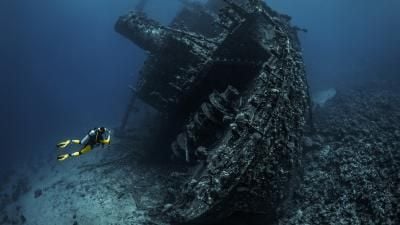
"That situation becomes more acute still if you can’t identify the exact location of the ship,” says Innes. “Our research used marine geophysical scanning and the recently digitised records at the Lloyd’s Register Foundation Heritage Centre to identify 129 previously unknown or misidentified wrecks in the Irish Sea. Three of those were tankers – all potentially highly polluting wrecks that could be catastrophic to the marine environment.” Others were carrying munitions which can present a range of other dangers to the environment and sea users.
Supported by Lloyd’s Register Foundation funding, the Heritage Centre provides free access to over 1.1 million documents for more than 80,000 ships from its Ship Plan and Survey Report Collection. With a global audience spanning over 190 countries worldwide, this digitised collection is a unique resource that is being used by historians, economists, linguists, ship model enthusiasts and family historians – as well as by marine archaeologists like Innes. “In nearly all cases, the records at the Heritage Centre were essential to our work,” adds Innes, whose book Echoes from the Deep describes his research and was published in September 2022. “The Heritage Centre enabled us to match plans of missing ships with seabed scans of wrecks. We’ve identified vessels from trawlers and submarines to large ocean liners – as well as munitions ships and tankers.
“One of those tankers is MV Rotula, which was carrying aviation spirit from Nova Scotia when she was bombed by German aircraft in March 1941. Thanks to our research, we now know that she broke in two and is lying in 90 metres of water. With the Rotula correctly identified, marine scientists can now investigate the environmental effects of its cargo on the seabed and the surrounding area.”
Read more about Dr Innes' work here.
SALMO operates as a specialist governmental unit that continually monitors the MoD’s inventory of around 5,700 shipwrecks. Consisting of wrecks dating from the 1870s onwards, many lost during the First and Second World Wars, SALMO routinely operate not only in UK waters, but those across the world. They are responsible for overseeing all environmental and safety considerations involved in the safe treatment of harmful substances or pollutants arising from these wrecks. In coordination with the MoD, the Maritime & Coastguard Agency (MCA), the Home Office, Department of Transport and other national and international governmental organisations, SALMO represent a crucial force in maintaining the United Kingdom’s marine capacity worldwide. When SALMO’s Wreck Researcher, Matt Skelhorn, approached the Lloyd’s Register Foundation his enquiry concerned a seventy eight year old wreck, lying just off the coast of Great Yarmouth, the Royal Fleet Auxiliary vessel War Mehtar.
Preliminary multi-beam sonar imaging of War Mehtar’s wreck confirmed a near complete split to her hull close to her centre fore bulkhead...."
In the course of their work SALMO prioritise each individual case on a scale of one to four. The most urgent cases, such as oil tankers like War Mehtar, or munitions ships, often fall into category one. Find out what happened next here.
Increasing interaction with the UK’s maritime heritage by making it easier to research and easier for the public to discover and share stories in new ways.
"Despite its importance, it’s not always easy to study our maritime heritage. Records, maps and objects are scattered across hundreds of different archives, museums, libraries and galleries. A large part of our work will be to develop new ways of making information across these different collections easy to search and find".
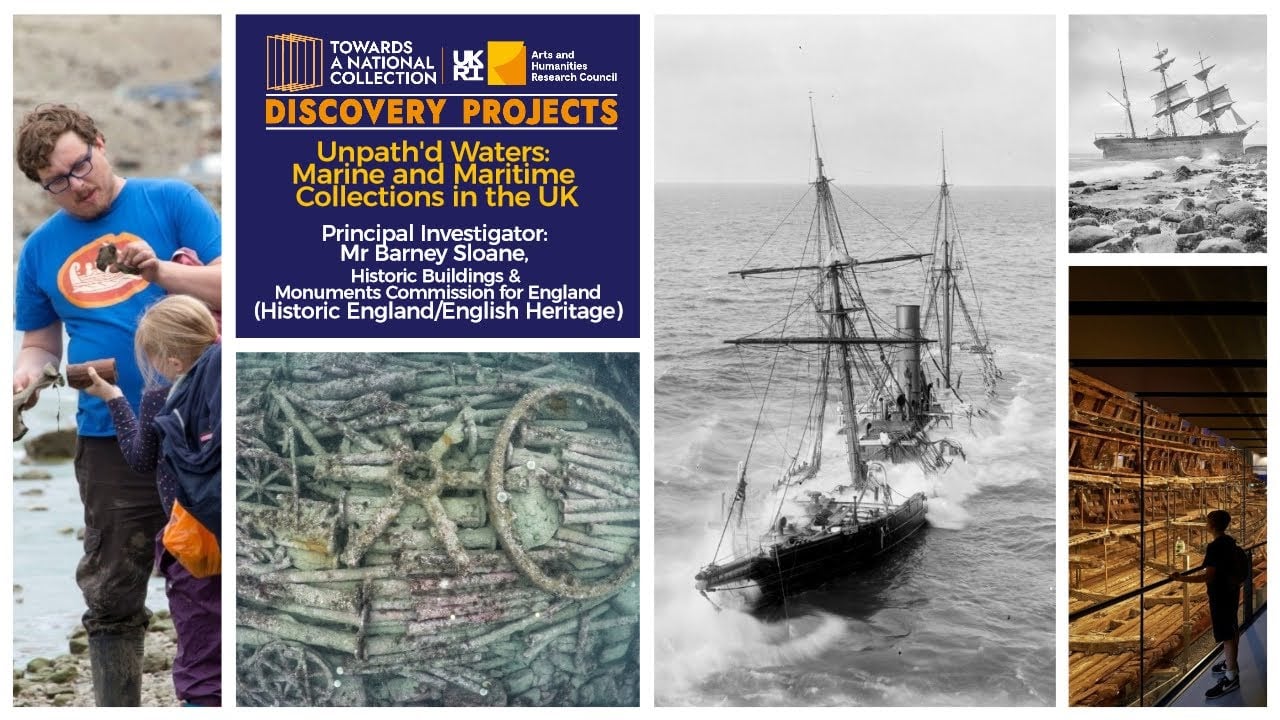
Lloyd's Register Foundation Heritage & Education Centre (HEC) was a partner Unpath’d Waters, one of five Discovery Projects, supporting the UK Research and Innovation/Arts and Humanities Research Council Towards a National Collection (TaNC) programme. Its aim was to look at the UK’s marine and maritime collections, to explore what potential existed for connecting those collections and opening them up to new audiences, and to set out what lessons could be learned in the drive towards developing a national collection.
Unpath’d Waters set out to discover how to best unlock new stories and effect sustainable management of the country's marine past. The consortium brought together universities, government agencies, museums, heritage trusts and research experts to confront this challenge. They worked with known and new audiences to understand how they – the users – would wish to interact with this heritage. They focused on digital collections and computing techniques to innovate searching across collections, create simulations to help visualise landscapes, and integrated scientific datasets and methods not normally applied to heritage collections to identify wrecks, understand their past, and explore their potential futures.
Making the Link - Enhanching Welsh Shipwreck records.
Our Foundation grant to the Royal Commission on the Ancient and Historic Monuments Wales in 2020 enabled them to link shipwreck records from the National Monuments Records of Wales to individual ship records contained within the Lloyd’s Register Casualty Returns, Lloyd’s Register of Ships & the Ship Plan & Survey Report Collection. In six months, 582 individual entries for Welsh shipwrecks (dating from 1890-2000) had been linked. Of these 124 were entirely new to the National Monuments Records. Find out more about the project in our Online Exhibition.
Isle of Man - wreck identification
A project launched within Unpath’d Waters aimed to identify the final resting place of vessels lost off the west coast of the Isle of Man. Collaborative researchers based at Bangor University, Ulster University, the Royal Commission on the Ancient and Historic Monuments of Wales and Manx National Heritage analysed data collected by the latest sonar technology, scientists and archaeologists aimed to identify dozens of shipwrecks in the Irish Sea. Find out more here.
"The ambition of Unpath'd Waters is to create new ways of identifying wrecks faster and with greater certainty by linking more collections into the search capability, so the two initiatives complement each other well indeed" - Barney Sloane
Uncover the story behind one of Britain's worst pre-Titanic disasters.
Explore the life of Vera Laughton Mathews, a WRNS pioneer whose influence extended far beyond the uniform.
Discover the dangers of guano shipping—flammable, toxic fertiliser that shaped maritime safety and global trade in the 19th century.

