


Behind the scenes: Ship Models at Sweden’s Maritime Museum
Explore the behind the scenes process of filming the Argentina, a 'votive', the Aeolus and the East Indiaman ship models at the National Maritime Museum, Sweden.
This page is approximately a 7 minute read
Anna Grybenyuk, Researcher
Anna Grybenyuk graduated from the University of St Andrews with a degree in Modern History and Russian in 2016, then again with an MLitt in Museum and Gallery Studies in 2020. Much of her knowledge of fishing and maritime activity comes from working at the Scottish Fisheries Museum, and from living so long by the coast. She currently works in Oxford, managing digital collections for the Pitt Rivers Museum and History of Science Museum. It is far from the sea, but she will take any opportunity to head back to the coast to spot birds and boats alike.
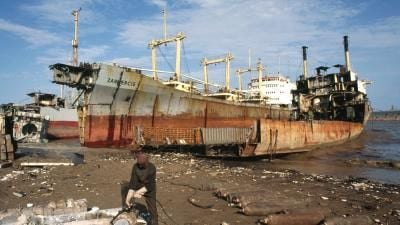
Like all things, ship have a finite lifespan. When it a ship is too old, too worn, and too unsafe to be worth the cost of maintenance, the most common course of action is for the owner to sell it to intermediaries, who then pass it on to be scrapped. This is where ship breakers come in, strip the ship for its components, pipes, and all goods within it, such as appliances or even kitchenware. Some of this is sold off at a premium, while other parts are recycled. Most valuable is the ship’s metals, which is are often melted down and repurposed, either into ships or items such as rails.
In 2025, 321 vessels were dismantled globally last year1. On the surface, that seems straightforward, even beneficial. Recycling steel saves 1.5 tons of CO2 per 1 ton of steel, and takes 74% less energy than it does to produce new steel2. However, there is a dark side to the ship scrapping industry. Much of this work happens in the Global South, where regulations are weaker3. Most (70-80%) ship breaking activity is located in Bangladesh, India, and Pakistan, with China and Turkey accounting for much of the rest of the market. This leaves leaving only 5% in other countries like Europe, the UK, and the US4, where there are much stricter safety standards and higher labour costs.
Shipbreaking is dangerous work, in no small part due to the materials found in ships. These commonly include asbestos, heavy metals, oil, and various carcinogenic and toxic substances like PCBs and PAHs5. As the average age of a ship at scrapping is 25 years, with some being older6, they may have been built before certain materials were banned. In the US and Europe, any hazardous materials on a ship must first be disposed of before scrapping. However, in Bangladesh, India, or Pakistan, workers who are poor and unskilled, working 12 hour days, must find and contend with any hazardous materials, often by improvised methods like lowering animals, such as chickens, into tanks to check for fumes or poisons7. They are given no safety guidance or equipment to help deal with these materials. These effects accumulate along with the consequences of back-breaking work, causing multiple illnesses among workers as they age, an effect that few of them are aware of when they take on this work8. The industry exploits these people with no regard for their lives or health.
However, there is not just a human cost, but an environmental one. These hazardous materials within the ship can easily leak out cause environmental damage such as oil spills or dumping of hazardous waste into the surrounding area. This is made even more acute due to the technique of beaching these ships to dismantle them. Beaching is when a vessel is driven on to shore at high tide, then worked on at low tide. This technique is dangerous, as it risks tearing apart ship hulls and spilling pollution into the sea, air, and sensitive ecosystems like mangrove forests9. This in turn can affect local livelihoods by destroying fishing grounds and contaminating water. A study published in 2001, found that along the coastline of Alang in India, where much of the country’s shipbreaking industry is based, there was a considerably higher concentration of heavy metals and disease-causing bacteria than a control stretch of shore further up the coast10. As many of these ships being recycled are owned by wealthier nations, this can be considered a form of environmental injustice11, shifting the consequences of pollution from the wealthy to the poor. It is therefore important to focus on this industry to see how it can be made safer for the people working it, and better for the environment.
There have been attempts to mitigate the safety and environmental issues that stem from shipbreaking. The 1989 Basel convention tried to limit transport of hazardous materials across borders, but this was possible to circumvent as it was too broad to easily apply to ships12. The 2009 IMO Hong Kong Convention that entered into force in 2025 tries to put in place and enforce environmental and safety standards specifically for shipbreaking13. This aims to mitigate some of the worst violations. This includes constructing the ship with disposal in mind, having an inventory of hazards aboard the ship, and a plan for its recycling, as well as obligating flag states to certify and verify these hazards. It also tries to define what a ship recycling yard is, though the definition is broad enough for many places which are still inadequate in safety or environmental law to fall outside the classification14. The European Union is also putting pressure on businesses within its member states, bringing in laws in 2020 to divert ship owners to cleaner, safer recycling yards15.
However, compliance is always a challenge. Ship owners can avoid these laws by using flags of convenience, which means their vessels are registered in countries with laxer laws on ship scrapping16, allowing them to bypass EU regulations or the Hong Kong Convention if the flag country has not ratified it. There is also the risk that, should compliance be unevenly enforced, shipyards which do raise their labour standards and thus costs are punished by losing work. This happened in Alang’s shipbreaking yard when it had to raise costs to enforce higher standards17, though this may be due to a combination of factors such as post-pandemic slowdown and the extension of the life of ships by companies for cost-saving reasons. Safety does not matter if there is no work, and workers may resent these measures for stealing their livelihoods.
Ship-scrapping is also important for the countries they take place in, as it brings in both resources and money to fuel their economies. Bangladesh especially relied on ship breaking to supply 80% of its 2013 domestic steel demand18. Putting down rules is just the beginning; enforcing them is more difficult, and without careful oversight, may do as much harm as good.
The Hong Kong convention has come into force, however it is thought to be only a first step to create change. A study by the Sustainable Shipping Initiative (SSI) highlighted, among other things, the need to create systems of works, including supervision, equipment, communication, infrastructure, opportunity and, in particular, training, as retaining an experienced, professional workforce is the primary driver of safety19. Time will tell if the industry will continue to mature and grow out of something that was bad for people and the planet to something healthy and sustainable that encourages growth for all.
Ali, Mohammad Zulfikar. “Shipbreaking Industry – Responsibility of the Maritime Industry.” ANZSIL Perspective, Australia and New Zealand Society of International Law, 15 Nov. 2020, https://anzsilperspective.com/shipbreaking-industry-responsibility-of-the-maritime-industry/.
Behal, Anuj, and Suchak Patel. “‘No Work’: India’s Alang, the World’s Largest Graveyard of Ships, is Dying.” Al Jazeera, 15 Dec. 2025, www.aljazeera.com/news/2025/12/15/no-work-indias-alang-the-worlds-largest-graveyard-of-ships-is-dying. Accessed 10 May 2026.
Frey, R. Scott. “Breaking Ships in the World-System: An Analysis of Two Ship Breaking Capitals, Alang-Sosiya, India and Chittagong, Bangladesh”. Journal of World-Systems Research, vol. 21, no. 1, Feb. 2015, pp. 25-49, https://doi:10.5195/jwsr.2015.529.
Fronda, Aaran. “The Nature of Shipbreaking i s Casting a Shadow over the Shipping Industry.” World Finance, www.worldfinance.com/markets/the-nature-of-shipbreaking-is-casting-a-shadow-over-the-shipping-industry. Accessed 10 May 2026.
Guenin, Mathilde. “Shipbreaking: A Deadly Industry.” Human Rights Research Center, 31 July 2025, www.humanrightsresearch.org/post/shipbreaking-a-deadly-industry.
Hossain, M. Shahadat, et al. ‘Occupational Health Hazards of Ship Scrapping Workers at Chittagong Coastal Zone, Bangladesh’. Chiang Mai Journal of Science, vol. 35, 2008, pp. 370–381. https://www.researchgate.net/publication/236015280_Occupational_Health_Hazards_of_Ship_Scrapping_Workers_at_Chittagong_Coastal_Zone_Bangladesh.
Ko, Nathanael, and Johannes Gantner. “Local Added Value and Environmental Impacts of Ship Scrapping in the Context of a Ship’s Life Cycle.” Ocean Engineering, vol. 122, Aug. 2016, pp. 317–321, https://doi.org/10.1016/j.oceaneng.2016.05.026.
Mulinaris, Nicola. “The Toxic Trade of Obsolete Ships.” The Ecologist, 15 Oct. 2018, https://theecologist.org/2018/oct/15/toxic-trade-obsolete-ships.
“The New Age of Old Ships.” Lloyd’s List Intelligence, blog, 6 May 2026, www.lloydslistintelligence.com/thought-leadership/blogs/new-age-of-old-ships.
“New Era for Ship Recycling as Hong Kong Convention Enters into Force.” International Maritime Organization, 26 June 2025, www.imo.org/en/mediacentre/pressbriefings/pages/hong-kong-convention-entry-into-force.aspx. Press release.
Nyka, Macej. “Ship Scrapping – the Challenges for International Environmental Regulation.” Scientific Journals of the Maritime University of Szczecin, vol. 59, no. 131, 2019, pp. 16–21, https://repository.am.szczecin.pl/handle/123456789/2558.
“Platform publishes list of ships dismantled worldwide in 2025.” NGO Shipbreaking Platform, 2 Feb. 2026, https://shipbreakingplatform.org/platform-publishes-list-2025/. Press release.
“Ship Breaking around the World.” Ship Breaking around the World – Ship Breaking in Bangladesh, https://shipbreakingbd.info/ship-breaking-around-the-world/. Accessed 9 May 2026.
“Ship Dismantling.” Basel Convention on the Control of Transboundary Movements of Hazardous Wastes and Their Disposal, www.basel.int/Implementation/ShipDismantling/Overview/tabid/2762/Default.aspx. Accessed 10 May 2026.
“Ship Recycling’s Ambition Problem.” Splash247, 6 May 2026, splash247.com/ship-recyclings-ambition-problem/.
Showen, Jason. “How Steel Recyclers Contribute to Lowering Carbon Emissions.” ECAM, 25 Feb. 2025, https://ecam.com/security-blog/how-steel-recyclers-contribute-to-lowering-carbon-emissions.
“SSI Charts the Progress Made under the Hong Kong Convention in New Report.” SAFETY4SEA, 13 May 2026, safety4sea.com/ssi-charts-the-progress-made-under-the-hong-kong-convention-in-new-report/.
Tewari, Akhilesh , et al. “The Effect of Ship Scrapping Industry and its Associated Wastes on the Biomass Production and Biodiversity of Biota in in situ Condition at Alang.” Marine Pollution Bulletin, vol. 42, no. 6, June 2001, pp. 461–468, https://doi.org/10.1016/s0025-326x(00)00185-5.
Thomson Reuters Foundation. “What Happens to Ships When They Die?” Eco-Business, 21 Feb. 2025, www.eco-business.com/news/what-happens-to-ships-when-they-die/.
Wan, Zheng, et al. “Ship Scrappage Records Reveal Disturbing Environmental Injustice.” Marine Policy, vol. 130, Aug. 2021, p. 104542, https://doi.org/10.1016/j.marpol.2021.104542.
“Why are Vessels Scrapped & What Happens to Them?” Martide blog, 20 Mar. 2023, www.martide.com/en/blog/why-are-vessels-scrapped-what-happens.
“Why Ships Are Toxic.” NGO Shipbreaking Platform, 5 Jan. 2026, https://shipbreakingplatform.org/issues-of-interest/why-ships-are-toxic/.
“Platform publishes list of ships dismantled worldwide in 2025.” NGO Shipbreaking Platform, 2 Feb. 2026, https://shipbreakingplatform.org/platform-publishes-list-2025/. Press release.
Showen, Jason. “How Steel Recyclers Contribute to Lowering Carbon Emissions Footprint.” ECAM, 25 Feb. 2025, https://ecam.com/security-blog/how-steel-recyclers-contribute-to-lowering-carbon-emissions.
Thomson Reuters Foundation. “What Happens to Ships When They Die?” Eco-Business, 21 Feb. 2025, www.eco-business.com/news/what-happens-to-ships-when-they-die/.
“Ship Breaking around the World.” Ship Breaking in Bangladesh, https://shipbreakingbd.info/ship-breaking-around-the-world/. Accessed 9 May 2026.
PCBs (polychlorinated biphenyls) and PAHs (polycyclic aromatic hydrocarbons). “Why Ships Are Toxic.” NGO Shipbreaking Platform, 5 Jan. 2026, https://shipbreakingplatform.org/issues-of-interest/why-ships-are-toxic/.
“The New Age of Old Ships.” Lloyd’s List Intelligence, blog, 6 May 2026, www.lloydslistintelligence.com/thought-leadership/blogs/new-age-of-old-ships.
Fronda, Aaran. “The Nature of Shipbreaking is Casting a Shadow over the Shipping Industry.” World Finance, www.worldfinance.com/markets/the-nature-of-shipbreaking-is-casting-a-shadow-over-the-shipping-industry. Accessed 10 May 2026.
Hossain, M. Shahadat, et al. “Occupational Health Hazards of Ship Scrapping Workers at Chittagong Coastal Zone, Bangladesh.” Chiang Mai Journal of Science, vol. 35, 2008, pp. 370–381. https://www.researchgate.net/publication/236015280_Occupational_Health_Hazards_of_Ship_Scrapping_Workers_at_Chittagong_Coastal_Zone_Bangladesh.
Ali, Mohammad Zulfikar. “Shipbreaking Industry – Responsibility of the Maritime Industry.” ANZSIL Perspective, Australia and New Zealand Society of International Law, 15 Nov. 2020, https://anzsilperspective.com/shipbreaking-industry-responsibility-of-the-maritime-industry/.
Tewari, Akhilesh, et al. “The Effect of Ship Scrapping Industry and its Associated Wastes on the Biomass Production and Biodiversity of Biota in in situ Condition at Alang.” Marine Pollution Bulletin, vol. 42, no. 6, June 2001, pp. 461–468, https://doi.org/10.1016/s0025-326x(00)00185-5.
Wan, Zheng, et al. “Ship Scrappage Records Reveal Disturbing Environmental Injustice.” Marine Policy, vol. 130, Aug. 2021, p. 104542, https://doi.org/10.1016/j.marpol.2021.104542.
“Ship Dismantling.” Basel Convention on the Control of Transboundary Movements of Hazardous Wastes and Their Disposal, www.basel.int/Implementation/ShipDismantling/Overview/tabid/2762/Default.aspx. Accessed 10 May 2026.
“New Era for Ship Recycling as Hong Kong Convention Enters into Force.” International Maritime Organization, 26 June 2025. www.imo.org/en/mediacentre/pressbriefings/pages/hong-kong-convention-entry-into-force.aspx. Press release.
Nyka, Macej. “Ship Scrapping – the Challenges for International Environmental Regulation.” Scientific Journals of the Maritime University of Szczecin, vol. 59, no. 131, 2019, pp. 16–21, https://repository.am.szczecin.pl/handle/123456789/2558.
Mulinaris, Nicola. “The Toxic Trade of Obsolete Ships.” The Ecologist, 15 Oct. 2018, https://theecologist.org/2018/oct/15/toxic-trade-obsolete-ships
Guenin, Mathilde. “Shipbreaking: A Deadly Industry.” Human Rights Research Center, 31 July 2025, www.humanrightsresearch.org/post/shipbreaking-a-deadly-industry.
Behal, Anuj, and Suchak Patel. “‘No Work’: India’s Alang, the World’s Largest Graveyard of Ships, is Dying.” Al Jazeera, 15 Dec. 2025, www.aljazeera.com/news/2025/12/15/no-work-indias-alang-the-worlds-largest-graveyard-of-ships-is-dying. Accessed 10 May 2026.
“EU Ship Recycling Regulation.” Lloyd’s Register, www.lr.org/en/services/statutory-compliance/eu-ship-recycling-regulation/. Accessed 30 July 2026.
“SSI Charts the Progress Made under the Hong Kong Convention in New Report.” SAFETY4SEA, 13 May 2026, safety4sea.com/ssi-charts-the-progress-made-under-the-hong-kong-convention-in-new-report/.
Explore the behind the scenes process of filming the Argentina, a 'votive', the Aeolus and the East Indiaman ship models at the National Maritime Museum, Sweden.
Explore the behind the scenes filming of the Cold War Rail Ferry, Oasis of the Seas, Stena Drillmax and Olympic Loyalty ship models at the IMO's headquarters.
A behind the scenes look at the process of filming HMS Vanguard, HMS Prince, Campania and Océan at the Science Museum's National Collections Centre, Swindon.


