




Theme 3: Safety – Shipwrecks and Maritime Disaster
Learning from past maritime disasters to develop a global perspective and integrate lessons learned to advance maritime safety, resilience and sustainability.
This page is approximately a 17 minute read
Roy and Lesley Adkins, Historians and Archaeologists
Roy and Lesley Adkins are historians and archaeologists who live in Devon. They have written widely acclaimed books on social, naval and military history, including Jack Tar, Gibraltar, Trafalgar, The War for All the Oceans, Eavesdropping on Jane Austen’s England and When There Were Birds. They are Fellows of the Society of Antiquaries, Fellows of the Royal Historical Society and Members of the Chartered Institute for Archaeologists.
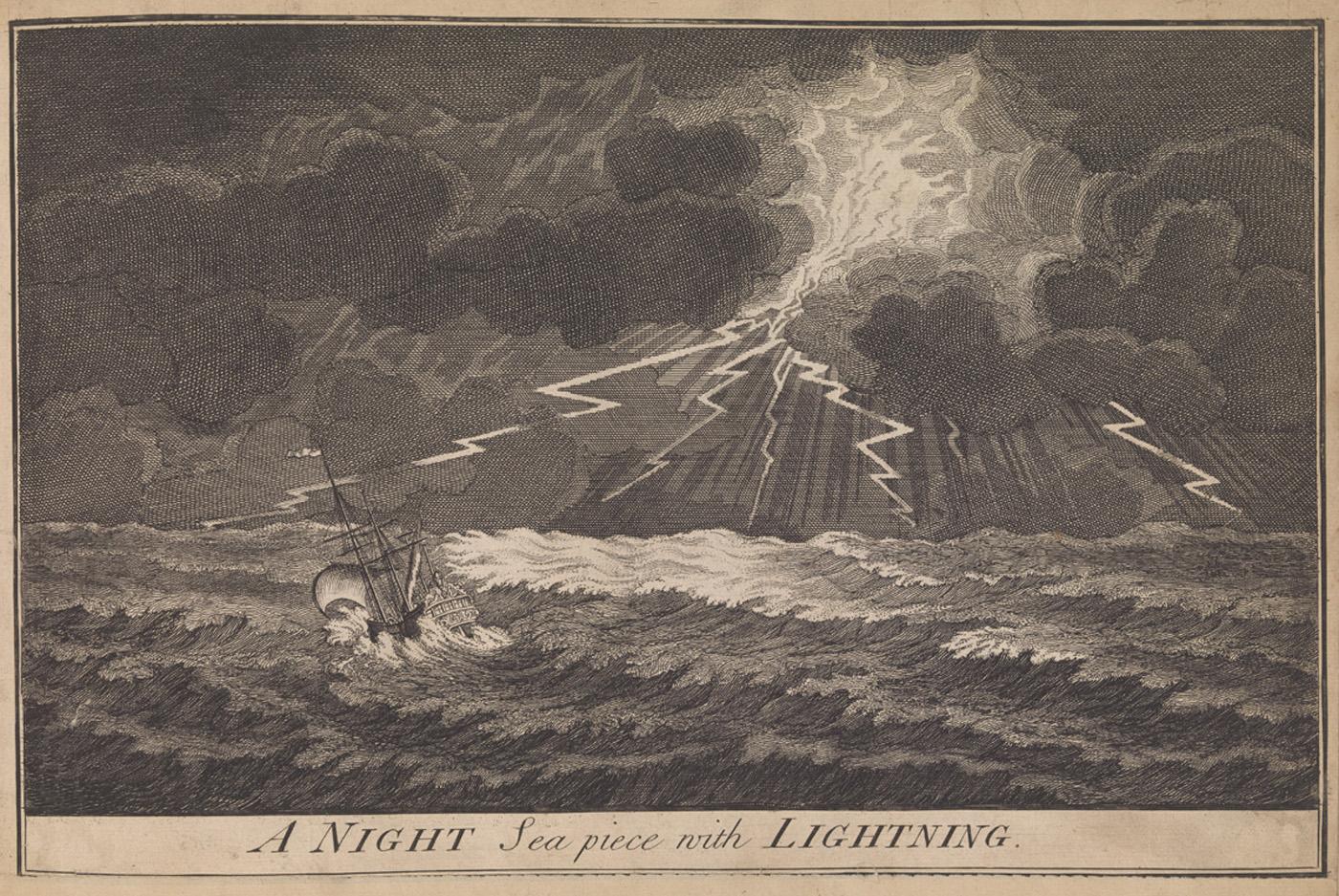
Lightning at sea is less common than on land, but more intense, and before the era of lightning conductors, wooden ships with their tall masts were at risk of damage, fires, injuries, deaths and total loss. Effective lightning conductors are seen from the 18th century, with improved fixed conductors devised in the early 19th, though initially there was a reluctance to install them. Iron and steel vessels were not immune. Seafarers also noticed related phenomena, especially St Elmo’s Fire and ball lightning.
Lightning (sometimes spelled lightening) occurs in turbulent, unstable environments such as thunderstorms, volcanic eruptions, heavy snowstorms and forest fires. In storm clouds the collision of water droplets, ice, hail and graupel (soft hail) leads to a massive charge of electricity. The upper part of clouds becomes positively charged and the lower and middle parts negatively charged. When the insulating properties of the air break down, lightning takes place, which is a massive spark or discharge of electricity that can reach 30,000 degrees centigrade (54,000 degrees fahrenheit). Around three-quarters of lightning is within storm clouds as intra-cloud (IC) lightning or between two or more storm clouds as cloud-to-cloud (CC) lightning.1
About one-quarter of lightning is between a cloud and the ground (which includes the sea). This cloud-to-ground (CG) lightning happens when channels with a negative charge rush down from a cloud towards the ground in a series of steps. Usually called stepped leaders, they are invisible to the naked eye and frequently split into branches. The leaders induce invisible streamers (positively charged channels or connecting sparks) to reach upwards from the ground, and when a stepped leader connects with one or more streamers, a massive flow of electricity occurs – a visible lightning flash or bolt. Not all streamers connect, but those from taller features such as mountains, buildings, trees, telegraph poles and even people and animals are more likely to do so.2
Lightning causes the air to heat up rapidly and explode, resulting in a shockwave. Because light travels considerably faster than sound, lightning is seen first, while the sound of the shockwave – thunder – lags behind. A flash of lightning followed by thunder 5 seconds later shows that the lightning discharge is about a mile away. If thunder is heard, but no lightning seen, the storm is probably up to 25 miles away. If virtually no time elapses between the lightning and thunder, it is extremely close or overhead, and the smell of ozone may be evident.3
Seawater contains dissolved salt in the form of positively charged sodium ions and negatively charged chloride ions, which react to the presence of storm clouds and make the sea an efficient conductor of lightning. Only about 10 per cent of lightning occurs at sea, but it is more intense and spectacular, as noted by Claude Woollard, an apprentice on board the Penrhyn Castle in 1900, when they were in the region of the equator: ‘The lightning displays during dark hours were sometimes remarkable and blinding.’4 Lightning takes the path of least resistance, which often means connecting with streamers from the tallest objects. This makes sailing ships with their lofty masts particularly vulnerable. Shipping can be hit by direct lightning strikes, but when lightning touches the seawater, it spreads horizontally across the surface, rather than going downwards, and so nearby vessels are also liable to be hit.5
In August 1798, a few days after the Battle of the Nile, the warship Goliath was struck by lightning, leaving 14-year-old Midshipman George Elliot badly injured and acutely aware of lightning strikes: ‘I never was a year in the Mediterranean without the ship being struck, but without serious injury to any of the crew.’6 William Snow Harris was a physician, natural philosopher and skilful yachtsman based at Plymouth in Devon who was fascinated by magnetism and elecricity, and in his 1843 book On the Nature of Thunderstorms he discussed the number of warships struck by lightning:
Since the commencement of the war in 1793, more than two hundred and fifty ships are known to have suffered in thunderstorms ... Though we have not the same means of ascertaining the damage done to our mercantile marine, yet the loss to the shipping interest, in consequence of lightning, must be extremely great. Scarcely a year passes, without a calamitous account appearing in the public prints, of some fine merchant ship having been damaged or totally destroyed.7
Even experienced seafarers could find thunderstorms alarming, like James Learmont on his first voyage to Chile as master of the full-rigged iron ship Brenhilda. By June 1902 they were close to the River Plate: ‘About midnight the darkness was “as black as the Earl of Hell’s riding boots”; suddenly with a flash the whole sky lit up, the lightning making it a mass of fire. It was really terrifying.’8The year before, Rex Clements was an apprentice on the three-masted steel barque Arethusa, and he was astonished by one thunderstorm as they approached Newcastle, New South Wales: ‘The lightning display ... was most curious – broad sheets erratically switching on and off like a gigantic electric-light ... The wind sprang up ... and the incessant lightning was no longer sheet but forked, while the thunder gave off a continuous ear-splitting roll of sound. To work aloft under such conditions was anything but pleasant.’9
Thunder was not mentioned by seafarers as much as lightning, but George Cockell described it on board the full-rigged three-masted iron ship Scottish Isles in 1900: ‘When in the latitude of the River Plate, one midnight we fell in with an electric storm, during which there was torrential rain and vivid and continuous lightning. The peals of thunder were deafening and, on that occasion at least, justified the expression “heaven’s artillery let loose.”’10 Godfrey Wicksteed was likewise affected as an able seaman on board the three-masted iron ship Transocean in May 1922: ‘The wind was making such a row that we never heard the thunder until one peal burst right on top of us and made us all jump. It sounded like all the sails carrying away’. He then explained: ‘please note that sails carry away “with a clap like thunder”.’11
The smell of lightning is said to be like ozone, acrid and metallic, but seafarers repeatedly likened it to sulphur, with Harris recording how the ‘suffocating smell of sulphureous matter is the most marked on shipboard ... The sailors always describe the odour as an intolerable stench of sulphur and brimstone’.12 This happened when the fishing smack London was struck by lightning on 29 August 1832 off St Abb’s Head, on the Northumberland coast: ‘the electric fluid ... knocked down several men, started some planks and bolts, filled the hold with dense sulphureous smoke, and left a coating of black bitumenous matter on a large extent of surface’.13 Similarly, when the brig Frisk was struck by lightning in May 1842, Andrew Livingston, a master mariner from Liverpool, told The Nautical Magazine that ‘After the lightning descended into the hold the vessel was filled with a thick sulphureous smelling smoke.’14
In the past seamen frequently described strange phenomena that are not always easy to interpret, but some will have been unusual aspects of lightning, in particular ‘transient luminous events’ (TLEs). Examples include red sprites, the name given to a reddish-orange burst of electricity high above storm clouds. Some lightning (perhaps 5 per cent) has a positive charge and is a much more powerful type of cloud-to-ground lightning than negative lightning. These lightning bolts or flashes can even move horizontally from a cloud for long distances before striking the ground without warning in a clear sky – literally, a bolt from the blue.15
Meteors (also described as shooting stars or fireballs) were once thought to be lightning, and the word meteor was commonly applied to ball lightning, which can occur in thunderstorms or as single events.16 Eyewitness accounts mention a glowing or burning sphere that travels more slowly than a lightning bolt, at times accompanied by a noise like thunder and a smell of ozone or sulphur. It can simply disappear, break into smaller balls or explode and cause considerable damage. One eyewitness was Robert Seyboth of the United States Weather Bureau, who related that in 1867 he was on board a ship in the Hudson Bay during a storm when he noticed an evil-looking cloud ‘and saw a ball of fire the size of a man’s head detach itself from the cloud and sail quite leisurely to the mizzen truck, striking which it exploded with a deafening crash and sent a shower of hissing sparks over rigging and deck’.17
Ball lightning was also confused with St Elmo’s Fire, an electrical discharge from the tips of pointed objects such as masts and yards, with a greenish-blue or violet glow. It resembles a fireball, but does not burn or explode. Seafarers noticed it mainly in thunderstorms, at times accompanied by a hissing or crackling sound. The name St Elmo’s Fire is derived from St Erasmus, a patron saint of sailors, and the phenomenon was generally believed to occur towards the end of a thunderstorm, a sign of salvation marking the return of fine weather. On 13 August 1825 the naval sloop HMS Blossom left Rio de Janeiro, and the next day Captain Frederick William Beechey recorded a thunderstorm with sheet and forked lightning, and towards the end St Elmo’s Fire, which he called meteors: ‘Shortly after midnight, a vivid flash of lightning left five meteors upon the mast-heads and topsail yard-arms, but did no damage: they were of a bluish cast, burnt about a quarter of an hour, and then disappeared. The weather almost immediately afterwards moderated, and the thunder cloud passed away.’18
Beliefs in St Elmo’s Fire were inconsistent, as it was also observed before and during thunderstorms. In early September 1886 the three-masted iron ship Avoca was rounding the Cape of Good Hope on a voyage from Calcutta (now Kolkata) to Demerara and Barbados with a cargo of rice and over 600 indentured emigrant labourers. Captain N G Hatch reported:
During the night we had a terrific thunderstorm, and I do not remember ever having experienced such vivid lightning; the air seemed charged with electricity, all the yard arms and mast heads were lit up with the St. Elmo lights; at intervals the whole of the ship seemed ablaze with the vivid flashes of lightning, every rope and spar plainly visible – and then complete darkness.19
According to Alfred George Course, seamen regarded St Elmo’s Fire as a bad omen. In late 1911 he was an apprentice on board the three-masted steel barque Lorton, and as they sailed from Chile to Newcastle, New South Wales, he saw St Elmo’s Lights for the first time when the captain told him to look up to the yard arms: ‘I received a shock for there, on the end of each steel yard arm, was a brilliant bluish light. The immediate effect in the black darkness was terrifying, more especially as I had then no idea what could be the cause; no wonder sailors looked upon them with foreboding. But in our case they were not the fore-runners of bad weather.’20
Lightning conductors (or rods) do not prevent lightning, but instead provide a safe low-resistance pathway to the ground – land or sea – without causing heat damage or injury. They channel lightning through or round a vessel and into the sea, keeping it safe, along with the crew and passengers. Wood is a poor conductor of electricity and therefore easily damaged and set alight by lightning strikes, and before lightning conductors it was a matter of chance whether or not a timber vessel was badly damaged. From ancient Roman times a coin was placed under the mast (‘mast stepping’) for good luck, but the archaeologist T C Lethbridge in 1952 related that his friend Dr T T Paterson ‘tells me that an ancestor of his own was struck by lightning at sea and that by tradition his death was believed to have been due to not inserting a coin in the mast’.21 The American three-masted wooden ship Hoogly was sailing from Hong Kong to New York when she was struck by lightning on 11 November 1881 in the Straits of Sunda in the East Indies, killing one seaman. No damage was done to the ship, which was attributed to the presence of glass:
A gin bottle with the neck broken off was on the truck of each mast as a precaution against damage by lightning ... The vessel had just tacked, when out of one of the clouds came lightning, which struck the fore truck and would infallibly have shattered the mast had it not been for the gin bottle ... Beyond the cracking of the bottle no other damage was done. The bottle remains on the truck of the mast.22
The earliest effective lightning conductors or electric chains for ships comprised a copper rod attached to a chain, as described in April 1815 by Henry Walsh, a seaman on board HMS Ulysses, while sailing from Cape Coast in Ghana to the islands of Sao Tome and Principe: ‘There was balls of fire struck our lightening conductors which happily conveyed them down our rigging and fell overboard without any damage either to our ship or men. Those lightening conductors ... is made of brass or copper links or chains which goes over the ship’s royal mast heads down the rigging, and hangs over the ship’s side.’23 The problem with these early lightning conductors is that they were set up only when a thunderstorm was anticipated or had already begun, or else were set up incorrectly, if at all. Because they got in the way, they were afterwards taken down and stored in boxes. It was hazardous for seamen to deal with them, as the naturalist Johann Reinhold Forster observed in August 1773 on board HMS Resolution at Tahiti, when thunderstorms were threatening:
... we were now and then obliged to fix the electric chain, to prevent fatal accidents ... the man who was sent up to the main top-gallant mast head, had scarcely fixed the chain, and another man was still clearing it of the main-chains and shrouds, when the latter received an electric shock, and the fire was seen running down the chain into the water, without doing any damage.24
During a passage on board the three-masted wooden packet ship George Washington from New York to Liverpool in June 1841, Samuel Leech, a former seafarer, described one storm when their temporary conductor was not set up: ‘More thunder and lightning, which threatened vengeance on our poor ship. The lightning is very sharp; we have no conductor up; it plays all around us, and, as it strikes the water, it hisses like red-hot iron. Several of the sailors felt a shock in descending the rigging, especially the first and second mates. We expected it would strike us every moment.’25
Two decades earlier William Snow Harris had devised an improved lightning conductor that was fixed in place down the mast and passed through the hull so as to connect with the exterior copper sheathing, and fittings were attached to other danger points such as the rigging in order to prevent side flashes. For years Royal Navy and merchant ships were resistant to this idea, and on the death of Harris in 1867, the scientist Charles Tomlinson said that ‘the most erroneous views were held respecting the phenomena of a thunder-storm, and the action of conductors. It was considered by many highly-educated persons, especially among naval men, that conductors did more harm than good.’26 Iron and steel vessels, including their masts, rigging and hull, acted as lightning conductors, but properly installed lightning protection systems are still advisable, especially today with so much electronic equipment. The safest place was below deck, and working aloft could be unnerving, as described by Rex Clements on board the steel barque Arethusa, but apprentices had no choice: ‘To lay out on a royal yard with a thunder squall rattling about one’s ears and the lightning ripping zig-zags all round, induces a tickling sensation in the bottom of one’s spine. But ship’s spars are seldom struck, and if ours were, we reflected, we shouldn’t know much about it.27
Casualties did happen, ranging from minor to serious incidents, including death, with all manner of injuries, many seemingly inexplicable, some short-lived, others permanent, along with occasional tales of lucky escapes. On board merchant ships, especially sailing vessels, it was the captain who dealt with medical matters, but even surgeons of naval ships struggled with lightning-related conditions, as revealed in descriptions written in their journals.28 Lightning-related incidents were newsworthy and frequently featured in local and national newspapers. On 18 July 1834 the sloop Elizabeth and Catherine, laden with limestone, was 3 miles off the Welsh coast at Worms Head heading for Appledore in Devon when she was struck by lightning. Fire was prevented by torrential rain and hail, but one seaman, James Kelly, was left hanging in the rigging, while the master, John Bassett, and another seaman, were knocked out. They eventually hauled Kelly down and ripped off his trousers, as he said his leg was broken. Newspapers reported that ‘they discovered that the poor fellow’s leg was burnt in a deplorable manner; and ... that the electric fluid had entered at his bosom, and passing between his clothes and skin, had escaped at his ancle; his linen, and all the interior part of his clothes were reduced to a mere tinder, and his body was scorched from head to feet.’ He was so badly injured that a subscription was opened to support him, his wife Peggy and four children.29
Lightning also disrupted equipment such as chronometers and compasses and remains a challenge today, since electronic equipment can be severely damaged. Andrew Livingston informed The Nautical Magazine about the wooden sailing brig Inca, under Captain J Lincoln, being struck by lightning in the 1830s:
... her compasses were changed about four points, and her two chronometers rendered useless. The master until he obtained observations was steering direct for America; and afterwards the chronometers, although repaired, were never good; and when I was last on board of her in dock here [Liverpool], the person who succeeded Mr. Lincoln in the command [Harrison], told me ‘her compasses were never right.’30
In September 1886 the Avoca nearly missed calling at St Helena, a navigation error that prompted Captain Hatch to compare his normally reliable chronometer with one from a German gunboat moored nearby: ‘I found to my surprise that my time was over 20 miles to the westward.’ He and a German officer agreed that it was most likely due to the electric storm a few days earlier off the Cape of Good Hope.31 In mid-August 1908 the steel screw steamer Whitewood was crossing the North Sea from Bremen in Germany. Captain Robson reported that they passed through ‘a sharp and dangerous electrical disturbance’, followed by lightning and a terrific clap of thunder. The steamer staggered, throwing him to the deck, splitting one mast and seriously affecting the compasses. Rather than trusting them, which he later realised would have led him to the coast of Norway, he instead took bearings from the sun and steered safely towards Bo’ness on the Firth of Forth.32
Countless ships with their crews were undoubtedly lost without trace due to lightning, either through navigation errors or from extensive damage to the vessel, especially fire. At times a ship’s fate was learned from crews rescued from stricken vessels or picked up from their lifeboats. In late November 1870 the American wooden barque A B Wyman was sailing across the Atlantic from Savannah to Liverpool with 2,700 bales of cotton, when lightning struck the mainmast and set fire to the cotton during a severe storm off the Banks of Newfoundland. Her captain changed course in an attempt to reach land, and on 10 December she was spotted by the Belgian sailing ship Charles Bengian, whose captain, F Lechere, bravely boarded the A B Wyman. The heat was almost intolerable, smoke issued from the seams, and he found the entire crew on deck, waiting for their captain’s order to launch their boats. They were all safely rescued by the Charles Bengian and taken to New York, 900 miles away. The scale of the disaster was apparent when the last of the crew opened the main hatch: ‘The whole ship was at once a mass of flames, and had the rescue been postponed much longer the whole crew would probably have perished.’33
Five years earlier, another disaster was observed when a severe storm developed over the fishing village of Filey, North Yorkshire, in the early hours of Sunday 26 March 1865. At its peak, The York Herald reported, ‘The wind came down in sudden gusts and was accompanied by sleet and snow and most vivid and frequent flashes of lightning, which were of an awful character to behold.’ The coastguard was watching out for ships in distress, and at dawn one vessel without masts was spotted 3 to 4 miles away: ‘The fishermen ran to the cliffs, expecting every moment to see her founder; but by the aid of a telescope was seen a small sail, hoisted on a spar, near her bows, with a flag of distress flying.’ Filey’s new lifeboat, the Hollon, was immediately launched and rescued the crew of three men and one boy, who were full of gratitude. They were from the schooner Kate of King’s Lynn, and Captain Newby said that they had left Middlesbrough with a cargo of coal the previous day. Just north of Scarborough, ‘about the height of the storm, a body of awful lightning, which he cannot describe, struck the ship, completely carrying away masts, bowsprit, and rigging with a tremendous crash’.34 Two nearby vessels were unable to help, and so they were resigned to being lost at sea.
In less fortunate circumstances, the Kate would have been one of those ‘posted missing’, assumed to have been overwhelmed by the heavy seas rather than struck by lightning. Serious scientific studies of electricity and its effect on ships gathered pace in the 19th century, and scientific understanding and technological improvements took the place of trial and error, guesswork and even superstition. Lightning protection is now much more sophisticated, with the additional ability to track and steer clear of storms, so that lightning strikes are no longer such a danger.
Lightning reflected at night within clouds is called sheet lightning. The tops of towering storm clouds often have an anvil shape. 30,000 degrees centigrade is hotter than the sun’s surface.
Lightning is referred to as forked or fork lightning, where it has multiple branches. Lightning bolts are about 1–2 inches (2–5 cm) in diameter. The visible electrical discharge is known as the return stroke.
Light travels about a million times faster than sound. Counting the seconds between lightning and thunder and dividing by 5 gives the distance of the storm in miles (divide by 3 for kilometres). Much of this section is based on various websites, in particular: National Oceanic and Atmospheric Administration ‘How Lightning is Created’ (last modified 5 April 2023) (https://www.noaa.gov/jetstream/lightning/how-lightning-is-created); ‘The Positive and Negative Side of Lightning’ (last updated 5 April 2023) (https://www.noaa.gov/jetstream/lightning/positive-and-negative-side-of-lightning); Royal Meteorological Society ‘Types of Lightning’ (posted 18 December 2017) (https://www.rmets.org/metmatters/types-lightning); and John Zavisa & Jesslyn Shields ‘How Lightning Works’ in ‘How Stuff Works’ (https://science.howstuffworks.com/nature/naturaldisasters/lightning.htm).
The negatively charged base of a storm cloud causes the positive seawater ions to cluster, while repelling the negative ions. See https://www.rmets.org/metmatters/what-happens-when-lightning-strikes-ocean; Claude L A Woollard 1967 The Last of the Cape Horners (Ilfracombe: Arthur H Stockwell), p 35.
See https://oceantoday.noaa.gov/lightning/ and https://www.rmets.org/metmatters/what-happens-when-lightning-strikes-ocean
Roy and Lesley Adkins 2006 The War for All the Oceans: From Nelson at the Nile to Napoleon at Waterloo (London: Little, Brown), p 70.
W Snow Harris 1843 On the Nature of Thunderstorms; and on the means of protecting buildings and shipping against the destructive effects of lightning (London: John W Parker), pp vi–x; W Snow Harris 1847 Remarkable Instances of the Protection of Certain Ships of Her Majesty’s Navy from the Destructive Effects of Lightning (London; and pp 72–3 of Sara Caputo 2025 ‘“One of the most alarming casualties to which the Sailor is exposed”: British Naval Medicine, Embodied Knowledge, and the Experience of Lightning at Sea, 1750–1840’ Transactions of the Royal Historical Society 3, pp 71–94. For William Snow Harris, see Charles Tomlinson 1967 ‘Biographical Notice of the Author’ in William Snow Harris 1967 A Treatise on Frictional Electricity, In Theory and Practice (London: Virtue and Co).
James S Learmont 1954 (2nd edn) Master in Sail (London: Percival Marshall), p 55. They were voyaging from North Shields to Valparaiso in Chile. For fear, see also Caputo 2025. The Brenhilda was built in 1874 by Barclay, Curle & Co at Glasgow, ON 13307, rated X100A1 by Lloyd’s Register in 1902 (when the vessel was noted as having been altered to a barque). See Lloyd’s Register of British and Foreign Shipping, from 1st July, 1902, to the 30th June, 1903. Volume II.–Sailing vessels (London).
Rex Clements 1925 A Gipsy of the Horn: The narrative of a voyage round the world in a Windjammer twenty years ago (Boston & New York: Houghton Mifflin), p 106 (first published 1924 by Heath Cranton). Clements was born in 1885. This was in May 1901. The Arethusa was built in 1891 at Dumbarton by A McMillan & Son, official number 98314, call sign MKRW, rated X100A1 by Lloyd’s Register. See Lloyd’s Register of British and Foreign Shipping, from 1st July, 1900, to the 30th June, 1901. Volume II.–Sailing vessels (London). There were two vessels by this name rated as X100A1. ThisArethusa was scuttled by a German submarine on 23 April 1917.
See p 371 of G A Cockell 1928 ‘Scottish Isles: Notes on a Good Passage’ Sea Breezes: The P.S.N.C. Magazine 10 (March 1928), pp 370–2. Captain George Albert Cockell (1878–1928) was an Australian who became harbourmaster at Maryport, Cumbria, and died aged 50 in September 1928 in a bicycle accident. In 1900 he was a crew member (possibly second or first mate), and the master was Captain F Stone. The Scottish Isles was built at Liverpool in 1883 and rated X100A1 by Lloyd’s Register. See Lloyd’s Register of British and Foreign Shipping, from 1st July, 1900, to the 30th June, 1901. Volume II.–Sailing vessels (London).
Godfrey Wicksteed 2018 Trading by the Wind: Sea Diaries 1919–1923 (edited and published by Brenda Tyler), p 54. This was his diary entry for 11 May 1922, when they were in the Indian Ocean (p 49), sailing eastwards towards Melbourne in Australia. The Transocean was built as the Skelmorlie in 1883 at Port Glasgow and was also known as Cerro Alegre and Puerto Mont. In 1922 she was in Swedish hands and in 1924 was broken up.
Letter from William Snow Harris to Charles Tomlinson on 10 August 1842 (Tomlinson 1867, p xiv). See also Caputo 2025, pp 72, 84, 86, 91.
The Edinburgh Evening Courant 1 September 1832, p 4. The London came from Banff in Scotland.
See p 641 of Andrew Livingston 1842 ‘Effects of Lightning’ The Nautical Magazine and Naval Chronicle for 1842, pp 641–2. TheFrisk was built at Whitby in 1835, rated A1 by Lloyd’s Register, and was struck by lightning 2 miles off Toe Head, County Cork, on 22 May 1842. See Lloyd’s Register of British and Foreign Shipping, from 1st July, 1842, to the 30th June, 1843 (London).
Other examples of TLEs are gigantic jets, blue jets, elves, trolls, pixies and gnomes. National Oceanic and Atmospheric Administration ‘The Positive and Negative Side of Lightning’ (last updated 5 April 2023) (https://www.noaa.gov/jetstream/lightning/positive-and-negative-side-of-lightning). Megaflashes have been recorded travelling hundreds of miles in cloud-to-cloud lightning in intense storms.
Meteorology is not the study of meteors (they were given that name in the belief that the phenomenon was atmospheric).
Scientific American 86 no 3 (January 1902), p 36. Robert Seyboth (1846–1921) was originally a signal officer in the army, and in 1870 the Signal Corps took over the Weather Bureau, where he worked for almost 50 years. He was knocked unconscious by the ball lightning and temporarily paralysed. The mizzen truck was the capping of the mizzen mast through which halyards were passed for flag signals. For examples and theories, see Royal Meteorological Society ‘Ball Lightning’ (https://www.rmets.org/metmatters/ball-lightning) and ‘Ball Lightning’ (https://en.wikipedia.org/wiki/Ball_Lightning).
F W Beechey 1832 Narrative of a Voyage to the Pacific and Beering’s Strait, to co-operate with the Polar Expeditions: performed in His Majesty’s Ship Blossom (Philadelphia: Carey & Lea), p 19. St Elmo’s Fire had many other names, including St Elmo’s Lights and corposant, which meant literally ‘holy body’. See Angelo S Rappoport 1928 Superstitions of Sailors (London: Stanley Paul & Co), pp 52–61.
See p 246 of N G Hatch ‘Coolie Ship Days: Three Years in the Avoca. Part II’ Sea Breezes: The P.S.N.C. Magazine 9 (February 1927), pp 246–50. The storm occurred when the Avoca had just passed Cape Francis. They reached Cape Point on 4 September and St Helena nine days later. The Avoca was built at Greenock in 1885, official number 91888. Hatch was her first master. She was rated X100A1 by Lloyd’s Register. See Lloyd’s Register of British and Foreign Shipping, from 1st July, 1886, to the 30th June, 1887 (London).
A G Course 1951 (2nd edn) The Wheel’s Kick and the Wind’s Song (London: Percival Marshall), pp 119–20. Captain G Laurenson was the Lorton’s master. The Lorton was built at Belfast in 1888 and rated X100A1 by Lloyd’s Register. See Lloyd’s Register of British and Foreign Shipping, from 1st July, 1910, to the 30th June, 1911. Volume II.–Sailing vessels (London).
T C Lethbridge 1952 Boats and Boatmen (London & New York: Thames and Hudson), p 86. Dr Thomas Thomson Paterson (1909–94) was a scholar in many fields.
Evening News (Portsmouth) 28 February 1882, p 3, taken from New York World of 13 February 1882. See also Annual Report of the Operations of the United States Life-Saving Service for the fiscal year ending June 30, 1882 (Washington: Government Printing Office 1883), p 349. The Hoogly was 1,159 tons. The incident took place off Anjier Point, Java. Glass is a good insulator, but is unlikely to have been effective here, though glass balls were supposedly buried in the top of some masts to repel lightning (https://en.wikipedia.org/wiki/Lightning_rod).
See p 246 in T W Moody (ed) 1961–2 ‘An Irish Countryman in the British Navy, 1809–1815’ The Irish Sword 5, pp 236–50. Walsh was from an Irish farming family and ran away to sea at the age of 25 in 1809. Copper is a very good conductor of electricity, though nowadays aluminium is also used. His description implies there was ball lightning during the storm.
John Reinhold Forster 1778 Observations made during a voyage round the world, on physical geography, natural history, and ethic philosophy (London: G Robinson), p 119. Johann is anglicised as John in this publication. Forster was the naturalist for Captain James Cook’s second Pacific voyage that left Plymouth in July 1772.
The storm took place at 2pm on 12 June 1841, with another earlier that morning. Samuel Leech 1843 Thirty Years from Home, or a voice from the main deck being the experience of Samuel Leech (Boston: Tappan & Dennet), pp 289–90. Leech (1798–1848) was born in Wanstead, Essex, and from the age of 12 served in the Royal Navy and took part in the War of 1812, during which he was captured and then joined the United States navy. The George Washington, 609 tons, was built in 1832 at New Bedford, Massachusetts, for the Blue Swallow Tail Line. Charles Dickens sailed in this vessel on the same passage exactly one year later, in June 1842 (see https://www.charlesdickenspage.com/sailing-1842.html). She was converted to a whaler in 1845.
Tomlinson 1867, pp x–xi, xv–xvii (the quote is on p x). See also William Snow Harris 1823 Observations on the Effects of Lightning on Floating Bodies (London: W Nicol); Harris 1847; and Allison Marsh 2025 ‘Past Forward: The British Navy Resisted a Decent Lightning Rod for Decades: Inventors vs. bureaucrats during the age of sail’ IEEE Spectrum. (https://spectrum.ieee.org/lightning-rod-2671217505). The Russian Navy adopted lightning conductors before the Royal Navy.
Clements 1925, p 244. This was close to the Azores in May 1902.
See Caputo 2025.
The Elizabeth and Catherine was built at Barnstaple in 1815 and wrecked in 1838. See The Register of Shipping for 1828 (London). The disaster is reported in The Western Times 26 July 1834, p 3, and The True Sun 28 July 1834, p 1. See also Vernon C Boyle and Donald Payne 1952 Devon Harbours (London: Christopher Johnson), pp 168–9, for a reprint of the subscription 115 years later in the local newspaper at Bideford. The Kelly family lived at Appledore.
Livingston 1842, p 641. The 217-ton Inca brig was built at Liverpool in 1825 and wrecked in May 1840. Lincoln was her master from 1827 to 1838. Livingston did not know the precise date of the lightning strike. See Lloyd’s Register of British and Foreign Shipping. From 1st JULY 1835 to the 30th JUNE 1836 (London).
Hatch 1927, p 248. The Avoca reached St Helena on 13 September 1886.
Daily Telegraph & Courier (London) 17 August 1908, p 7. The Whitewood screw steamer was built in 1907, official number 125422, and rated X100A1 by Lloyd’s Register. See Lloyd’s Register of British and Foreign Shipping, from 1st July, 1908, to the 30th June, 1909. Volume I.–Steamers (London).
In early December 1909 the Whitewood went missing on passage to Bremen with coal in a severe storm. See https://www.wrecksite.eu/wreck.aspx?140597 for the wreck.
Cheltenham Examiner (supplement) 11 January 1871, p 9. The A B Wyman was built in 1866, and her captain was also Wyman. The lightning struck on 28 November 1870. The CharlesBengian was going to New York from Antwerp. She was a smaller sailing vessel, 586 tons, and was involved in the 1860s in trips to Australia, also under Captain Lechere.
The Hull Advertiser 29 March 1865, p 4; The York Herald 1 April 1865, p 10; The Life-Boat or Journal of the National Life-Boat Institution 5 no 58 (2 October 1865), p 737. The lifeboat was just over a year old, a 33-foot Peake Self-Righting vessel.
Learning from past maritime disasters to develop a global perspective and integrate lessons learned to advance maritime safety, resilience and sustainability.
Explore the behind the scenes process of filming the Argentina, a 'votive', the Aeolus and the East Indiaman ship models at the National Maritime Museum, Sweden.
Explore the behind the scenes filming of the Cold War Rail Ferry, Oasis of the Seas, Stena Drillmax and Olympic Loyalty ship models at the IMO's headquarters.

