


Theme 3: Safety – Shipwrecks and Maritime Disaster
Learning from past maritime disasters to develop a global perspective and integrate lessons learned to advance maritime safety, resilience and sustainability.
This page is approximately a 6 minute read
Dr Marcelo Weissel, Founder of the Fundación Museo Histórico de La Boca
Marcelo N. Weissel holds a PhD in Archaeology from the University of Buenos Aires and specializes in maritime, port, and coastal heritage archaeology of the Río de la Plata and the South Atlantic. A researcher and professor at the National University of Lanús, he has dedicated his career to the study of the archaeological landscape of the port of La Boca.
He is also a member of the International Congress of Maritime Museums (ICMM) and founder of La Boca Archaeological Museum Foundation, dedicated to enriching our understanding of the ocean, ports, and rivers through archaeology and maritime heritage research.
For over 490 years, the port of the city of Buenos Aires has been located at the mouth of a Riachuelo river where it flows into the Río de Plata. This challenging location where the wide Río de Plata estuary meets the waters of the Atlantic Ocean has a long history of flooding, strong winds, shipwrecks and fire incidents. Today, can we say that we have learned from the past histories of disaster?
A Fundación Museo Histórico de La Boca project, funded through the Foundation’s Small Grant scheme, is collating a database of historic events of floods, fire, and shipwrecks at La Boca port. The project is conducted by Dr Marcelo Weissel, with the help of local and national Argentinian institutions. Local firefighters of La Boca and Vuelta de Rocha, the Casa Museo Carpintero de Ribera, the Museo Conventillo, the Museo Arqueológico de La Boca (member of the International Congress of Maritime Museums) and the underwater archaeology programme of the National Institute of Anthropology are actively supporting the project, making available a series of fragmented records to researchers and the public for the first time. Records include documentary and published resources, photographs and oral histories/lived experiences.
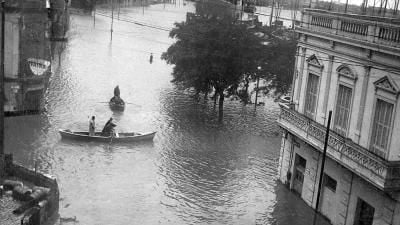
According to the National Hydrographic Service of Argentina, there are records of five flood events for the year 1940, where the water rose over 2.60 m above the Riachuelo’s average level. The flood of the 14 April proved to be the most disastrous, and the worst of the century, as La Boca and coastal neighbourhoods flooded for 40 hours (the combined recorded time for all floods that year is 49 hours), paralysing the city of Buenos Aires and great part of the province. Water reached the highest historical record of 4.65 m above average, according to La Boca firefighters.
The April 1940 flood was the product of a meteorological phenomenon common to a vast region around the estuary of the Río de la Plata, the Sudestada (a strong southeasterly wind). This happens when cold southwestern winds saturate masses of polar air with humidity and the southeastern winds blow against the current, being aligned to the estuary, interfering with the regular flow of the Río de la Plata and its tributaries. The difficulty in drainage combined with strong winds increases the risk of floods along the coast.
Since 1938, there had been a system of floodgates to prevent water from entering through the drainage channels of the low-lying area. However, such was the force and speed of the current that the system proved ineffective. Within La Boca neighbourhood, many dwellings were wooden tin-roofed huts on stilts. Here, the local population was evacuated by canoe from their windows, with people seeking safety on top of tables and furniture awaiting to be rescued.
Police and firefighters joined forces to rescue the inhabitants. Several coastal islands were entirely submerged, including the Isla Paulino next to the port of La Plata, several miles southeast. The total number of casualties is unknown, with the number of deaths estimated in the dozens. Extensive work to raise the level of the main streets was undertaken after the flood, on the initiative of the national government.
The local community at La Boca still remembers the April 1940 event, with a deeply rooted awareness that if water should rise over 3.80 m above average, the flood will be as equally disastrous. “3,80 y Crece” (3.80 and Growing) is the name of a local theatre group, the name chosen to represent resilience against adversity. From 1905 to 1990, 81 floods with water levels exceeding the average by 2.80 m triggered the population evacuation protocols.
Today, the area is part of Dock Sud in Buenos Aires, a port established in 1889 and completed in 1905 by the Great Southern Railway Company. It covers 380 hectares and support more than 40 companies.
This is the area of the port infrastructure of Buenos Aires dedicated to the reception, storage and distribution of fuel. This includes the gas carrier and tanker terminals, and petrolchemical plants and refineries.
On the night of the 28 June 1984, the tanker Perito Moreno burst into flames while unloading fuel at the eastern dock of Dock Sud. The Coast Guard and other firefighters battled the blaze for 11 consecutive days. Perito Moreno was completed at El Ferrol (Spain) in 1967 to Lloyd’s Register class (LR/IMO no. 6512421). She was a motor tanker of 12,622 gross tons operating in coastal waters, fitted with 21 tanks and a capacity of 25,385 cubic metres of oil (more than 2.5 million litres or circa 160,000 barrels).
Perito Moreno was classed with Lloyd’s Register until 1971, and was subsequently out of class. On the night of the 28 June 1984, a fire broke out on board the tanker while it was unloading fuel in Dock Sud. A huge explosion followed, with the vessel breaking in two and flames and thick smoke reaching a height of 200 m. The prompt response of the firefighters prevented the flames from reaching the nearby onshore fuel storage tanks, which would have caused a major catastrophe if they had exploded.
Firefighters battled the blaze for 11 consecutive days. As the fire on the Perito Moreno raged, four crew members jumped off the ship and swam to shore. Ambulance access was difficult due to the intense heat from the blaze spread hundreds of metres around the tanker. The day following the explosion, a group of firefighters climbed aboard to directly tackle the fire at its source, while chain explosions were still happening inside the hull. The Argentinian President Raúl Alfonsín went to Dock Sud in person against the recommendations of his advisors. The entire dock infrastructure was still at risk of explosion.
As the fire intensified in the stern, firefighters were forced to withdraw from the tanker, still trying to prevent the explosion of Tank 6, loaded with 3,000 cubic metres of crude oil. After several more days of efforts, the flames were completely extinguished on the 9 July and a day of national festivities proclaimed for the following day.1
The explosion of Perito Moreno was one of the most memorable events for residents living next to Dock Sud. Local and environmental groups were formed, calling for community relocation and better safety controls at the petrochemical complex.
This Small Grant project has examined fires and floods in the urban area of the Port of Buenos Aires, bringing forward evidence and insight these risks. By revisiting historic events, the study shows how past dangers reappear in the present, reminding us that today’s conditions shape the immediate future. The two cases examined here highlight the need for broad preparedness in managing risk.
In the first case, the risk of water and wind in the Río de la Plata estuary was addressed in 1999 through flood control works in La Boca and Barracas, which tackled the main causes of flooding in the area. On the second issue of fire risk, the dataset on fire‑damaged ruins reveals the complex and sensitive issue of human vulnerability.
Learning from past maritime disasters to develop a global perspective and integrate lessons learned to advance maritime safety, resilience and sustainability.
Explore the practical ways to protect coastlines from pollution, erosion and human impact.
A single cigarette sparked disaster at sea, revealing how small acts can lead to catastrophic consequences for ships and crew safety.


