




Behind the scenes: Ship Models at Sweden’s Maritime Museum
Explore the behind the scenes process of filming the Argentina, a 'votive', the Aeolus and the East Indiaman ship models at the National Maritime Museum, Sweden.
This page is approximately a 18 minute read
Roy and Lesley Adkins, Historians and Archaeologists
Roy and Lesley Adkins are historians and archaeologists who live in Devon. They have written widely acclaimed books on social, naval and military history, including Jack Tar, Gibraltar, Trafalgar, The War for All the Oceans, Eavesdropping on Jane Austen’s England and When There Were Birds. They are Fellows of the Society of Antiquaries, Fellows of the Royal Historical Society and Members of the Chartered Institute for Archaeologists.
Grain came to be traded across the world, and for thousands of years wheat was the most significant crop. Ships even transported grain to the ancient city of Rome from Egypt. Grain is prone to shifting and so is a particularly dangerous cargo and the subject of much legislation. The cargo itself can produce dangerous levels of carbon dioxide and be spoiled by excessive moisture, overheating, mould, insect and rat infestation and germination. Sailing ships carried grain right into the 20th century, with so-called ‘grain races’ for the fastest passage.
The term ‘cereals’ (grasses that produce edible grain) refers to wheat, barley, rye, oats, maize, millet and rice – needed for human consumption and animal feed. More commonly, ‘grain’ is used for wheat and various other crops grown in many countries, and Britain’s 1880 Carriage of Grain Act defined grain as ‘any corn, rice, paddy, pulse, seeds, nuts, or nut kernels’. Captain Thomas’s 1928 book on the stowage of cargoes lists 62 foodstuffs regarded around the world as ‘grain or seed’, including barley, flax, maize, oats, poppy, rice, rye, sunflower and wheat. The generic word ‘corn’ refers primarily to wheat, but also to crops like oats and barley, while in the United States maize is known as corn.1
Grain, especially wheat, became the most important traded commodity and remains crucial today, as bread made from wheat has long been a vital part of the diet, especially in the western hemisphere. Grain was imported whenever it was needed, often from locations with a plentiful harvest to wherever crops had failed or insufficient grain could be grown to support an increasing population, such as in the ancient city of Rome. By the 2nd century BC ancient Rome was taking wheat as tax payments from its provinces, which was sold cheaply or distributed as hand-outs to inhabitants of this immense metropolis to prevent famine or garner votes in elections. Roman emperors continued this practice of subsidised or free grain (the annona), along with free entertainment – chariot racing was especially popular, staged in venues known as circuses and giving rise to the phrase ‘bread and circuses’ for bribes to placate the people.2 Throughout history it has been generally cheaper to transport grain by water than by land, and so the Roman authorities brought in shipments from as far afield as North Africa and Egypt. The Roman seagoing sailing ships were substantial, with some cargoes exceeding 1,000 tons, and the Mediterranean voyage from Italy to Alexandria in Egypt and back again was more than 3,000 miles. The large size of their ships meant transferring the grain to smaller vessels for the journey up the River Tiber to Rome.3
Perhaps the most famous example of grain imported to prevent famine was by the medieval city states of Italy after a period of cool, wet summers and harvest failure, probably due to volcanic activity in 1345. This grain, from the Black Sea region, introduced the Black Death, carried by rats with plague-infected fleas and killing over half of Europe’s population from 1347.4 As European concepts of the world expanded from the Mediterranean to the entire globe, distances increased over which traded goods were shipped. Grain shipped from Russian and Baltic ports came to supply much of Europe, but by the late 19th century the industrialised European nations with their expanding towns and cities imported substantial quantities from Canada, the United States, Argentina, Australia and India. Although steamships replaced sail in many spheres, sailing ships remained economical into the 20th century for bulk cargoes transported over long distances, like guano, nitrate, coal, wool, timber and grain.5
Before loading loose grain (in bulk) or grain sewn up in bags or sacks, the hold needed cleaning, especially where the previous cargo or ballast was dirty or odorous, such as coal or sulphur. The Imberhorne was a large full-rigged iron ship, and after reaching San Francisco in 1902 laden with coal, one seafarer noted: ‘After the completion of discharge came the inevitable, disgusting job of washing down the holds ... preparatory to lining the holds with light timber and burlap.’6 Crew members were generally responsible for cleaning the hold and lining it with wood, known as dunnage, which was needed especially for iron or steel ships, as they were prone to ‘sweating’ (condensation). In his 1858 book on the stowage of cargoes, Robert White Stevens said: ‘All corn, wheat, rice, pease, beans, &c., when in bulk ... should be stowed on a good high platform or dunnage wood, of not less than 10 inches, and in the bilges 14 in. dunnage.’7
Over the dunnage was spread old sails, canvas and matting to prevent loose grain from sinking down into the bilges where water collected. The pumps were also protected. Sailing ships mostly carried grain in bags, but dunnage was still necessary, because rats were likely to damage bags. It was easier to stow the thousands of bags if the gaps between them were filled with loose grain, even though ships were liable for damage to the bags. Stevedores (or lumpers) invariably slit some bags so that grain poured into the gaps. Bags of grain were often hauled aboard in slings from a lighter or from a wharf or jetty. In March 1934 Richard Sheridan, an apprentice in the four-masted steel barque Lawhill, described the process at Port Victoria, Australia: ‘The ketches carried some eighty to one hundred tons of wheat ... We hoisted the grain bags aboard in slings of eight with a steam winch. They were dumped on a platform beside the main hatch, whence they were slid down chutes into the holds, where the stevedores stood ready to receive and stow them.’8 That same year Commander Claude Martin Butlin was a passenger aboard the four-masted steel barque L’Avenir, loading with 46,000 bags of wheat at Port Germein, Australia. He commented on the subterfuge of stevedores: ‘In some ports the stevedores adopt the low trick of carrying a small blade, sharp as a razor, fastened to a ring which is worn on the middle finger. When each bag is in position, a final affectionate stroke will make a slit down the side so neatly that even the most watchful mate is often unable to detect it’.9
Loose grain in bulk is a dangerous cargo, because it flows and shifts easily, causing disasters. By filling the hold up to the top, the cargo had no room to move, but could settle, as Stevens warned: ‘Care should be taken to fill up to the deck between the beams; for a hold, filled on leaving port, will sometimes be found, through settling, only seven-eighths full on reaching its destination.’10 For the most part, sailing ships preferred the grain to be in bags, as this was considered more stable, but from the mid-19th century steamships and the large iron and steel sailing ships might carry loose grain or a partial cargo of loose grain, often with bags of grain and other cargo on top to prevent shifting. On 9 September 1868 the Florence steamship, just two years old, left Trieste (the main port of the Austro-Hungarian Empire) laden with loose grain (barley and maize) and other goods.11 Their destination was London, and on the 26th the Florence was in the English Channel when a violent gale blew up, and the cargo shifted, causing the ship to list. They tried to reach the Isle of Wight, but when battens securing the main hatch were washed away, seawater poured in. Distress ‘flare-ups’ were burned, and in the early hours of the 28th the Fawn pilot boat from Cowes arrived, but the Florence sank. Six people including Captain James Johnson Thompson were lost, but others were saved, as one newspaper related: ‘All, apparently who could, jumped overboard ... and the pilot boat Fawn being in close attendance, and her crew sharply on the lookout, twenty of the officers and crew of the vessel were rescued by her, including the young son of the unfortunate commander.’12
Such tragedies usually meant the loss of all hands, but survivors from the Florence testified at the Inquiry, where James O’Dowd, the Board of Trade’s solicitor, also ‘read some passages from “Stevens on Stowage,” which was considered a very high authority on the matter’. This book was published only a decade earlier, and Stevens had advised: ‘To prevent cargo from shifting, there should be suitable bulkheads and shifting boards, perfectly dry and well stanchioned off the side, and well plated with good cleats.’13 Bulkheads were strong, solid partitions between the holds, while removable shifting boards enabled grain to be loaded in compartments to stop movement, but they were not always fitted, even when required by legislation. The Florence’s first mate, John Young Johnson, informed the Inquiry: ‘The barley in bulk came right up to the deck, in the after hold. It came in sacks, and was shot down the hold. The Indian corn was in bulk in the after hold, and was divided from the barley by 250 sacks of flour ... We shipped a number of oak staves. There were some at the bottom of the ship as dunnage ... There were no shifting boards to keep the cargo together.’ The second mate was more critical: ‘I have been accustomed to carrying grain cargoes for some years, but in sailing ships. It was always carried in bulk. Never carried a full cargo of grain in bulk before without shifting boards. I never heard of the practice of making a bulkhead with sacks until I sailed in a steamer.’14 The Inquiry concluded that although the master was drunk, the ship’s loss was due to the lack of shifting boards:
The Court feels bound to express its opinion that there was a grave omission on the part of those responsible in not having fitted the Florence on this voyage with shifting boards amidships, fore and aft, at Trieste, where grain was stowed in bulk to prevent it fetching way from one side to the other. There is no doubt that had these boards been properly fitted in this ship, this fatal disaster might, in all probability, have been avoided ... The loss of the ship, therefore, must be mainly attributed to the cargo shifting.15
In April 1874 Henry Grant Spence, a shipbuilder primarily of steamships, appeared as a witness before the Royal Commission on Unseaworthy Ships. Lord Eslington asked: ‘Is not a grain cargo the most dangerous of all cargoes?’, to which Spence replied: ‘Yes. It is not the weight of the grain, but the liability to shift which makes it so dangerous.’ Mr E R Arthur, a mariner, shipbuilder and shipping surveyor in north-east England, also testified: ‘A grain loaded ship is usually a very dangerous ship.’ He thought that a third or a half of the cargo should be in bags, ‘and then there would not be the same danger of ships turning over or shifting their cargo’. The subsequent Merchant Shipping Acts of 1875 and 1876 stipulated that if a third or more of the cargo was grain or a similar commodity, it should be in bags, sacks or barrels, or else secured from shifting by boards or bulkheads.16 Even so, grain ship disasters continued, and in the second reading of the Merchant Shipping (Carriage of Grain) Bill in August 1880, Lord Sudeley reported that the Select Committee had examined the situation in Canada:
Evidence was given of the practice prevailing in Canada, and especially in the port of Montreal. Previously to 1873 there were many losses of Canadian grain-laden ships; but since that date, when stringent precautions were adopted, it was a remarkable fact no loss whatever had occurred. The main conditions of the Canadian system were embodied in the Bill, and consisted in the requirement of sufficient and substantial shifting boards, and in the provision of a certain proportion of bags.17
Arguments for all grain to be carried in bags were dismissed, as expressed by John Glover, chairman of the Chamber of Shipping:
It is well known that want of stability, rather than cargo shifting, has led to many of the recent disasters. So much weight of cargo is above the centre of gravity that ships, in nautical phrase, ‘turn turtle.’ Grain in bulk occupies less space than grain in bags; consequently, with the same number of tons of weight on board, the vessel entirely laden with bags would have more weight above her centre than if she had grain in bulk below.18
The improved regulations of the 1880 Act were further amended in 1894 and 1906. Similar regulations were developed globally, leading to the International Code for the Safe Carriage of Grain in Bulk (International Grain Code) in 1991, with amendments that came into force on 1 January 2026.19
After grain is harvested, it continues to absorb oxygen and give off carbon dioxide, water and heat. A cargo is therefore at risk of deterioration if stowed with the moisture content too high or in damp weather. Especially where the cargo temperature is above 25°C, the continuing metabolic processes lead to an accelerated cycle of mould, fungi, bacteria, insect infestation, fermentation, the risk of germination (premature sprouting) and increased heat, along with dangerous levels of carbon dioxide and depleted oxygen. The cargo is also likely to be spoiled or even rot, creating an obnoxious stench. Moisture in a hold could be due to seawater leaking through rotten or damaged timbers, cargo sweat (grain releasing moisture), ship’s sweat (condensation on iron and steel surfaces) and seawater pouring through the hatches, which might result in the grain swelling up and causing structural damage to the vessel.20 Ventilation was critical to reduce the moisture, temperature and carbon dioxide, and the small hatches or hatchways to the enormous holds needed to be secured with tarpaulins, battens, caulking and other suitable materials to try to keep rain and seawater out. In November 1915, during the First World War, the Inverclyde, a three-masted steel barque, left Seattle with a cargo of wheat, possibly all in bags, and two months later encountered such severe weather in the Southern Ocean that the cargo shifted: ‘She laid down until several feet of the lee side of the main hatch were in the water. The lee side of tarpaulin got adrift through wedges and battens being knocked out and water began to go down through the hatches. The cargo was successfully moved, some discarded, and the vessel righted.’21
In September 1916, also during the First World War, the Araby steamer left Liverpool for Argentina to load a cargo of oats that was needed for fodder by the allied armies in France.22 After crossing the Atlantic there and back safely, a German submarine was spotted near Boulogne, so the master took the heavily laden Araby closer to the shore, but she ran aground. Tugs towed her to Boulogne, but the towing hawsers broke, leaving the Araby blocking the harbour entrance, and as the tide receded, she broke her back. In January 1917, part of the cargo was removed, and the Royal Engineers created concrete bulkheads so the Araby was watertight and could be pumped out, before hauling the vessel inside the harbour. She then broke into two parts, which were beached. Further salvage attempts were made months later, but because the holds still contained oats, precautions were taken to clear any carbon dioxide. Disaster struck when one workman collapsed deep in the hold:
Barely making a sound, he staggered and fell on the rotting grain. His comrade, seeing him drop ... at once turned to help the fallen man. By the time he had taken two or three steps the deadly gas had robbed him, too, of his senses. Looking down into the hold, one of the salvage crew saw his two comrades stagger and drop. Regardless of his own safety, he lowered himself to the rescue. The gas was so strong that ... he dropped insensible beside the men he was trying to bring out ... all three men were dead by the time they were brought out.23
Grain cargoes were also spoiled by vermin, especially rats and infestations of insects, a topic that is covered in ‘Vermin at Sea: The Hazards of Unwanted Wildlife, from Lice to Cockroaches, Rats and Shipworm’. The presence of grain encouraged rats, which also endangered crews and the ship, spoiled the cargo and potentially spread disease worldwide. Claude Woollard, second mate of the three-masted steel barque Penrhyn Castle, said that on sailing from Williamstown in Australia in early 1904, rats were a huge problem: ‘There were fights all the time with these pests and we would pick up the nearest article that was handy to kill them.’24 An idea of their numbers was given in 1886 by Captain John Steel: ‘I once caught 63 rats in my longboat by lying some time alongside of a grain laden ship. Of course there would be hundreds in the hold.’25
Ships were fumigated to eradicate vermin, but poisons were liable to affect the cargo and provisions, while traps were of little use. When fumigation was carried out, nobody could go below deck until the fumes cleared, so it was usually done in port before the cargo was loaded. That meant trying to prevent rats from boarding the ship during the loading. In early January 1921 the four-masted steel barque Bellands left Melbourne in Australia, laden with wheat and bound for Europe, but barely a week later Godfrey Wicksteed saw an enormous rat, ‘a survivor of the fumigation’. Owing to the superstition that a ship was doomed if deserted by all the rats, the crew was actually pleased that the fumigation had failed.26 Claude Butlin noted that when L’Avenir arrived in Australia, she was fumigated in accordance with the regulations, but very few dead rats were found. He too considered the fumigation ineffective, because as ‘the voyage progressed, the presence of rats on board became more and more evident’. By the end of the voyage the ship was swarming with rats, who thrived on the wheat: ‘Whenever the holds were opened for ventilation, one could see at a glance the sort of damage that rats do to a cargo. Although there was no lack of wheat lying about, they had seemed to take pleasure in ripping open fresh bags.’27 Nowadays, the fumigation of cargoes and the use of pesticides are strictly controlled.
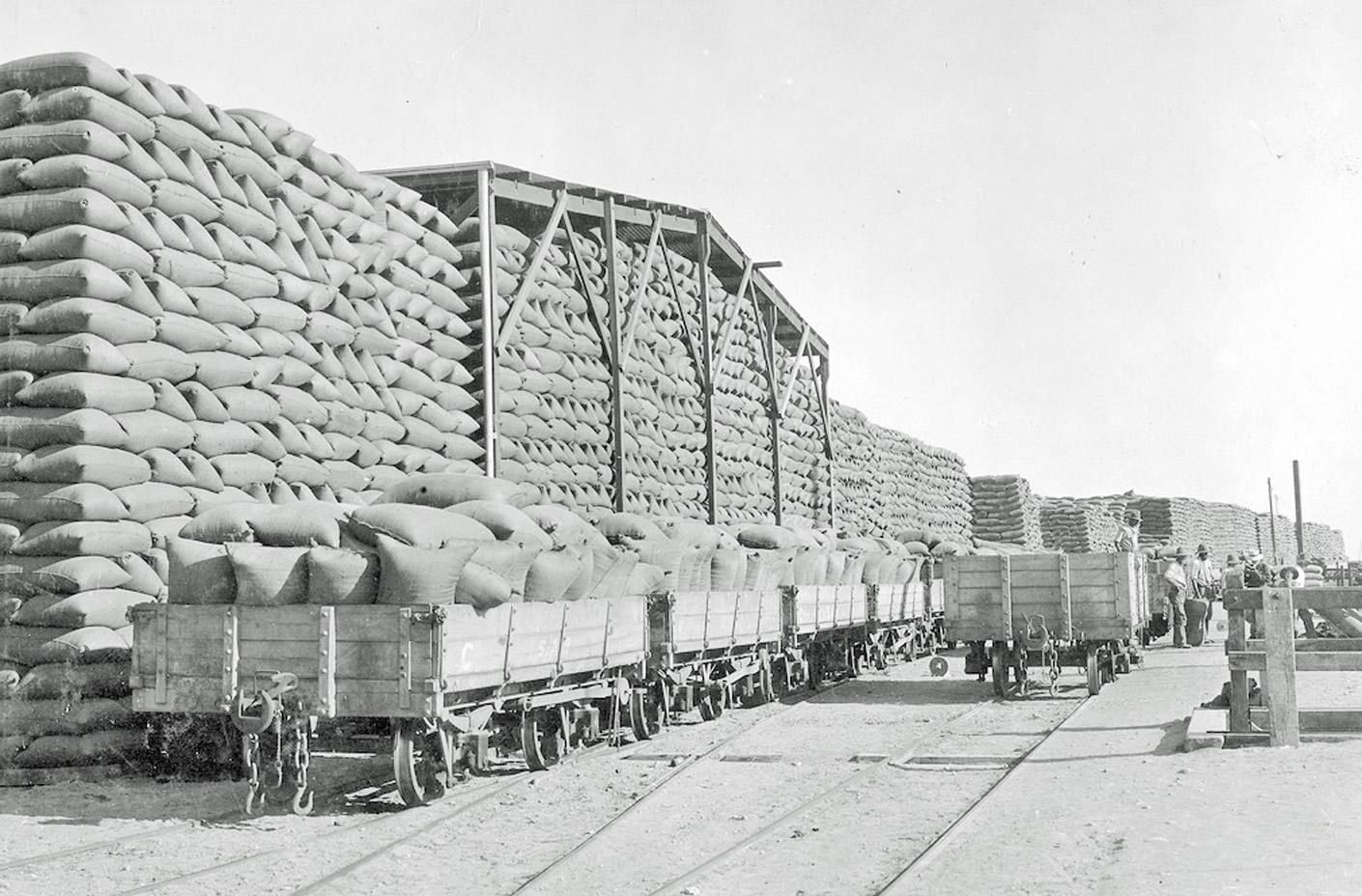
For thousands of years manual labour moved grain contained in bags, baskets and casks. At the ship’s destination, it took weeks to unload using shore labour, but eventually the entire process was mechanised. Mechanical aids such as winches helped take the weight, while steam-powered donkey engines28 on board vessels or at the dockside provided power. A transformation began in the prairies of north America from the mid-19th century, when the invention of steam-powered grain elevators enabled grain to be lifted up by a series of buckets to fill enormous storage buildings that became a feature of the landscape. From here it was taken by railroad to storage facilities at ports, then loaded onto ships, and at its destination discharged into dockside storage elevators, ready for milling into flour or animal feed.29
Ultimately, the pneumatic grain elevator was developed, which can transfer grain to and from ships and storage containers through pipes. As L’Avenir approached the English Channel in June 1934, Butlin thought about the unloading of her cargo:
At some ports, powerful machinery sucks the wheat out of the holds in an incredibly short space of time. It takes longer in a sailing ship than a steamer, as the stevedores must cut the stitching at the mouth of each bag, and empty it into the central pool, into which the trunk of the machine is thrust. The suction is tremendously powerful, for hats, empty bags and shirts are liable to disappear for ever.30
So-called ‘grain races’ between rival sailing ships were unlike the earlier ‘tea races’ where the first ship back could command a higher price for the tea. The winner of each year’s grain race was not necessarily the first to arrive, because the ships set sail at different times and from different ports. The winner was the one who made the fastest passage from South Australia or from Oregon or California to Queenstown or Falmouth for orders.31 The steel barque Lucknow left San Francisco on 3 October 1885 and reached Falmouth 100 days later, to win the grain race of some 18,000 miles. One newspaperman, A H Ballard, was a passenger, and he told the Liverpool Daily Post that they enjoyed friendly wagers on the British ships:
It is a well-known fact that much rivalry as to speed exists among the many large sailing ships that each year bring grain and flour from California and Oregon to England. There is general racing among the fleet as regularly as the autumn comes round, and each commander tries his best to win the race ... Betting before the ships sailed was indulged in by charterers, captains, officers, clerks, and various attaches of shipping affairs ... More than $1,000 were staked on the Lucknow this year, besides suits of clothes, silk hats, etc., without number.32
After the First World War, grain races were a feature of the trade from Australia (mainly the Spencer Gulf ports) to England, and in March 1932 twenty square-rigged ships had similar charters, including the Parma, Pamir, C B Pedersen, Melbourne and Archibald Russell. Alan Villiers was on board the Parma, laden with 62,650 bags (5,200 tons) of wheat: ‘In the Parma we were not out to race, but to deliver our cargo. There was nothing to be gained hurrying in from the sea.’ Even so, he reckoned that these five ships had a chance for a real race:
Of course, none of the masters would admit that he was racing. “If there is a race, I’m not in it,” said the Pamir’s commander. “If there is a race, count me out of it,” said the master of the Melbourne. “I have never raced in my life,” said Captain de Cloux ... Well, well, well! No one is going to race, but all desperately anxious to be first!33
The winning ship of the 1932 race was the Parma, completing the passage from Port Broughton round Cape Horn to Falmouth in 103 days. The last true Grain Race took place in 1939, won by the Moshulu and immortalised by Eric Newby in a book published after the Second World War. The last commercial cargo to go round Cape Horn was a decade later, bringing to an end an incredible and significant episode of maritime history.34
Bulk carriage of grain: https://bulkcarrierguide.com/carriage-of-grain.html
New design for bulk grain stowage: https://www.napa.fi/new-bulk-grain-stowage-type/
Merchant Shipping Act 1875 (38 and 39 Vict c 88): https://www.legislation.gov.uk/ukpga/Vict/38-39/88/contents/enacted
Merchant Shipping Act 1876 (39 and 40 Vict c 80): https://www.legislation.gov.uk/ukpga/Vict/39-40/80/contents/enacted
Merchant Shipping (Carriage of Grain) Act 1880 (43 and 44 Vict c 43): https://www.legislation.gov.uk/ukpga/Vict/43-44/43/contents/enacted
Merchant Shipping Act 1894 c 60 (paragraphs 452–6): https://www.legislation.gov.uk/ukpga/Vict/57-58/60/enacted
Merchant Shipping Act 1906 c 48: https://www.legislation.gov.uk/ukpga/Edw7/6/48/contents/enacted
International Code for the Safe Carriage of Grain in Bulk (1991): https://www.imo.org/en/ourwork/safety/pages/grain-code.aspx
The Merchant Shipping (Carriage of Cargoes) Regulations 2024: https://www.legislation.gov.uk/uksi/2024/637/part/2/made
Amendments to the International Grain Code (1 January 2026): https://www.lr.org/en/knowledge/class-news/09-25/
Transportation (loading, problems and fumigation) of wheat: https://www.skuld.com/topics/cargo/solid-bulk/agricultural-cargoes/transportation-of-wheat/
Risk of carriage of grain: https://www.cargohandbook.com/Grain
The Grain Races: https://www.hrmm.org/history-blog/a-short-history-of-grain-races
Merchant Shipping (Carriage of Grain) Act 1880, p 212, section 10. ‘Pulse’ includes beans or peas. R E Thomas 1928 Stowage: The Properties and Stowage of Cargoes (Glasgow: Brown, Son & Ferguson), p 149. In the United States, the word ‘grain’ is used like ‘corn’ in Britain, to signify wheat, oats and barley. The breakfast cereal cornflakes is made from flakes of maize.
Lesley and Roy Adkins 2004 (updated edition) Handbook to Life in Ancient Rome (New York: Facts On File), pp 151–2, 213.
Adkins 2004, pp 207, 213–14; G E Rickman 1980 ‘The Grain Trade under the Roman Empire’ Memoirs of the American Academy in Rome 36, pp 261–75; David Kessler and Peter Temin 2007 ‘The Organization of the Grain Trade in the Early Roman Empire’ The Economic History Review 60, pp 313–32.
See Martin Bauch and Ulf Büntgen 2025 ‘Climate-driven changes in Mediterranean grain trade mitigated famine but introduced the Black Death to medieval Europe’ Commun Earth Environ 6, 986, https://doi.org/10.1038/s43247-025-02964-0. The authors suggest that the fleas fed on grain dust, but adult fleas need blood, and to judge from the evidence of later grain ships, it is likely that rats also made the journey.
See p 187 of P L Moine and P A Mège 1979 ‘The tramp ships to carry anything anywhere’ in Henri Kummerman and Robert Jacquinet (eds) 1979 Ships’ Cargo, Cargo Ships (London: MacGregor Publications), pp 187–95; John A Chartres 2007 ‘Foodstuffs Trade: Early Trade’, pp 53–4 in John B Hattendorf (ed) The Oxford encyclopedia of maritime history Volume 2 (Oxford and New York: Oxford University Press); Hugh Chisholm 1910 ‘Grain Trade’ The Encyclopaedia Britannica 12 (11th edn), pp 322–5; George Frederick Zimmer 1910 ‘Granaries’ The Encyclopaedia Britannica 12 (11th edn), pp 336–41; C Ernest Fayle 1933 A Short History of the World’s Shipping Industry (London: George Allen & Unwin), pp 227, 245; p 84 of Gerald S Graham 1956 ‘The Ascendancy of the Sailing Ship 1850–85’ in The Economic History Review new series 9 no 1 (1956), pp 74–88; David B Clement 2021 Square-Rigger Sunset: The Passages of the Four and Five-masted Ships and Barques volume 1 (Exeter: The South West Maritime History Society), pp 151–3.
The coal was from Newcastle, New South Wales. See p 232 of ‘A Voyage in the “Imberhorne”’ Sea Breezes 6 (new series) 1948, pp 230–3. The Imberhorne was built in 1882 at Dumbarton and classed ✠100A1 by Lloyd’s Register. See Lloyd’s Register of British and Foreign Shipping, from 1st July, 1902, to the 30th June, 1903, volume II. Sailing Vessels (London).
Robert White Stevens 1858 On the Stowage of Ships and Their Cargoes (Plymouth: Stevens; London: Longmans), p 67 paragraph 241; Clement 2021, pp 124–6.
From Richard Brinsley Sheridan 1935 Heavenly Hell: The Experiences of an Apprentice in a Four-Mast Barque (London: Putnam), p 181, cited by Clement 2021, p 155 (where there is also an image of the Pommern being loaded with bags of grain at Port Victoria). See also bags of grain at Port Victoria in Eric Newby 1999 Learning the Ropes: An Apprentice in the Last of the Windjammers (London: John Murray), pp 110–11.
C M Butlin 1935 White Sails Crowding (London: Jonathan Cape), p 19. See also Clement 2021, pp 155–6. The term bag or sack was interchangeable. The large, coarse, strong bags were also referred to as sacking, jute, hessian and burlap.
Stevens 1858, p 66.
The Florence was built at Willington, Newcastle-upon-Tyne, in 1866. See Lloyd’s Register of British and Foreign Shipping, from 1st July, 1867, to the 30th June, 1868 (London), ship’s names beginning with ‘F’ no. 221. She was rated by Lloyd’s Register as AB1 (See Interpreting the 19th century Register Books for more information on maritime symbols), subject to special survey every three years. The maize was also referred to as ‘Indian corn’. Trieste is now part of Italy, but in 1868 this free port was the main port for landlocked Austria and Hungary and the headquarters of the Austrian Lloyd steamship company.
The Suffolk Chronicle 3 October 1868, p 7; The Shipping and Mercantile Gazette 21 October 1868, p 2; 22 October 1868, pp 2–3; and 23 October 1868, p 2. Richard and Bridget Larn 1995 Shipwreck Index of the British IslesVolume 2 (London: Lloyd’s Register of Shipping), section 2 Isle of Wight, under ‘Florence’. The master, five crew and one passenger were lost, close to the Nab Light.
The Shipping and Mercantile Gazette 21 October 1868, p 2; Stevens 1858, p 66, paragraph 232. The Inquiry was held at Greenwich 21–23 October 1868.
TheShipping and Mercantile Gazette 22 October 1868, p 2.
The Shipping and Mercantile Gazette 23 October 1868, p 2.
Royal Commission on Unseaworthy Ships: Final Report of the Commissioners, Minutes of the Evidence, and Appendixvol II 1874 (London: HMSO), pp 159, 201. Lord Eslington was one of two Members of Parliament for Northumberland South. The 1875 Act, passed for just one year, was primarily concerned with stopping unseaworthy ships from going to sea. From 1876 a load line had to be marked on ships to stop overloading, though the line’s position was only fixed by law in 1894. It became known as the Plimsoll Line. See also p 427 of William Glover 2020 ‘Samuel Plimsoll and the 1880 Carriage of Grain Legislation’ The Northern Mariner/Le marin du nord 30 no 4, pp 419–48.
Merchant Shipping (Carriage of Grain) Bill, debated 30 August 1880 (Hansard 256). The Act became law in September 1880. See also Glover 2020, p 425.
See Hansard 250 (24 February 1880, column 1354); Glover 2020, p 230. John Glover became the chairman of the UK Chamber of Shipping in February 1880. He later became chairman of Lloyd’s Register (1899–1907). See Nigel Watson 2010 Lloyd’s Register: 250 years of service (London: Lloyd’s Register), p 265.
Hansard 250 (24 February 1880, column 1354); Glover 2020, pp 434–45. See also Thomas 1928, pp 303–28, for various regulations and legislation globally.
Rickman 1980, p 265; Clement 2021, pp 124–5. See https://agriculture.institute/wheat-maize-coarse-grains-milling/wheat-respiration-storage-quality/
Clement 2021, p 108. From the log of Captain W J King, 20 January 1915, cited in Basil Lubbock 1927 The Last of the Windjammers volume 1 (Glasgow: Brown, Son & Ferguson), p 14. The Inverclyde was built at Port Glasgow in 1898 and rated ✠100A1 by Lloyd’s Register – see Lloyd’s Register of British and Foreign Shipping, from 1st July, 1914, to the 30th June, 1915, volume I. Sailing Vessels (London).
The Araby was a steel screw steamer of 3,303 tons, built in 1903 at Stockton-on-Tees, official number 118070.
The Araby needed moving so that seaplanes could use the beach. In July 1918 the stern was refloated and towed across the Channel to England, followed by the bow, leaving the harbour completely free. See David Masters 1926 (rev edn) The Wonders of Salvage (London: John Lane), pp 174–9 ; David Masters 1936 ‘The Ship That Broke Her Back’ Shipping Wonders of the Worldvol 1 (London: The Fleetway House), pp 515–18. David Masters was the pen name of Charles Edwin Brand (1883–1965).
The Penrhyn Castle was rated ✠100A1 by Lloyd’s Register – see Lloyd’s Register of British and Foreign Shipping, from 1st July, 1900, to the 30th June, 1901, volume II. Sailing Vessels (London). Claude L A Woollard 1967 The Last of the Cape Horners (Ilfracombe: Arthur H Stockwell), p 117.
Captain John Steel FRAS had served in the merchant navy for 38 years and gave evidence at the loss of life at sea commission on 5 March 1886. See Final Report of the Royal Commission on Loss of Life at Sea: Part III Minutes of Evidence and Appendix 1887 (London: HMSO), p 95.
Stevens 1858, p 158, paragraph 573. Godfrey Wicksteed 2018 Trading by the Wind: Sea Diaries 1919–1923 (edited and published by Brenda Tyler), p 160. Wicksteed was an ordinary seaman on the Bellands.
Butlin 1935, pp 186–7.
The terminology is confusing, as grain elevator can mean the equipment to raise grain out of a ship’s hold and also the tall storage structures, whose compartments were termed silos or bins. In Britain grain storage buildings were usually called granaries and later on grain warehouses. See Ben Wilson 2016 Heyday: Britain and the Birth of the Modern World (London: Weidenfeld & Nicolson), pp 120–2; Clement 2021, p 151.
Butlin 1935, p 242.
Queenstown (now Cobh) in Ireland and Falmouth in Cornwall were where masters were told the name of the discharge port.
Cited in Sea Breezes 11 (November 1928), p 254, and The Glasgow Herald 6 March 1886, p 4. The Lucknow disappeared in 1889, bound for Newcastle, New South Wales, with coal for San Francisco.
A J Villiers 1933 Voyage of the “Parma”: The great Grain Race of 1932 (London: Geoffrey Bles), pp 16–17. Villiers (1903–82) was a mariner, writer and adventurer.
Villiers 1933, p 261; Kate Lance 2009 Alan Villiers: Voyager of the Winds (London: National Maritime Museum), p 85. For the 1939 grain race, see Eric Newby 1956 The Last Grain Race (London: Secker & Warburg) and Newby 1999.
Explore the behind the scenes process of filming the Argentina, a 'votive', the Aeolus and the East Indiaman ship models at the National Maritime Museum, Sweden.
Explore the behind the scenes filming of the Cold War Rail Ferry, Oasis of the Seas, Stena Drillmax and Olympic Loyalty ship models at the IMO's headquarters.
Learning from past maritime disasters to develop a global perspective and integrate lessons learned to advance maritime safety, resilience and sustainability.

