


The GDR's rail ferries: Titan's of the Cold War
This is a miniature model of the GDR's rail ferries. They were constructed at the height of the Cold War to transport freight between Germany and Lithuania.
This page is approximately a 4 minute read
This page was published on
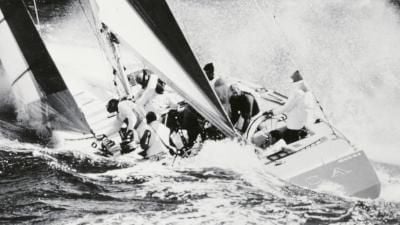
The America's Cup is the most prestigious and iconic yacht racing competition, with a long standing history beginning in Victorian times. Lloyd's Register was involved with the classification of the high performance yachts competing in the race, requiring a great technical expertise. Explore this online exhibition to learn more about the history of this competition.
What was to become known as the America’s Cup started very innocently with the preparations for the Great Exhibition of 1851, with a letter sent from Britain to the newly constituted New York Yacht Club encouraging the construction of the fastest vessel that the US could produce. The challenge was accepted by Commodore John Cox Stevens, and the task of designing and building the yacht was entrusted to George Steers. The result was a wooden schooner yacht of 170 tons named America.
Upon arrival at Cowes in 1851, Commodore Stevens issued a challenge to the Royal Yacht Squadron (RYS) to run America against any schooners of the Yacht Squadrons of the United Kingdom. Such was the obvious supremacy of the yacht, that nobody accepted the offer. Commodore Stevens then decided to enter America in the RYS Regatta, on a course around the Isle of Wight. America was indeed the fastest out of the eighteen competitors and won the ‘One Hundred Guinea Cup’.
At the end of the 19th Century, technological advancements had made the construction of lightweight yachts possible. However, these lightly built yachts would have no future as cruising yachts after their racing career was over. Year-on-year advancements were so great that investors became reluctant to commission new racing yachts. In 1906, the firm Camper & Nicholsons convinced a client to build their racing yacht, Nyria, to Lloyd’s Register’s Rules. The success of Nyria led the International Rating Committee to make Lloyd’s Register class mandatory for all racing yachts built to the International Rule (Metre class).
Sir Thomas Lipton was the sole contender for the Cup for 30 years from 1899 to 1930. Hoping to capture the trophy for Ireland’s Royal Ulster Yacht Club, he commissioned a series of five special crafts, all named Shamrock – and all defeated. At the age of 80 he was planning the construction of a sixth Shamrock when his death put a halt to his great ambition.
From 1937 to 1957 there was a 20-year lapse in the America’s Cup races, largely due to the Second World War. Inevitably, the large J-Class sloops disappeared because in the post-war era they had become far too expensive and impractical to build. Many were broken up during World War II and their keels used in the war effort where every scrap of metal was re-used. In 1958, the American Columbia won the race against Sceptre (UK).
The contending yachts are cloaked in secrecy, and it is this air of mystery that enhances the excitement surrounding the America’s Cup. The divulgence of any design details would give the competitors a tempting chance to use the information and emulate the design of a rival. Precautions are taken to ensure that the plans, designs, and yachts are always kept under the strictest security measures.
Many unconventional designs emerged over the years, some of which caused controversy. A notable case was the British challenger Lionheart in the 1980 race. Lionheart had a ‘bendy’ mast – the top section of the mast was made of glass fibre and foam, which could bend therefore offering a larger sail area at the top of the mast where it is quite an advantage under certain wind conditions. This was challenged by the French and Americans but allowed. By the following season the rules had been changed, not to disallow a bendy mast but based upon the sail area allowed. This meant that no matter how much the mast bent, as the sails had to be cut in a certain way, all of the benefits of a bendy mast had been removed.
Controversy rose again in the 1983 challenge when it was revealed that Australia II, the yacht which was to wrest the America’s Cup from the Americans for the first time, had an unorthodox keel designed by Ben Lexcon. Surveyors inspected the keel and were satisfied that there was nothing untoward about its design which should preclude it from competing – it was simply a very good idea. As the surveyors pointed out, they were not actually interested in the shape of the keel or its hydrodynamics, but in the weight distribution and the keel’s centre of gravity so that the keel bolting arrangements could be approved.
After a detailed study during construction by surveyors, their final official duty is to carry out a Confirmatory Classification Survey. This is peculiar to the yachts taking part in the America’s Cup races and is traditionally undertaken just before the start of the races. The purpose of this survey is to ensure that no unauthorised alterations have been made between completion of construction and the commencement of racing so that the vessel’s rating validity is retained.
This is a miniature model of the GDR's rail ferries. They were constructed at the height of the Cold War to transport freight between Germany and Lithuania.
Explore the behind the scenes process of filming the Argentina, a 'votive', the Aeolus and the East Indiaman ship models at the National Maritime Museum, Sweden.
Explore the behind the scenes filming of the Cold War Rail Ferry, Oasis of the Seas, Stena Drillmax and Olympic Loyalty ship models at the IMO's headquarters.

