


The GDR's rail ferries: Titan's of the Cold War
This is a miniature model of the GDR's rail ferries. They were constructed at the height of the Cold War to transport freight between Germany and Lithuania.
From celebrated dock worker panels to their mysterious disappearance in the 1960s, this is a tale of art, history, and rediscovery.
This page is approximately a 7 minute read
This page was published on
Max Wilson, Senior Archivist
As the Senior Archivist at the Centre, Max plays a key role in overseeing the management, development, and accessibility of the archive and heritage collections. He is responsible for ensuring proper preservation and conservation of materials, as well as managing acquisitions, selection processes, and the arrangement of archival collections.
After a lengthy refurbishment, 2025 has led many of us to reflect on the 124-year history of Lloyd’s Register at 71 Fenchurch Street. Occupied from December 1901 to the design of Thomas Edward Collcutt, The Magazine of Art described the building that year as a ‘Modern Palace of Art.’ Lavishly designed in the style of a 16th century Italian palazzo, the building plays host to a number of different styles, crafts and works from trusted sculptors and artists known to Collcutt. These craftsmen and artists that were incorporated into the building and its fittings, fixtures and works of art include names like Sir George Frampton, Frank Lynn Jenkins, Gerald Moira, William de Morgan, and Sir Frank Brangwyn.
Brangwyn, a leading figure in the art nouveau movement was commissioned to produce a range of paintings for Lloyd’s Register, many of which are still found on our walls today. In 2022, two artistic studies by Brangwyn came up for sale at an arthouse. Digging into our archives they represent an important link to works commissioned by Lloyd’s Register in 1908. One was titled ‘Beer Porters’, the other ‘Working Men.’ The finished versions, however, have long disappeared…
Brangwyn was born in 1867 in Bruges, where his father, a Welsh architect was working. Returning to Britain sometime later, Brangwyn would serve an apprenticeship with William Morris between 1882-84. He had a lifelong connection with the city of his birth, Bruges, and donated an important part of his collection, leading to the establishment in 1936 of the Brangwyn Museum.
A British all-round artist with more than 12,000 known creations, Brangwyn painted in colourful bold strokes, his works of art taking inspiration from human experience, history and nature. He painted with oil, tempera, watercolour, was a leading graphic artist, designing furniture, carpets, stained glass windows and jewellery. He was an Official War Artist during the First World War. Famous for his murals, they can be found in buildings in Japan, the United States, and Canada in addition to the Royal Exchange, the Skinners’ Hall and Oldham’s Press in London. His work spans Art Nouveau, Art Deco, Modernism, Social Realism, and the Wiener Secession. He lived the greater part of his life at Ditchling, Sussex and died there in 1956, receiving eighteen honours and awards throughout his life. Though his technique and style was to become unpopular with critics, often linked with the decline of the British Empire, his influence in art remains far reaching. Today, three Brangwyn Museums can be found, in Belgium, France and Wales.
Brangwyn already had a relationship with LR prior to the 1908 commission. In 1902, the General Shipowners Society presented Lloyd’s Register with Brangwyn’s The visit of Queen Elizabeth to Sir Francis Drake at Deptford, November 1580, after his circumnavigation of the world, still hanging over the chimney-piece in the Lloyd’s Register Foundation’s Chief Executive’s office. One year earlier, Lloyd’s Register had also purchased another Brangwyn, titled Blake’s Return after the capture of the Plate ships, 1657, to cover Bertram Pegram’s Carrara marble relief on the chimney-piece of the west wall of the General Committee Room.
‘Beer Porters’, a squared cartoon by Brangwyn in charcoal and chalk illustrates a gang of London dock workers, specifically beer porters, at work. The foreground features porters lifting beer casks to be loaded or unloaded, under the watchful eye of the Customs Officer or Tally Clerk and the gang’s top hand. Also seen in the background are a variety of figures similarly lifting and carrying casks against a backdrop of steam funnels, ventilators, and ship’s davits.
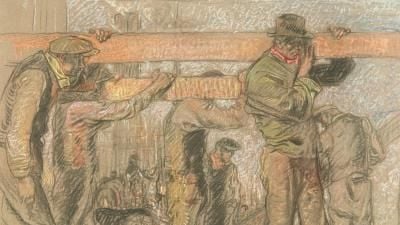
The other, ‘Working Men’, is a squared study also by Brangwyn in pencil, red and white chalk on paper. It is rough uncoloured but shaded and features two dock workers scaling an unknown object to work.
Seen independently, the works demonstrate strong artistic technique and are noteworthy if only for the depiction of ordinary working people as its central subject. Beyond this, their significance may be easily overlooked. However, seen together and in context, they form studies for a series of commissioned artworks often referred to as Dockside Labour, or sometimes, simply Work. In 1908 Brangwyn gained the commission to create works of art for the third floor Luncheon Room at 71 Fenchurch Street. Already known to Lloyd’s Register through earlier work he was recommended by Lloyd’s Register’s then-Chairman Sir Thomas Lane Devitt. He was appointed to produce 10 canvas tempera panels and a lunette, in addition to the design of the room and its furniture. Four panels were produced measuring 137 x 122 cm, four that were 137 x 244, one panel that was 137 x 91 cm and a lunette measuring 244 x 671 cm for the end wall. Intended as a celebration of working-class trades that underpinned British commerce, the panels illustrated the different types of porters in the London Docks. Each panel bear an individual title: Meat Porters, Pottery Porters, Timber Porters, Curios and Coal, Fruit and Wool, Rug Porters, Fruit Porters, Tea and Sugar Porters, and Boiler Makers (the lunette).
Beer Porters features as part of this series of panels, whilst Working Men is believed to have been a large-scale study of figures working at height, visible within the Boiler Makers lunette.
View the Pottery Porters, Timber Porters and Rug Porters panels.
Working on the commission between 1908 and 1914, the panels received international attention. They were exhibited at the Ghent International Exhibition in 1913 where it included a near full-size mock-up of the Luncheon Room. The (smaller) Boiler Makers lunette which Brangwyn produced specifically for this exhibition is with the Mildura Arts Centre, Victoria. Additionally, in 1914 the Berlin Photographic Company in London produced a portfolio entitled Work which illustrated the pastel studies.
The only known surviving photograph of the Luncheon Room with the series in place can be found within the archives of the Brangwyn Museum in Bruges. The panels, however, never found favour with the General Committee (LR’s historic governing body). Originally glued to the walls of the Luncheon Room, the panels were eventually removed in the 1960s during the refurbishment of the building, stored in the basement and subsequently disappeared. Their fate remains unknown.
At that time, knowledge of the art and artefacts at LR were patchy in terms of recordkeeping, though the Foundation’s Curator of Maritime History and Heritage, Barbara Jones, would conduct significant research over more than thirty years on existing holdings, locations, and their backgrounds for insurers and valuers.
A distinct possibility is that The Boiler Makers lunette, may have been sold or gifted in 1929 to the prolific Japanese collector and first President of Kawasaki Dockyard Co Ltd, Kojiro Matsukata (1866-1950). Matsukata, a close friend of Brangwyn (who would receive a commission to design a museum for his collection) began collecting artworks in London during the First World War. Following the 1927 economic crisis, and the collapse of Kawasaki’s bank, Matsukata resigned and was forced to dispose of his own property to keep the company afloat. Though much of the collection was sold, Matsukata had also left a considerable number in storage at a London warehouse, the London Pantechnicon, which was destroyed by fire in 1939.
Until the late 1990s, Lloyd’s Register only had a series of signed limited-edition prints of the Dockside Labour series. In 1997 a cartoon of The Tea and Sugar Porters was offered for sale by Bonhams, the London auction house. It was purchased by Lloyd’s Register, conserved, restored, and framed. Photographic copies were made of the series, plus the cartoon, together with another painting by Brangwyn from the CEO’s office and displayed in one of the meeting rooms.
The emergence of these two works for sale represented a unique opportunity to bring something of these works back home.
Though they represent only studies for the finished works, not only are they a testament to Brangwyn’s skill and accomplishments but they are also a small piece in the development of Lloyd’s Register’s historic collections. Crucially, they offer a vision of the changing world in which Lloyd’s Register operated and its vision for the London headquarters. Today, as we grapple with contested histories and the challenges of preserving and presenting our historic home to the world, these pieces provide us with a fascinating snapshot in the history of 71 Fenchurch Street.
This is a miniature model of the GDR's rail ferries. They were constructed at the height of the Cold War to transport freight between Germany and Lithuania.
Explore the behind the scenes process of filming the Argentina, a 'votive', the Aeolus and the East Indiaman ship models at the National Maritime Museum, Sweden.
Explore the behind the scenes filming of the Cold War Rail Ferry, Oasis of the Seas, Stena Drillmax and Olympic Loyalty ship models at the IMO's headquarters.

